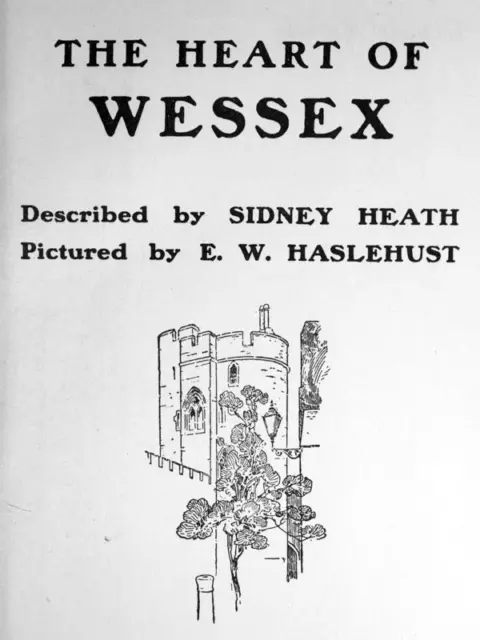
The Heart of Wessex
Sidney Heath
THE CLASSIC COLLECTION · 1907
"Our Homeland Churches and How to Study Them" by Sidney Heath is a historical account written in the early 20th century. This work explores the rich heritage of British ecclesiastical architecture, focusing on various styles and their symbolic meanings throughout history. The book aims to provide readers with insights into how to appreciate and understand the many details and features found in churches across England. The opening of the book sets the stage for a comprehensive exploration of church architecture by emphasizing the historical importance of these structures. Heath begins with a preface and dedication that reflect a deep respect for old buildings and the craftsmen who built them. He introduces the idea that churches are not merely architectural entities but are imbued with symbolism reflecting the beliefs and values of the eras in which they were constructed. The preface establishes the tone for the text, indicating that the author will guide readers through the significance of church design and ornamentation while uncovering the layers of historical context that inform the visitor's experience.
Introduction adapted from the source catalogue; source summaries may be automatically generated.
Free to read · English · 28,996 words · No account needed
MAKE TIME FOR A GOOD BOOK
On by default. Untick to stop anonymous reading totals. Each page counts after 10 seconds in view. How this works.
Anonymous counting is on unless you have switched it off.
CORNICE The horizontal termination of a building in the form of a moulded projection.
COURSE A continuous and regular line of stones or bricks in the wall of a building.
CROCKETS Projecting ornaments in the form of leaves, flowers, etc., used to embellish the angles of pinnacles, spires, gables, canopies, etc.
CROSS The accepted symbol of the Christian religion and an architectural church ornament usually placed upon the apex of the gable. A large cross called a rood was at one time always placed over the entrance to the chancel. The cross was worn as a personal ornament ages before the Christian era by the Assyrians, and we are told that the Druids also used this symbol in very early times.
CRYPT Sometimes called the Undercroft, a vaulted chamber, usually underground and, in churches, rarely extending beyond the area of the choir or chancel, and often of less dimensions.
CUSPS Projecting points giving the foliated appearance to tracery, arches, panels, etc.
DORMER A gabled window pierced through a sloping roof.
DRIPSTONE A projecting ledge or narrow moulding over the heads of doorways, windows, etc., to carry off the rain.
FAN-TRACERY Tracery in which the ribs form a fan-like appearance and diverge equally in every direction. (Peculiar to the late Perp.)
FLAMBOYANT Tracery whereof the curves assume flame-like waves and
shapes.
FLYING BUTTRESS A buttress in the form of a bridge, usually transferring the thrust of the main roof from the clerestory walls to the main or aisle buttresses.
FONT The vessel for holding the consecrated water used in
baptism.
GARGOYLE A projecting spout usually grotesquely carved and used to throw the water from the roof well away from the building.
GROIN The line of intersection in vaulted roofs.
IMPOST Horizontal mouldings, capping a column or pier, from which the arch springs.
JAMB The side of a window or door.
KEYSTONE The central stone at the top of an arch. The bosses in vaulted ceilings are frequently called keys.
LADY CHAPEL A chapel dedicated to the Blessed Virgin Mary,
called "Our Lady."
LANTERN A small structure or erection surmounting a dome or tower to admit light. These towers are known as Lantern Towers.
LOZENGE A name given in modern times to Norman mouldings which partake of a lozenge formation.
LYCH-GATE From the Anglo-Saxon lich, a corpse. A small and often picturesque shelter at the entrance to a churchyard.
MINSTER The church usually of a monastery or abbey or one to which such has been an appendant. York and Beverley, however, are exceptions to this rule.
MISERERE A small bracket on the undersides of the seats of
stalls.
Your reading position is saved on this browser. Take it to another device with a library code. Reading pages adapt to text, rather than matching a printed edition.
Sidney Heath
Sidney Heath
Sidney Heath
Sidney Heath
BEHIND THE BOOK
This eBook is for the use of anyone anywhere in the United States and most other parts of the world at no cost and with almost no restrictions whatsoever. You may copy it, give it away or re-use it under the terms of the Project Gutenberg License included with this eBook or online at www.gutenberg.org. If you are not located in the United States, you will have to check the laws of the country where you are located before using this eBook. Read the source licence.
The original source file, including credits and licence, is retained by this library. Request an original-format copy at no charge. Please include the book title and Project Gutenberg identifier #30290.
KEEP YOUR CURIOSITY GOING

David Patterson (Spirit) Hatch

David Patterson (Spirit) Hatch

David Patterson (Spirit) Hatch
Cécile Tormay

Moritz Busch
John L. Ransom