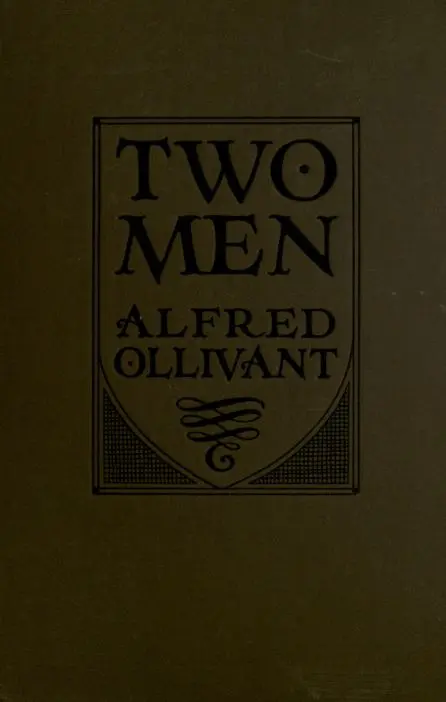
Two Men: A Romance of Sussex
Alfred Ollivant

THE CLASSIC COLLECTION · 1921
"One Woman: Being the Second Part of a Romance of Sussex" by Alfred Ollivant is a novel written in the early 20th century. The book explores the lives and relationships of Ruth Boam and Ernie Caspar, a young couple recently married, as they navigate the challenges of love, family, and societal expectations in Sussex. Central to the story is their joy as newlyweds, contrasted with the complexities of their pasts and the shadowy figures that linger in their lives. The opening of the novel paints a vivid picture of Ruth and Ernie's quiet wedding day and the simple journey they undertake in a carrier's cart. As they settle into their new life together, the narrative introduces key figures like Alf, Ernie's brother, whose lurking presence hints at deeper tensions. The richness of the Sussex setting is highlighted, and the couple’s joy brings a sense of hope to their future. However, underlying currents of past troubles, family dynamics, and social challenges begin to weave into the story, suggesting a blend of romance and personal struggle that will likely unfold as the novel progresses.
Introduction adapted from the source catalogue; source summaries may be automatically generated.
Free to read · English · 86,950 words · No account needed
MAKE TIME FOR A GOOD BOOK
On by default. Untick to stop anonymous reading totals. Each page counts after 10 seconds in view. How this works.
Anonymous counting is on unless you have switched it off.
Ern was not called up after all.
The trap-door through which men had peered aghast into the fires of hell, closed suddenly as it had opened. Only the clang of the stokers working in the darkness under the earth could still be heard day and night at their infernal busyness by any who paused and laid ear to the ground.
England and the world breathed again.
"Touch and go," said Mr. Trupp, who felt like a man coming to the
surface after a deep plunge.
"Dress rehearsal," said the Colonel.
"It'll never be so near again!" Mr. Pigott announced pontifically to
his wife. "Never!"
"Thank you," replied that lady. "May we take it from you?"
When it was over the Colonel found that the walls of Jericho had fallen: the Liberal Citadel had been stormed. Mr. Geddes took the chair at a meeting at St. Andrew's Hall to discuss the programme of the League.
"It looks as if you were right after all," the tall minister said to
the Colonel gravely.
"Pray heaven I'm not," the other answered in like tones.
The second significant incident of this time, which occurred during a lull before the final flare-up of the long-drawn Agadir crisis, had less happy results from the point of view of the old soldier.
In August, suddenly and without warning, the railway-men came out. The Colonel had been up to London for the night on the business of the League, and next morning had walked into Victoria Street Station to find it in possession of the soldiers: men in khaki in full marching order, rifle, bayonet, and bandolier; sentries everywhere; and on the platform a Union official in a blue badge urging the guard to come out.
The guard, a heavy-shouldered middle-aged fellow, was stubbornly lumping along the platform on flat feet, swinging his lantern.
"I've got a heart," he kept on reiterating. "I've got a wife and
children to think of."
"So've I," replied the official, dogging him. "It's because I am thinking of them that I'm out."
"Silly 'aound!" said a bystander
"No, he ain't then!" retorted a second.
"Yes, he is!" chipped in a third. "Makin trouble for isself and everybody else all round. Calls isself the workers' friend!--Hadgitator, I call him!"
All the way down to Beachbourne in the train the Colonel marked pickets guarding bridges; a cavalry patrol with lances flashing from the green covert of a country lane; a battery on the march; armies on the move.
Joe Burt's right, he reflected, it's war.
"I never thought to see the like of that in England," said a fellow-traveller, eyes glued to the window.
"Makes you think," the Colonel admitted.
Your reading position is saved on this browser. Take it to another device with a library code. Reading pages adapt to text, rather than matching a printed edition.
Alfred Ollivant

Alfred Ollivant
Alfred Ollivant
Alfred Ollivant
BEHIND THE BOOK
This eBook is for the use of anyone anywhere in the United States and most other parts of the world at no cost and with almost no restrictions whatsoever. You may copy it, give it away or re-use it under the terms of the Project Gutenberg License included with this eBook or online at www.gutenberg.org. If you are not located in the United States, you will have to check the laws of the country where you are located before using this eBook. Read the source licence.
The original source file, including credits and licence, is retained by this library. Request an original-format copy at no charge. Please include the book title and Project Gutenberg identifier #57641.
KEEP YOUR CURIOSITY GOING
Coulson Kernahan

Maurice Baring
Frances Wright
Cécile Tormay

Frederic Jesup Stimson

W. H. P. (William Henry Pope) Jarvis