
The Writing of News A Handbook with Chapters on Newspaper Correspondence and Copy Reading
Charles G. (Charles Griffith) Ross
THE CLASSIC COLLECTION · 1919
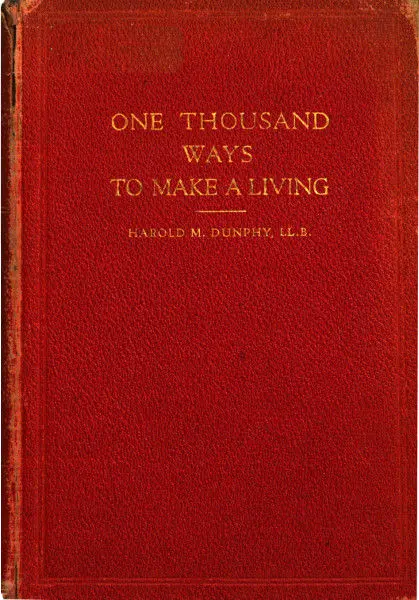
"One Thousand Ways to Make a Living; or, An Encyclopædia of Plans to Make Money" by Harold M. Dunphy is a practical guidebook written in the early 20th century. It compiles a diverse range of ideas and plans aimed at helping individuals find methods to earn a living, particularly in the context of post-World War I America. The book focuses on providing actionable, straightforward strategies for generating income, rather than offering vague financial advice or "get-rich-quick" schemes. The opening portion of the book introduces the purpose and intention behind its creation, emphasizing its goal of empowering individuals, particularly those affected by unemployment post-war. It features a dedication to assisting those who have sacrificed for their country, as well as highlighting the importance of self-initiative. Furthermore, the text introduces several initial plans for making a living, showcasing inventive ideas like weaving baskets for ferns, becoming a professional hostess, or taking on creative ventures such as cooking and crafting—all of which demonstrate resourcefulness and adaptability. This serves as a foundation for the many strategies that will follow, inviting readers to explore new potential avenues to enhance their livelihoods.
Introduction adapted from the source catalogue; source summaries may be automatically generated.
Free to read · English · 457,568 words · No account needed
MAKE TIME FOR A GOOD BOOK
On by default. Untick to stop anonymous reading totals. Each page counts after 10 seconds in view. How this works.
Anonymous counting is on unless you have switched it off.
Deck duty is varied and crowded with emergencies. “The sailor’s daily work in all kinds of vessels and weather, at the wheel, on the lookout, and on deck, teaches him to know the sea and how to work with it. His work with tackles, lines, and cables, in hoisting and lowering, trains his judgment of strains and distances.”[23] “The amount of gear and equipment used in the deck department on different classes of steamships varies greatly, but the difference is one of degree rather than of the kind.”[24]
[23] International Conference on Safety at Sea, p. 119.
[24] International Conference on Safety at Sea, p. 121.
PLAN No. 1015. NAVAL VERSUS MERCHANT MARINE CREWS
The crew and the work done on a merchant vessel are so different from those on a naval vessel that the disabled sailor would have much to learn in going from a naval vessel to a merchant vessel. One fundamental difference is this: The merchant vessel carries generally only about one-third the crew--ton for ton--that the naval vessel does. On a naval vessel the men work in groups; on a merchant vessel the man works as an individual and not in a group.
The crew of a large merchant vessel consists more or less of the following officers, seamen, and attendants: Master, chief mate, second mate, third officer, fourth officer, senior quartermaster, quartermaster, master-at-arms, chief steward, chief second-class steward, chief third-class steward, chief engineer, first assistant engineer, second assistant engineer, third assistant engineer, junior engineer, deck engineer, leading fireman, oiler, electrician, carpenter, boatswain, able seamen, ordinary seamen, deck boy, water tender, lookout, purser, assistant purser, freight clerk, and bakers, chefs, cooks, buglers, butchers, cadets, storekeeper, and watchman.
PLAN No. 1016. THE MASTER OR CAPTAIN
The master has general supervision over the vessel, crew, and passengers. He has complete charge of the vessel at all times, but during a severe storm or other emergency he stands on the watch continuously day and night and issues the necessary orders. He is responsible for the safe navigation of his vessel. His responsibility extends to the management of the various departments as well as to the vessel and its care as a whole--for the safety of the lives of passengers and crew, and for the safe storage, carriage, and unloading of cargo. He must have a thorough knowledge of navigation, which subject he must have studied thoroughly, and in which he must have passed a rigid examination before he received his license as a master. He must likewise possess a legal knowledge of the laws governing right upon the sea and determining his duties as regards the ship and its passengers, crew, and cargo. Among his other duties are to keep the log properly and to inspect the ship regularly as to ventilation, warmth, and cleanliness. He must be the last man to leave the ship in case of disaster, and must do everything within his power for the safety of the passengers and crew. He must have received much of his training in lower positions upon the sea, but he must also have studied navigation in some school or under some able master. He must have executive ability of a high order and be able to act efficiently in an emergency.
Your reading position is saved on this browser. Take it to another device with a library code. Reading pages adapt to text, rather than matching a printed edition.
BEHIND THE BOOK
This eBook is for the use of anyone anywhere in the United States and most other parts of the world at no cost and with almost no restrictions whatsoever. You may copy it, give it away or re-use it under the terms of the Project Gutenberg License included with this eBook or online at www.gutenberg.org. If you are not located in the United States, you will have to check the laws of the country where you are located before using this eBook. Read the source licence.
The original source file, including credits and licence, is retained by this library. Request an original-format copy at no charge. Please include the book title and Project Gutenberg identifier #62231.
KEEP YOUR CURIOSITY GOING
Charles G. (Charles Griffith) Ross
Hannah Webster Foster

Emily Lawless
Edwin Hamlin Carr

Charles De Lano Hine
Andrew Ure