
The Writing of News A Handbook with Chapters on Newspaper Correspondence and Copy Reading
Charles G. (Charles Griffith) Ross
THE CLASSIC COLLECTION · 1919
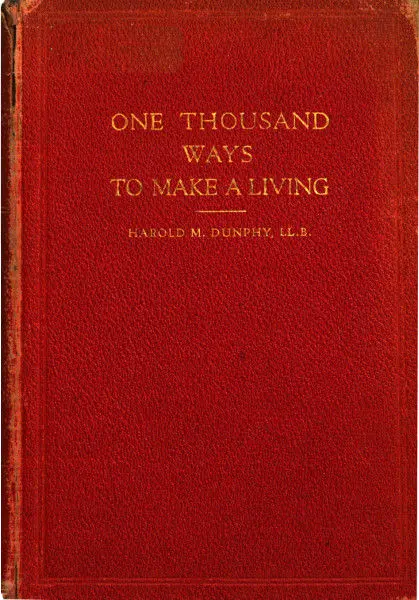
"One Thousand Ways to Make a Living; or, An Encyclopædia of Plans to Make Money" by Harold M. Dunphy is a practical guidebook written in the early 20th century. It compiles a diverse range of ideas and plans aimed at helping individuals find methods to earn a living, particularly in the context of post-World War I America. The book focuses on providing actionable, straightforward strategies for generating income, rather than offering vague financial advice or "get-rich-quick" schemes. The opening portion of the book introduces the purpose and intention behind its creation, emphasizing its goal of empowering individuals, particularly those affected by unemployment post-war. It features a dedication to assisting those who have sacrificed for their country, as well as highlighting the importance of self-initiative. Furthermore, the text introduces several initial plans for making a living, showcasing inventive ideas like weaving baskets for ferns, becoming a professional hostess, or taking on creative ventures such as cooking and crafting—all of which demonstrate resourcefulness and adaptability. This serves as a foundation for the many strategies that will follow, inviting readers to explore new potential avenues to enhance their livelihoods.
Introduction adapted from the source catalogue; source summaries may be automatically generated.
Free to read · English · 457,568 words · No account needed
MAKE TIME FOR A GOOD BOOK
On by default. Untick to stop anonymous reading totals. Each page counts after 10 seconds in view. How this works.
Anonymous counting is on unless you have switched it off.
5. To add mechanical precision to judgment and experience in developing and maintaining the utility of a flock.
For further information and plans showing the construction of a trap nest, send for Farmers’ Bulletin 682, “A Simple Trap Nest for Poultry.”
Classification of Poultry Feeds
=================+=========================+========================== Nature provides--|Scientific classification| Poultrymen feed-- -----------------+-------------------------+-------------------------- Worms and bugs |Nitrogenous material, or |Meat (Green cut bone or |protein |beef scrap), milk or | |cottage cheese. Seeds |Carbohydrates |Wheat, oats, corn, barley, | |etc. Greens |Succulents |Lettuce, cabbage, kale, | |mangels, alfalfa, clover, | |sprouted oats, etc. Grit |Mineral matter |Grit and oyster shell. Water |Water |Water. -----------------+-------------------------+--------------------------
In order to obtain an abundance of eggs it is necessary to have healthy, vigorous stock, properly fed.
The following are good grain mixtures for the laying stock, the
proportions being by weight:
Ration 1. Ration 2. Ration 3.
Equal parts of: 3 parts cracked corn. 2 parts cracked corn.
Cracked corn. 2 parts oats. 1 part oats.
Wheat. 1 part wheat.
Oats.
A choice of any one of these rations should be scattered in the litter twice daily, morning and evening.
Either of the following suggested dry-mash mixtures should be fed in a dry-mash hopper such as illustrated, allowing the fowls to have access to it at all times.
Mash No. 1. Mash No. 2. 2 parts corn meal. 1 part middlings. 3 parts corn meal. 1 part bran. 1 part beef scrap. 1 part beef scrap.
When fowls do not have access to natural green feed, sprouted oats, cabbage, mangels, cut clover, etc., should be fed.
When wet mashes are fed, be sure that they are crumbly and not sticky. Plenty of exercise increases the egg yield.
Fresh, clean drinking water should be always provided. Charcoal, grit, and oyster shell should be placed before the fowls so that they can have access to them at all times.
For additional information on feeds and feeding request Farmers’ Bulletin 287, “Poultry Management,” and Farmers’ Bulletin 528, “Hints to Poultry Raisers,” from U. S. Department of Agriculture, Washington, D. C.
Produce the infertile egg. Infertile eggs are produced by hens that have no male birds with them.
The following table shows that the losses of fertile eggs are computed to be nearly twice as great as in the case of infertile eggs.
===============================+========+========= | Fertile|Infertile | Eggs | Eggs -------------------------------+--------+--------- |Per cent|Per cent On the farm | 29.0 | 15.5 At country store | 7.1 | 4.0 Transportation to packing house| 6.4 | 4.7 +--------+--------- Total | 42.5 | 24.2 -------------------------------+--------+---------
The hen’s greatest egg-producing periods are the first, second, and third years, depending upon the breed. The heavier breeds, such as Plymouth Rocks, may be profitably kept for two years; the lighter breeds, such as Leghorns, three years.
Your reading position is saved on this browser. Take it to another device with a library code. Reading pages adapt to text, rather than matching a printed edition.
BEHIND THE BOOK
This eBook is for the use of anyone anywhere in the United States and most other parts of the world at no cost and with almost no restrictions whatsoever. You may copy it, give it away or re-use it under the terms of the Project Gutenberg License included with this eBook or online at www.gutenberg.org. If you are not located in the United States, you will have to check the laws of the country where you are located before using this eBook. Read the source licence.
The original source file, including credits and licence, is retained by this library. Request an original-format copy at no charge. Please include the book title and Project Gutenberg identifier #62231.
KEEP YOUR CURIOSITY GOING
Charles G. (Charles Griffith) Ross
Hannah Webster Foster

Emily Lawless
Edwin Hamlin Carr

Charles De Lano Hine
Andrew Ure