
The Writing of News A Handbook with Chapters on Newspaper Correspondence and Copy Reading
Charles G. (Charles Griffith) Ross
THE CLASSIC COLLECTION · 1919
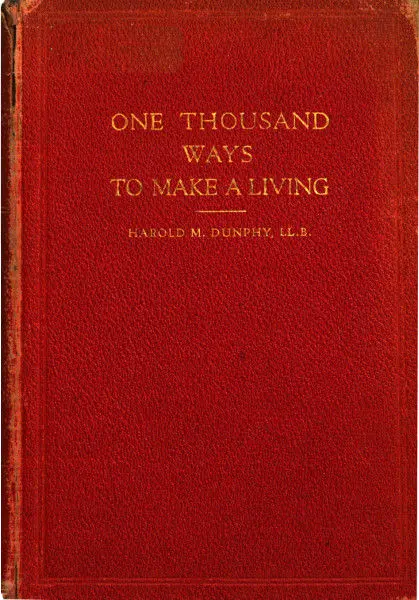
"One Thousand Ways to Make a Living; or, An Encyclopædia of Plans to Make Money" by Harold M. Dunphy is a practical guidebook written in the early 20th century. It compiles a diverse range of ideas and plans aimed at helping individuals find methods to earn a living, particularly in the context of post-World War I America. The book focuses on providing actionable, straightforward strategies for generating income, rather than offering vague financial advice or "get-rich-quick" schemes. The opening portion of the book introduces the purpose and intention behind its creation, emphasizing its goal of empowering individuals, particularly those affected by unemployment post-war. It features a dedication to assisting those who have sacrificed for their country, as well as highlighting the importance of self-initiative. Furthermore, the text introduces several initial plans for making a living, showcasing inventive ideas like weaving baskets for ferns, becoming a professional hostess, or taking on creative ventures such as cooking and crafting—all of which demonstrate resourcefulness and adaptability. This serves as a foundation for the many strategies that will follow, inviting readers to explore new potential avenues to enhance their livelihoods.
Introduction adapted from the source catalogue; source summaries may be automatically generated.
Free to read · English · 457,568 words · No account needed
MAKE TIME FOR A GOOD BOOK
On by default. Untick to stop anonymous reading totals. Each page counts after 10 seconds in view. How this works.
Anonymous counting is on unless you have switched it off.
Owner furnishes all seed and one-half of fertilizer.
All horse power, machinery and equipment.
All feed except one-half ensilage which tenant furnishes.
Twenty-five to thirty dairy cows and one registered bull.
Tenant receives one-third of gross income and owner two-thirds of
gross income.
Which includes one-third share in all young stock.
Provides all labor which consists of own service and two hired men by the year and labor necessary for harvesting and housing crop.
Bears one-third of stock loss.
Pays 6% interest on one-third of value of cows.
Keeps machinery and equipment in good condition and pays for necessary
repairs.
All buildings to be kept in good repair.
Holds in check all weeds and filth along fence rows and in field.
Pays one-third of cost of delivery of milk to city distributers.
Furnishes one-third of fertilizer.
Furnishes one-third of thrashing and silo filling bills.
Apportionment of undivided property or improvement if at any time contract should be terminated.
Runs for 10 years but may be terminated at the end of the year.
If tenant does not live up to agreement, farm automatically returns to owners complete control.
Owner can then hire such labor as is necessary to carry on business to end of year at which time lease will expire and tenant’s heirs or assignees would be paid their net share of the income due after expenses are paid.
The renter likes the plan for the following reasons:
It gives tenant residence for 10 years. No expense for frequent moves.
Live stock as dairy cows gives tenant income each month.
Tenant capitalizes his labor.
Tenant on farm long enough to gain the advantage of added benefits
from live stock farming and the application of stable manure to
fields.
The owner likes it for the following reasons:
The land is improved constantly.
Allows him to engage in other business and follow farming evenings and
Saturdays.
Plan urges tenant to do his best to make grain and milk crops as large
as possible.
Plan assures the owner that the live stock and farm equipment is well
cared for.
The best tenant is a young married man experienced, competent and who likes the farm and wants to own a farm himself some day.
PLAN No. 810. BUILD AND SELL FARM HOME CONVENIENCES
The Agricultural Department of the United States put out a booklet in which are given the following ways of making Farm Home Conveniences. The farmer can by building these home articles save much money, but city people can also profit by doing the same.
Your reading position is saved on this browser. Take it to another device with a library code. Reading pages adapt to text, rather than matching a printed edition.
BEHIND THE BOOK
This eBook is for the use of anyone anywhere in the United States and most other parts of the world at no cost and with almost no restrictions whatsoever. You may copy it, give it away or re-use it under the terms of the Project Gutenberg License included with this eBook or online at www.gutenberg.org. If you are not located in the United States, you will have to check the laws of the country where you are located before using this eBook. Read the source licence.
The original source file, including credits and licence, is retained by this library. Request an original-format copy at no charge. Please include the book title and Project Gutenberg identifier #62231.
KEEP YOUR CURIOSITY GOING
Charles G. (Charles Griffith) Ross
Hannah Webster Foster

Emily Lawless
Edwin Hamlin Carr

Charles De Lano Hine
Andrew Ure