
The Writing of News A Handbook with Chapters on Newspaper Correspondence and Copy Reading
Charles G. (Charles Griffith) Ross
THE CLASSIC COLLECTION · 1919
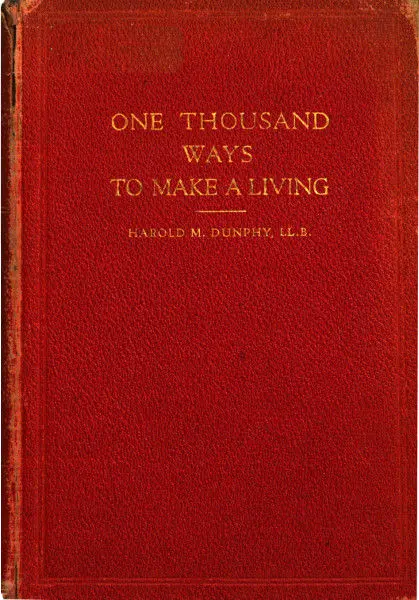
"One Thousand Ways to Make a Living; or, An Encyclopædia of Plans to Make Money" by Harold M. Dunphy is a practical guidebook written in the early 20th century. It compiles a diverse range of ideas and plans aimed at helping individuals find methods to earn a living, particularly in the context of post-World War I America. The book focuses on providing actionable, straightforward strategies for generating income, rather than offering vague financial advice or "get-rich-quick" schemes. The opening portion of the book introduces the purpose and intention behind its creation, emphasizing its goal of empowering individuals, particularly those affected by unemployment post-war. It features a dedication to assisting those who have sacrificed for their country, as well as highlighting the importance of self-initiative. Furthermore, the text introduces several initial plans for making a living, showcasing inventive ideas like weaving baskets for ferns, becoming a professional hostess, or taking on creative ventures such as cooking and crafting—all of which demonstrate resourcefulness and adaptability. This serves as a foundation for the many strategies that will follow, inviting readers to explore new potential avenues to enhance their livelihoods.
Introduction adapted from the source catalogue; source summaries may be automatically generated.
Free to read · English · 457,568 words · No account needed
MAKE TIME FOR A GOOD BOOK
On by default. Untick to stop anonymous reading totals. Each page counts after 10 seconds in view. How this works.
Anonymous counting is on unless you have switched it off.
“This year I had 85 acres of barley, which yielded 50 bushels per acre, and 640 acres of wheat, which yielded 29 bushels per acre. I sold my barley at $1.20 per hundred and my wheat at $1 per bushel. My 1913 crop was still better, as part of my wheat made 52 bushels.”
PLAN No. 628. LIKES THE WEST
Here is what he did with $3,000:
“I came to the State of Washington twelve years ago from Central Illinois with about $4,500. I purchased 160 acres at $50 per acre, paying $3,000 down. I bought fourteen head of cows at a cost of $700, sowed most of my land to grass, alfalfa, timothy and clover.
“The first five years I practiced dairying and mixed farming, selling the whole milk, hay, small grain and potatoes. I also have a one-acre orchard, which has produced an average of 200 boxes of apples per year, besides what we used. Four years ago I bought 120 acres more, paying $100 an acre. I now have a farm that is worth $30,000 and feel that I have done very well, but no better than any one else can do who will follow mixed farming and give it careful attention. I believe mixed farming will pay anywhere.”
PLAN No. 629. FINDS HOGS PROFITABLE
He handled hogs as a side line, and his results run as follows:
“On October 1, 1913, I owned 11 sows, 90 gilts and barrows, 2 boars and 60 pigs, worth approximately $1,270. During the year following I purchased $60 worth of hogs and fed $1,310.21 of feed, all of which, with the exception of $310.90 was produced on my farm. During the same year my sale of hogs amounted to $2,316.33, and on October 1, 1914, I had 8 sows, 100 gilts and barrows, 2 boars and 8 pigs remaining, worth $856. I figure my net profit, exclusive of labor $532.33--not very bad for a side line.”
PLAN No. 630. BEEF CATTLE PAY WELL
Here is a man that made money during the war. This is what he says:
“In October, 1912, I owned three head of beef cows, worth $225. During the next two years I purchased $721 worth of cattle. I do not have a record of my feeding costs, but it would not be very much, as I pastured them on cheap pasture most of the year and fed only a small amount of hay for three months in the winter. During the same two years I sold $827 worth of butter and cattle, and on October 1, 1914, I had sixteen head remaining, worth $1,360. I figure my net profit, exclusive of labor and feed, $1,241. I am now satisfied that I can make the beef cattle business pay me a nice profit, and will go into it on a larger scale.”
PLAN No. 631. HE WANTED TO BE SECRETARY TO THE MAYOR
Your reading position is saved on this browser. Take it to another device with a library code. Reading pages adapt to text, rather than matching a printed edition.
BEHIND THE BOOK
This eBook is for the use of anyone anywhere in the United States and most other parts of the world at no cost and with almost no restrictions whatsoever. You may copy it, give it away or re-use it under the terms of the Project Gutenberg License included with this eBook or online at www.gutenberg.org. If you are not located in the United States, you will have to check the laws of the country where you are located before using this eBook. Read the source licence.
The original source file, including credits and licence, is retained by this library. Request an original-format copy at no charge. Please include the book title and Project Gutenberg identifier #62231.
KEEP YOUR CURIOSITY GOING
Charles G. (Charles Griffith) Ross
Hannah Webster Foster

Emily Lawless
Edwin Hamlin Carr

Charles De Lano Hine
Andrew Ure