
The Writing of News A Handbook with Chapters on Newspaper Correspondence and Copy Reading
Charles G. (Charles Griffith) Ross
THE CLASSIC COLLECTION · 1919
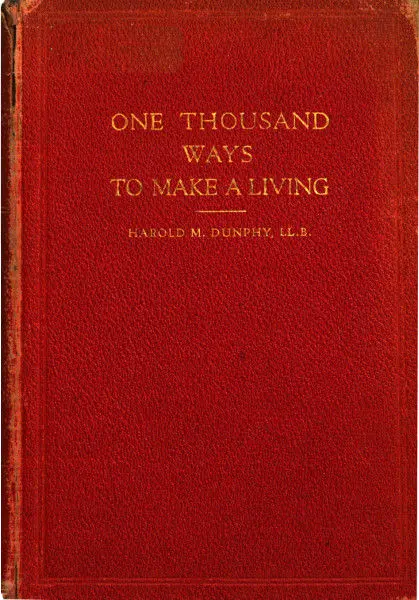
"One Thousand Ways to Make a Living; or, An Encyclopædia of Plans to Make Money" by Harold M. Dunphy is a practical guidebook written in the early 20th century. It compiles a diverse range of ideas and plans aimed at helping individuals find methods to earn a living, particularly in the context of post-World War I America. The book focuses on providing actionable, straightforward strategies for generating income, rather than offering vague financial advice or "get-rich-quick" schemes. The opening portion of the book introduces the purpose and intention behind its creation, emphasizing its goal of empowering individuals, particularly those affected by unemployment post-war. It features a dedication to assisting those who have sacrificed for their country, as well as highlighting the importance of self-initiative. Furthermore, the text introduces several initial plans for making a living, showcasing inventive ideas like weaving baskets for ferns, becoming a professional hostess, or taking on creative ventures such as cooking and crafting—all of which demonstrate resourcefulness and adaptability. This serves as a foundation for the many strategies that will follow, inviting readers to explore new potential avenues to enhance their livelihoods.
Introduction adapted from the source catalogue; source summaries may be automatically generated.
Free to read · English · 457,568 words · No account needed
MAKE TIME FOR A GOOD BOOK
On by default. Untick to stop anonymous reading totals. Each page counts after 10 seconds in view. How this works.
Anonymous counting is on unless you have switched it off.
Six high-school girl-graduates, who had just finished a course in domestic science, and were wondering what they could do to make a little money, were told by their instructress that she would give each of them a valuable household formula to work with, and that she would give a cash prize of $25 to the girl who made the most profit out of her formula in six months. The girls promptly accepted the offer, and went diligently to work with the following results:
PLAN No. 534. GOOD WHITE POLISHING POMADE
Girl No. 1 selected the following as the basis of her activity:
Tripoli powder, 1 pound; whiting, 1 pound; pumice flour, ¹⁄₂ pound; crude oleic acid, ¹⁄₄ pound; kerosene, 3 fluid ounces. Mix together with sufficient petroleum jelly to form a paste, and add perfume, such as oil of lemon, cassia, or nitrobenzol (mirbane) which gives the usual almond odor.
Making up a considerable quantity, in the above proportions, she canvassed a large part of the residence district in the city and took trips to outside towns, demonstrating and selling it, and received valuable aid from one of the drug companies when she put it on sale.
Her profits for the six months were $248.
PLAN No. 535. A FIRST-CLASS FOOT POWDER
The third girl chose a foot powder to work upon, the formula being as
follows:
Finely powdered talc, 60 ounces; boric acid, 30 ounces; salicylic acid, 1 ounce; powdered alum, 1 ounce. Mix well, and scent as desired. The drug stores of the city told her they would take all of this she could make, as it was better and cheaper than powder widely advertised, and in the following six months her profits amounted to $287.
PLAN No. 536. A GOOD AND CHEAP HAIR DYE
Girl No. 4 thought she saw in a formula for a hair dye the foundation of at least a small income, so she chose that:
She gave samples to several elderly ladies of her acquaintance, and they were delighted with it. From these samples, indirectly, she sold several hundred bottles, and then a young lady friend of hers, a very successful canvasser, offered to sell all she could make of it, on a commission of 40 per cent. She accepted the offer and, began making it in large quantities, while the other girl sold it, and at the end of six months found that her profits were $397.
PLAN No. 537. INSECT POWDER
Girl No. 5 was rooming at a house where cockroaches were driving the landlady almost frantic, and gladly chose the following formula as her field of operations: Persian insect powder, 4 ounces; borax 30 ounces; starch, 4 ounces; sugar, 3 ounces; cocoa, 4 ounces; tartar emetic, 4 ounces. Reduce all to a fine powder and mix thoroughly.
Your reading position is saved on this browser. Take it to another device with a library code. Reading pages adapt to text, rather than matching a printed edition.
BEHIND THE BOOK
This eBook is for the use of anyone anywhere in the United States and most other parts of the world at no cost and with almost no restrictions whatsoever. You may copy it, give it away or re-use it under the terms of the Project Gutenberg License included with this eBook or online at www.gutenberg.org. If you are not located in the United States, you will have to check the laws of the country where you are located before using this eBook. Read the source licence.
The original source file, including credits and licence, is retained by this library. Request an original-format copy at no charge. Please include the book title and Project Gutenberg identifier #62231.
KEEP YOUR CURIOSITY GOING
Charles G. (Charles Griffith) Ross
Hannah Webster Foster

Emily Lawless
Edwin Hamlin Carr

Charles De Lano Hine
Andrew Ure