
The Writing of News A Handbook with Chapters on Newspaper Correspondence and Copy Reading
Charles G. (Charles Griffith) Ross
THE CLASSIC COLLECTION · 1919
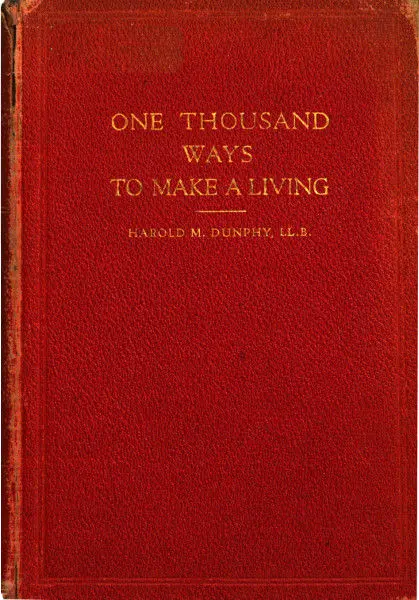
"One Thousand Ways to Make a Living; or, An Encyclopædia of Plans to Make Money" by Harold M. Dunphy is a practical guidebook written in the early 20th century. It compiles a diverse range of ideas and plans aimed at helping individuals find methods to earn a living, particularly in the context of post-World War I America. The book focuses on providing actionable, straightforward strategies for generating income, rather than offering vague financial advice or "get-rich-quick" schemes. The opening portion of the book introduces the purpose and intention behind its creation, emphasizing its goal of empowering individuals, particularly those affected by unemployment post-war. It features a dedication to assisting those who have sacrificed for their country, as well as highlighting the importance of self-initiative. Furthermore, the text introduces several initial plans for making a living, showcasing inventive ideas like weaving baskets for ferns, becoming a professional hostess, or taking on creative ventures such as cooking and crafting—all of which demonstrate resourcefulness and adaptability. This serves as a foundation for the many strategies that will follow, inviting readers to explore new potential avenues to enhance their livelihoods.
Introduction adapted from the source catalogue; source summaries may be automatically generated.
Free to read · English · 457,568 words · No account needed
MAKE TIME FOR A GOOD BOOK
On by default. Untick to stop anonymous reading totals. Each page counts after 10 seconds in view. How this works.
Anonymous counting is on unless you have switched it off.
PLAN No. 208. PERFUMED BAGS FOR THE BATH
The delights of the bath are increased 100 per cent by the use of a perfumed bath bag, which a druggist friend made up as follows:
Fine oatmeal, 4 pounds; bran, 1 pound; powdered castile soap, 1 pound; powdered orris, ¹⁄₂ pound. Mix well together and tie up in muslin bags, of any desired tint, and fasten with ribbon or silk. Each bag contained about one pound of the mixture, and sold readily at 25 cents each. Anyone can make considerable money by making and selling these.
PLAN No. 209. VINEGAR MADE PROM STRAWBERRIES
Thoroughly mash a quantity of ripe strawberries into a paste, and let stand for 24 hours. Then press out the juice and let it stand for a few days, to ferment and to allow the slimy contents to separate. Then filter the juice and put into clean, well-closed bottles, and put in a cool place, where it will keep a long time. Added to good cider vinegar, when ready to use, it makes an excellent flavoring.
It was cheap and easy to make, and profitable to sell.
PLAN No. 210. CANNED FRUIT AND VEGETABLES
While Mr. Farmer devoted his time and attention to the larger operations of general farming, his wife made a profitable side issue of such subsidiary lines as the orchard, the garden and the poultry yard, in all of which the products were of the highest order.
Buying Mason jars in large quantities, at a practically wholesale price, she utilized these in the canning of fruits, berries and vegetables, as they keep longer and look better when put up in this way, and bring much higher prices.
While her specialty was tomatoes, she also canned peas, beans, carrots, beets, turnips, parsnips, sweet potatoes, squash, pumpkins, sweet corn, shredded cabbage, brussels sprouts, and many other products of that kind, and they retained their original flavor and appearance throughout the entire year, if kept beyond the winter season. Of fruits, she canned peaches, pears, apples, cherries, blueberries, blackberries, raspberries and strawberries, put up in their syrup for making pies and puddings as well as for general table uses.
Hundreds of city people gladly purchased these canned fruits and vegetables, and though she sold them at prices lower those asked for inferior grades in the market, she still netted a good profit from all her products.
PLAN No. 211. PICKLES AND RELISHES PRESERVED
She made immense quantities of the most delicious pickles and relishes. She made these from the very best recipes she could procure anywhere, and the product was so excellent that she was proud to have it known that it was due to her own skill in making everything just right.
Your reading position is saved on this browser. Take it to another device with a library code. Reading pages adapt to text, rather than matching a printed edition.
BEHIND THE BOOK
This eBook is for the use of anyone anywhere in the United States and most other parts of the world at no cost and with almost no restrictions whatsoever. You may copy it, give it away or re-use it under the terms of the Project Gutenberg License included with this eBook or online at www.gutenberg.org. If you are not located in the United States, you will have to check the laws of the country where you are located before using this eBook. Read the source licence.
The original source file, including credits and licence, is retained by this library. Request an original-format copy at no charge. Please include the book title and Project Gutenberg identifier #62231.
KEEP YOUR CURIOSITY GOING
Charles G. (Charles Griffith) Ross
Hannah Webster Foster

Emily Lawless
Edwin Hamlin Carr

Charles De Lano Hine
Andrew Ure