
The Writing of News A Handbook with Chapters on Newspaper Correspondence and Copy Reading
Charles G. (Charles Griffith) Ross
THE CLASSIC COLLECTION · 1919
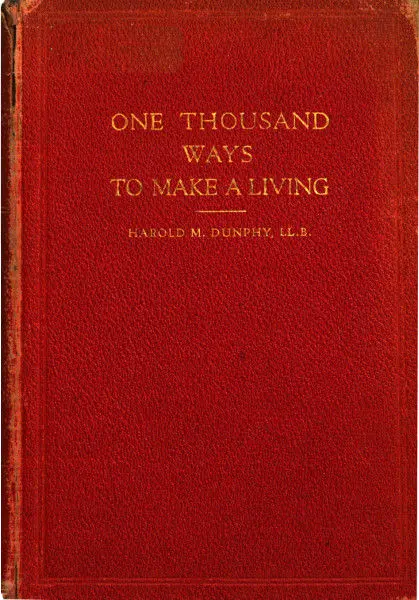
"One Thousand Ways to Make a Living; or, An Encyclopædia of Plans to Make Money" by Harold M. Dunphy is a practical guidebook written in the early 20th century. It compiles a diverse range of ideas and plans aimed at helping individuals find methods to earn a living, particularly in the context of post-World War I America. The book focuses on providing actionable, straightforward strategies for generating income, rather than offering vague financial advice or "get-rich-quick" schemes. The opening portion of the book introduces the purpose and intention behind its creation, emphasizing its goal of empowering individuals, particularly those affected by unemployment post-war. It features a dedication to assisting those who have sacrificed for their country, as well as highlighting the importance of self-initiative. Furthermore, the text introduces several initial plans for making a living, showcasing inventive ideas like weaving baskets for ferns, becoming a professional hostess, or taking on creative ventures such as cooking and crafting—all of which demonstrate resourcefulness and adaptability. This serves as a foundation for the many strategies that will follow, inviting readers to explore new potential avenues to enhance their livelihoods.
Introduction adapted from the source catalogue; source summaries may be automatically generated.
Free to read · English · 457,568 words · No account needed
MAKE TIME FOR A GOOD BOOK
On by default. Untick to stop anonymous reading totals. Each page counts after 10 seconds in view. How this works.
Anonymous counting is on unless you have switched it off.
Of the many thousands of automobiles in use a great many of them have the varnish worn off or scratched, through carelessness and hard usage, and this fact gave an enterprising young Portland man an idea.
He made up a considerable quantity of a fine polish from the following formula: Orange shellac, 30 ounces; Venice turpentine, one ounce; castor oil, one ounce; gum sandarac, one ounce; nigrosine, one ounce; wood alcohol, 9 pints and 6 ounces. These he mixed, and shook them until thoroughly dissolved.
This mixture he put up in pint tin cans, with tight-fitting tops, the same as paint cans, pasted an attractive label on each can, gave it a fancy name, and was ready for business.
The directions for using were: Remove all dust and dirt with a clean cloth, and apply the dressing to the body of the auto or carriage with a soft camel hair brush, letting it dry thoroughly.
At first he took orders for applying the polish to autos himself, but he later decided he could make more money by employing agents to sell it for him. Each can cost but a trifle, and sold readily for $1, so that, after paying the agents liberal commission, he still had a net profit of over 50 cents per can. Later he began to advertise it throughout the country, and in a few months he had built up a mail order business, that netted him a good living.
PLAN No. 194. SINGING SONGS THROUGH A MEGAPHONE
With a strong, melodious voice, a megaphone, a hand organ in a covered wagon, and a few hundred copies of a popular song, a young man in New York City earned a good living.
This young man, standing up in the front part of the wagon, would stop the horse at a crowded corner, place the megaphone to his mouth and, giving a sign to the man manipulating the hand organ in the covered wagon, would commence to sing one of the latest songs of the day.
When the crowd became interested, as it always did, he would stop
singing, offer the copies of the song, words and music, for 10 cents
each.
The song sold rapidly, and when the ten minute limit for stopping in one place expired he would start up the horse, move on to another location, probably in the same block, and repeat the performance.
PLAN No. 195. A SUBSCRIPTION AGENCY
Most magazines, as well as daily and weekly newspapers, are always glad to pay a liberal commission for subscriptions, and some of them offer bonuses besides for good lists of subscribers.
Your reading position is saved on this browser. Take it to another device with a library code. Reading pages adapt to text, rather than matching a printed edition.
BEHIND THE BOOK
This eBook is for the use of anyone anywhere in the United States and most other parts of the world at no cost and with almost no restrictions whatsoever. You may copy it, give it away or re-use it under the terms of the Project Gutenberg License included with this eBook or online at www.gutenberg.org. If you are not located in the United States, you will have to check the laws of the country where you are located before using this eBook. Read the source licence.
The original source file, including credits and licence, is retained by this library. Request an original-format copy at no charge. Please include the book title and Project Gutenberg identifier #62231.
KEEP YOUR CURIOSITY GOING
Charles G. (Charles Griffith) Ross
Hannah Webster Foster

Emily Lawless
Edwin Hamlin Carr

Charles De Lano Hine
Andrew Ure