
The Writing of News A Handbook with Chapters on Newspaper Correspondence and Copy Reading
Charles G. (Charles Griffith) Ross
THE CLASSIC COLLECTION · 1919
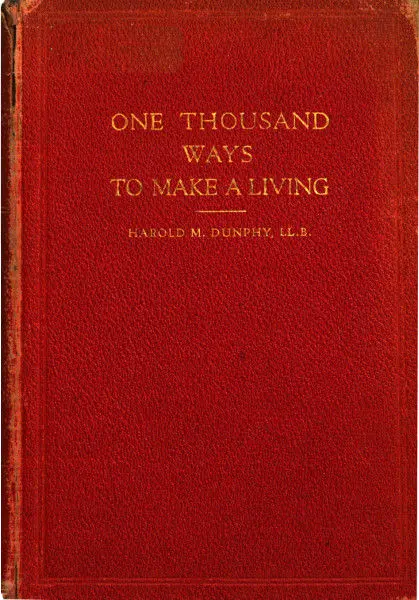
"One Thousand Ways to Make a Living; or, An Encyclopædia of Plans to Make Money" by Harold M. Dunphy is a practical guidebook written in the early 20th century. It compiles a diverse range of ideas and plans aimed at helping individuals find methods to earn a living, particularly in the context of post-World War I America. The book focuses on providing actionable, straightforward strategies for generating income, rather than offering vague financial advice or "get-rich-quick" schemes. The opening portion of the book introduces the purpose and intention behind its creation, emphasizing its goal of empowering individuals, particularly those affected by unemployment post-war. It features a dedication to assisting those who have sacrificed for their country, as well as highlighting the importance of self-initiative. Furthermore, the text introduces several initial plans for making a living, showcasing inventive ideas like weaving baskets for ferns, becoming a professional hostess, or taking on creative ventures such as cooking and crafting—all of which demonstrate resourcefulness and adaptability. This serves as a foundation for the many strategies that will follow, inviting readers to explore new potential avenues to enhance their livelihoods.
Introduction adapted from the source catalogue; source summaries may be automatically generated.
Free to read · English · 457,568 words · No account needed
MAKE TIME FOR A GOOD BOOK
On by default. Untick to stop anonymous reading totals. Each page counts after 10 seconds in view. How this works.
Anonymous counting is on unless you have switched it off.
Fritz L. Gienandt. The Twentieth Century Book for the Progressive Baker-Confectioner, published by the author, in Boston.
Emil Braun. Secrets of Bread Making.
Siebel’s Manual.
Recipe Book for the Practical Baker. Malzbender.
Paul Richards. Bakers’ Bread, with appendix.
Biscuits and Cakes, 1911. Reliable Flour Co., Boston, Mass.
Robert Wells. Bread, Biscuits, Buns, and Cakes.
Frank A. Kennedy. The Biscuit Industry, 1895.
Wihlfahrt, J. E., A Treatise on Flour, Yeast, Ferment, and Baking.
Laws and Gilbert. The Wheat Grain, Its Milling Products and Bread.
Charles and James Scott. Vienna Bread.
Owen Simmons. The Book of Bread.
Dr. Harry Snyder. Studies on Bread and Bread Making.
J. A. Wanklyn. Bread Analysis.
H. W. Wiley. Cereal and Cereal Products.
Mrs. H. W. Atwater. Bread and the Principles of Bread Making.
Blandy. Studies in Bread Making.
Gill. Short History of the Baker’s Art.
Gill. Chemistry of Bread Making.
T. B. Wood. The Story of a Loaf of Bread.
Grant. Chemistry of Bread Making.
Dr. John Goodfellow. The Dietetic Value of Bread.
William Jago. The Principles of Bread Making.
Archer Kirkland. Studies for the Bakehouse.
John Kirkland. All About Bread Making.
John Kirkland. The Modern Baker, Confectioner, and Caterer.
It is thus seen that for the man who is ambitious to learn about baking there are many sources of knowledge. The baker, or baking employee who aspires to become a baker, can find much assistance and inspiration from bulletins, books, journals, and societies, and by correspondence with experts of the Department of Agriculture. The disabled soldiers who believe they can qualify to become bakers have every reason to feel encouraged.
PLAN No. 1248. DENTAL MECHANICS AS A VOCATION
This monograph was prepared by Dr. Harold DeWitt Cross, director, the Forsyth Dental Infirmary, Boston, Mass., and Dr. Guy S. Millberry, dean, college of dentistry, University of California, Berkeley, Calif.
Mechanical dentistry has been practiced by individuals for over a thousand years, though its development in a scientific way can be said to date from the beginning of the last century.
It is a part of the practice of dentistry which is limited to working upon inert matter and does not include work of any kind upon patients. For this reason anyone can become a dental mechanic, for the laws governing the practice of dentistry in all States specifically point out that such are exempt from the licensing requirements and penalties of law.
Your reading position is saved on this browser. Take it to another device with a library code. Reading pages adapt to text, rather than matching a printed edition.
BEHIND THE BOOK
This eBook is for the use of anyone anywhere in the United States and most other parts of the world at no cost and with almost no restrictions whatsoever. You may copy it, give it away or re-use it under the terms of the Project Gutenberg License included with this eBook or online at www.gutenberg.org. If you are not located in the United States, you will have to check the laws of the country where you are located before using this eBook. Read the source licence.
The original source file, including credits and licence, is retained by this library. Request an original-format copy at no charge. Please include the book title and Project Gutenberg identifier #62231.
KEEP YOUR CURIOSITY GOING
Charles G. (Charles Griffith) Ross
Hannah Webster Foster

Emily Lawless
Edwin Hamlin Carr

Charles De Lano Hine
Andrew Ure