
The Writing of News A Handbook with Chapters on Newspaper Correspondence and Copy Reading
Charles G. (Charles Griffith) Ross
THE CLASSIC COLLECTION · 1919
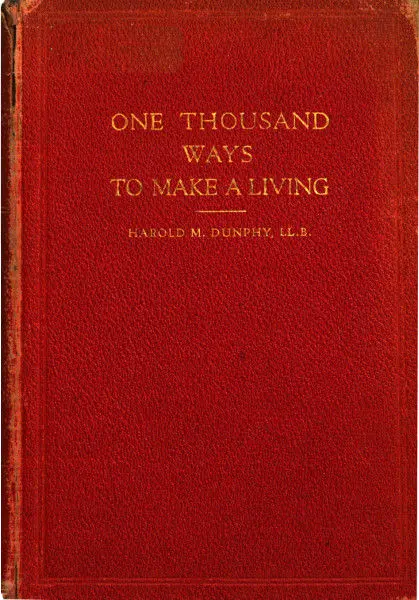
"One Thousand Ways to Make a Living; or, An Encyclopædia of Plans to Make Money" by Harold M. Dunphy is a practical guidebook written in the early 20th century. It compiles a diverse range of ideas and plans aimed at helping individuals find methods to earn a living, particularly in the context of post-World War I America. The book focuses on providing actionable, straightforward strategies for generating income, rather than offering vague financial advice or "get-rich-quick" schemes. The opening portion of the book introduces the purpose and intention behind its creation, emphasizing its goal of empowering individuals, particularly those affected by unemployment post-war. It features a dedication to assisting those who have sacrificed for their country, as well as highlighting the importance of self-initiative. Furthermore, the text introduces several initial plans for making a living, showcasing inventive ideas like weaving baskets for ferns, becoming a professional hostess, or taking on creative ventures such as cooking and crafting—all of which demonstrate resourcefulness and adaptability. This serves as a foundation for the many strategies that will follow, inviting readers to explore new potential avenues to enhance their livelihoods.
Introduction adapted from the source catalogue; source summaries may be automatically generated.
Free to read · English · 457,568 words · No account needed
MAKE TIME FOR A GOOD BOOK
On by default. Untick to stop anonymous reading totals. Each page counts after 10 seconds in view. How this works.
Anonymous counting is on unless you have switched it off.
Description: The millwright is responsible for the upkeep of the mill in general and for all trouble with the spouting, milling machinery, and equipment. He repairs, installs, or takes out machinery, equipment, or spouting under direction of the head miller.
Qualifications: He must be a highly skilled wood and sheet metal worker, and must have a general knowledge of all the milling processes. He should have had experience as carpenter, metal worker, and spouter, also knowledge of belting, and machine repairing. He should have good lungs.
Schooling: Common school.
Description: The sack man has complete charge of the stock of unfilled flour and feed sacks, bags, cartons, and barrels. It is his duty to keep the packers supplied with the proper kind and number of sacks, bags, cartons, and barrels.
Qualifications: He must be able to render reports of the supplies received and used, and to render accurate inventory of the supplies on hand. He must be intelligent, accurate, and attentive to duty.
Schooling: Common school.
Description: The sack sewer repairs sacks by hand or on a sewing machine, and does other required sewing.
Qualifications: He must be able to do plain hand sewing or use a
sewing machine.
Kindred occupation: Packer foreman.
Description: The warehouse foreman has charge of the warehouse and has general supervision of all truckers and packers. He superintends the loading of all cars, and issues packing instructions to the packer foreman. He must keep strict account of all cars placed at the warehouse for loading and unloading, and must be able to make out various reports, such as those relating to the loading of cars, the delivery of goods, and the inventory of stock.
Qualifications: This position is one of responsibility and requires a responsible man who has executive ability and who has had previous high-grade warehouse experience. He must have a high degree of intelligence and be physically strong.
Schooling: Common school; preferably high school.
Description: Supervises the mill on a particular watch; responsible to the head miller; takes the lead in adjusting trouble at any particular point; presence required in all parts of the mill.
Qualifications: Like those for miller.
Schooling: Common school.
The following occupations--unloader, loader, elevator man, sweeper, smutter, sack man, trucker--may be classified as unskilled, and the men who work in these occupations work under immediate direction of their foreman.
The following occupations--unloader foreman, loader foreman, elevator foreman, warehouse foreman--may also be considered unskilled, but they are filled by men who are able to direct operations of the first group.
Your reading position is saved on this browser. Take it to another device with a library code. Reading pages adapt to text, rather than matching a printed edition.
BEHIND THE BOOK
This eBook is for the use of anyone anywhere in the United States and most other parts of the world at no cost and with almost no restrictions whatsoever. You may copy it, give it away or re-use it under the terms of the Project Gutenberg License included with this eBook or online at www.gutenberg.org. If you are not located in the United States, you will have to check the laws of the country where you are located before using this eBook. Read the source licence.
The original source file, including credits and licence, is retained by this library. Request an original-format copy at no charge. Please include the book title and Project Gutenberg identifier #62231.
KEEP YOUR CURIOSITY GOING
Charles G. (Charles Griffith) Ross
Hannah Webster Foster

Emily Lawless
Edwin Hamlin Carr

Charles De Lano Hine
Andrew Ure