
The Writing of News A Handbook with Chapters on Newspaper Correspondence and Copy Reading
Charles G. (Charles Griffith) Ross
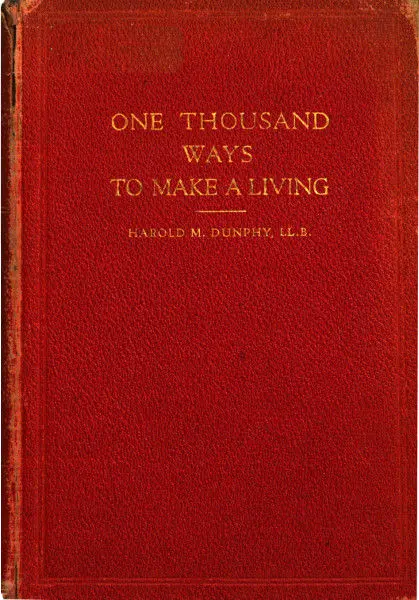
THE CLASSIC COLLECTION · 1919
"One Thousand Ways to Make a Living; or, An Encyclopædia of Plans to Make Money" by Harold M. Dunphy is a practical guidebook written in the early 20th century. It compiles a diverse range of ideas and plans aimed at helping individuals find methods to earn a living, particularly in the context of post-World War I America. The book focuses on providing actionable, straightforward strategies for generating income, rather than offering vague financial advice or "get-rich-quick" schemes. The opening portion of the book introduces the purpose and intention behind its creation, emphasizing its goal of empowering individuals, particularly those affected by unemployment post-war. It features a dedication to assisting those who have sacrificed for their country, as well as highlighting the importance of self-initiative. Furthermore, the text introduces several initial plans for making a living, showcasing inventive ideas like weaving baskets for ferns, becoming a professional hostess, or taking on creative ventures such as cooking and crafting—all of which demonstrate resourcefulness and adaptability. This serves as a foundation for the many strategies that will follow, inviting readers to explore new potential avenues to enhance their livelihoods.
Introduction adapted from the source catalogue; source summaries may be automatically generated.
Free to read · English · 457,568 words · No account needed
MAKE TIME FOR A GOOD BOOK
On by default. Untick to stop anonymous reading totals. Each page counts after 10 seconds in view. How this works.
Anonymous counting is on unless you have switched it off.
===================+========================+========================+ Class of work. | Requirements and |Disqualifying handicaps.| | qualifications. | | -------------------+------------------------+------------------------+ Custom tailors. |High-grade intelligence;|Bad eyesight; loss of | |knowledge of cutting, |both hands. | |designing, operating; | | |knowledge of materials, | | |common-school education.| | | | | Designers. |Good judgment; artistic |Blindness; loss of both | |taste; high-grade |hands. | |intelligence; knowledge | | |of drafting; experience | | |in cutting and garment | | |making; common-school | | |education. | | | | | Cutters. |Above average |Loss of hand; amputation| |intelligence; accuracy; |of the leg would | |steady hand; ordinary |seriously handicap | |strength; ability to |unless a well-adjusted | |stand; experience as |artificial limb enabled | |spreader, marker, etc.; |the man to stand easily;| |three years as |bad eyesight. | |apprentice, common- | | |school education. | | | | | Sample makers. |All-round tailor; |Bad eyesight; loss of | |knowledge of cutting, |arm. | |operating, fitting, | | |ordinary strength and | | |ability. | | | | | Foremen. |Initiative; executive |Blindness. | |ability; mechanical | | |ability; knowledge of | | |processes; experience as| | |cutter or fitter; | | |ordinary strength and | | |ability; common-school | | |education. | | | | | Machine operators. |Ordinary intelligence; |Bad eyesight; loss of | |adaptability; speed and |hands; tuberculosis; | |manual dexterity; |nervousness. | |ability to stand nervous| | |strain of noisy | | |machines; ability to run| | |power machines; | | |knowledge of English. | | | | | Handworkers (very |Ability to do plain hand|Bad eyesight; loss of | few men are |sewing, to thread |hands. | employed). |needles, and to tie | | |knots rapidly, take even| | |stitches, and fasten | | |work; deftness of | | |fingers; good eyesight; | | |steady nerves. | | | | | Pressers. |Average intelligence; |Loss of one or both | |ability to handle a |arms; loss of legs; bad | |pressing machine; more |eyesight. | |than average strength. | | | | | Examiners. |Skillful with scissors; |Bad eyesight; loss of | |experience as operator; |both arms; loss of | |intelligence; |fingers or hands. | |reliability; knowledge | | |of styles; ability to | | |detect poor work; | | |common-school education.| | -------------------+------------------------+------------------------+
===================+==========================
Class of work. | Training required.
|
-------------------+--------------------------
Custom tailors. |Tailors are trained in the
|trade.
|
Designers. |Designers are trained by
|working as apprentices to
|custom tailors and to
|factory cutters. A course
|in drafting, either with
|a private teacher or at a
|school for designing is
|desirable.
|
Cutters. |Cutters learn, through
|apprenticeship, the
|technique of laying
|patterns, stretching
|cloth, sloping, and the
|right use of materials;
|cutting small parts with
|knife; “repair” cutting
|with shears.
|
Sample makers. |The training is the same
|as for a tailor which is
|usually gotten in the
|trade.
|
Foremen. |Foremen are often selected
|from workers. Special
|training is sometimes
|given men with secondary
|education through a course
|in the workshop.
|
Machine operators. |Instruction in power
|sewing machine operating
|and handling of materials.
|In a few weeks’ time
|an operator learns enough
|for an easy operation, a
|year or two years is
|required to become
|
Handworkers (very |Hand sewers are taught how
few men are |to adjust their knowledge
employed). |of plain sewing to factory
|methods.
|
Pressers. |Pressers ere trained by
|doing. Beginners press
|seams, then skirts and
|dresses; after this
|experience the pressing of
|coats and cloaks may be
|undertaken.
|
Examiners. |Through a knowledge of
|garment making as machine
|operators or as helpers to
|examiners.
-------------------+--------------------------
Your reading position is saved on this browser. Take it to another device with a library code. Reading pages adapt to text, rather than matching a printed edition.
BEHIND THE BOOK
This eBook is for the use of anyone anywhere in the United States and most other parts of the world at no cost and with almost no restrictions whatsoever. You may copy it, give it away or re-use it under the terms of the Project Gutenberg License included with this eBook or online at www.gutenberg.org. If you are not located in the United States, you will have to check the laws of the country where you are located before using this eBook. Read the source licence.
The original source file, including credits and licence, is retained by this library. Request an original-format copy at no charge. Please include the book title and Project Gutenberg identifier #62231.
KEEP YOUR CURIOSITY GOING
Charles G. (Charles Griffith) Ross
Hannah Webster Foster

Emily Lawless
Edwin Hamlin Carr

Charles De Lano Hine
Andrew Ure