
The Writing of News A Handbook with Chapters on Newspaper Correspondence and Copy Reading
Charles G. (Charles Griffith) Ross
THE CLASSIC COLLECTION · 1919
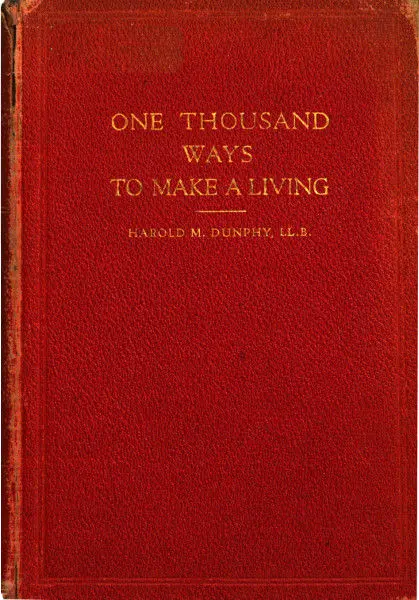
"One Thousand Ways to Make a Living; or, An Encyclopædia of Plans to Make Money" by Harold M. Dunphy is a practical guidebook written in the early 20th century. It compiles a diverse range of ideas and plans aimed at helping individuals find methods to earn a living, particularly in the context of post-World War I America. The book focuses on providing actionable, straightforward strategies for generating income, rather than offering vague financial advice or "get-rich-quick" schemes. The opening portion of the book introduces the purpose and intention behind its creation, emphasizing its goal of empowering individuals, particularly those affected by unemployment post-war. It features a dedication to assisting those who have sacrificed for their country, as well as highlighting the importance of self-initiative. Furthermore, the text introduces several initial plans for making a living, showcasing inventive ideas like weaving baskets for ferns, becoming a professional hostess, or taking on creative ventures such as cooking and crafting—all of which demonstrate resourcefulness and adaptability. This serves as a foundation for the many strategies that will follow, inviting readers to explore new potential avenues to enhance their livelihoods.
Introduction adapted from the source catalogue; source summaries may be automatically generated.
Free to read · English · 457,568 words · No account needed
MAKE TIME FOR A GOOD BOOK
On by default. Untick to stop anonymous reading totals. Each page counts after 10 seconds in view. How this works.
Anonymous counting is on unless you have switched it off.
Many card writers are trained in the shop. Correspondence courses afford fair advantages to the man who must save time and money, but personal supervision is of great advantage, and personal criticism is essential if a correspondence course is taken. Courses in card writing are now offered in technical schools and Y. M. C. A. classes and vocational schools all over the country. Among the schools now offering courses in show-card writing are the following:
Federal School of Commercial Art, Minneapolis, Minn.
Idaho Technical Institute.
Los Angeles Y. M. C. A. schools.
St. Louis Y. M. C. A. schools.
Lowry Sign and Advertising Service, Chicago.
Link’s Business College, Boise, Idaho.
State Trade School. Danbury, Conn.
Appleton, Wis., Industrial School.
Kenosha, Wis., Vocational School.
Neenah, Wis., Industrial School.
New York High School.
New York Vocational Schools.
Detroit, Mich., School of Letters.
Augustana College, Rock Island, Ill.
College of Commerce, De Paul University, Chicago.
School of Industrial Arts, Trenton, N. J.
Koester School, Chicago.
Semby School, Minneapolis, Minn.
The length of time required for the completion of courses depends upon the student; one very good course covers eight weeks. Some students after the fifth or sixth lesson have done work sufficiently creditable to bring a money return. Proper and methodical training is very necessary. Care and exactness must first be acquired and speed will naturally follow.
Courses given in show-card writing cover such subjects as how to mix and when to use water colors, inks, and oils; the care of brushes and pens; the proper kind and color of cardboards to use; and how to apply bronze and diamond dust. The formation of pen and brush letters is, of course, fundamental, and the principles of lettering must be taught in a simple, thorough, and correct way. Proper instruction, with application, is bound to bring success.
Lesson plates Nos. 1 to 6.--Improved method for teaching, correct formation and relative proportions of letters and numerals.--Brush method.
General instructions.--Proper material, student’s worktable, light, how to care for brushes, show-card paint, how to practice, kind of practice that counts, lesson plates explained, how to fill the brush, how to bring the brush to working point, how to hold the brush, position at table, position of paper.
Lesson plates Nos. 7 to 10--Single stroke rapid Roman lettering.--How to begin the practice, time-saving methods, how to hold the brush, various positions of the brush explained, how to manipulate the brush to produce clean-cut strokes, purpose of single-stroke vertical and italic roman lettering.
Lesson plates Nos. 11 and 12--How to shade letters.--Various styles of shading, proper colors for shading, shading as an embellishment, shading to give emphasis.
Your reading position is saved on this browser. Take it to another device with a library code. Reading pages adapt to text, rather than matching a printed edition.
BEHIND THE BOOK
This eBook is for the use of anyone anywhere in the United States and most other parts of the world at no cost and with almost no restrictions whatsoever. You may copy it, give it away or re-use it under the terms of the Project Gutenberg License included with this eBook or online at www.gutenberg.org. If you are not located in the United States, you will have to check the laws of the country where you are located before using this eBook. Read the source licence.
The original source file, including credits and licence, is retained by this library. Request an original-format copy at no charge. Please include the book title and Project Gutenberg identifier #62231.
KEEP YOUR CURIOSITY GOING
Charles G. (Charles Griffith) Ross
Hannah Webster Foster

Emily Lawless
Edwin Hamlin Carr

Charles De Lano Hine
Andrew Ure