THE CLASSIC COLLECTION✦The story of the Philippines, for use in the schools of the Philippine IslandsCLASSIC FREE BOOKS
The story of the Philippines, for use in the schools of the Philippine Islands
Adeline Knapp
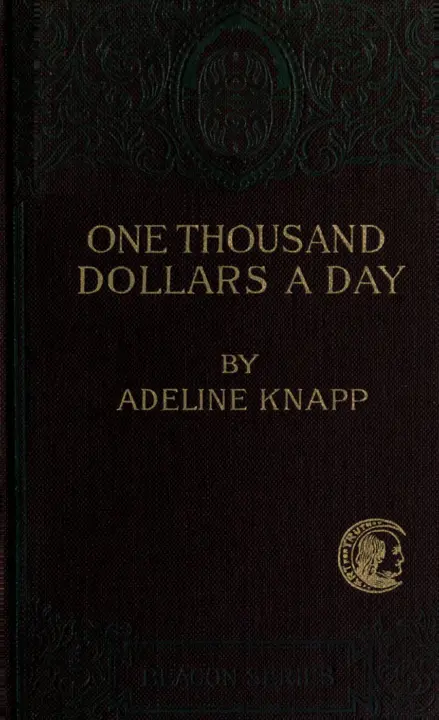
THE CLASSIC COLLECTION · 1894
"One Thousand Dollars a Day: Studies in Practical Economics" by Adeline Knapp is a collection of essays and fables that delve into the complexities of economics and societal structures, written in the late 19th century. This book combines literary elements with socio-economic commentary, likely intended for readers interested in understanding the practical implications of economic theory on everyday lives. The underlying topic examines the interplay between labor and capital in a rapidly industrializing society, reflecting the challenges and inequalities of that era. The book presents several distinct pieces, among them a fictional narrative about a financial experiment that distributes wealth to citizens, leading to unforeseen societal chaos. Knapp explores human behavior in response to sudden wealth and critiques the capitalist system, illustrating through her characters the disconnect between the rich and the poor, as well as the alienation laborers feel despite being essential to production. Other essays in the collection address themes of community, the nature of work, and the moral responsibilities of capitalism, leaving readers to ponder the necessary balance between economic gain and social equity. Overall, Knapp's work serves as a reflective critique on the economic and ethical dilemmas of her time, resonant with contemporary discussions about wealth distribution and labor rights.
Introduction adapted from the source catalogue; source summaries may be automatically generated.
Free to read · English · 16,036 words · No account needed
MAKE TIME FOR A GOOD BOOK
On by default. Untick to stop anonymous reading totals. Each page counts after 10 seconds in view. How this works.
Anonymous counting is on unless you have switched it off.
“But if the system is in such bad shape, and owes the organism so much, why does not the latter take it out of the management’s hands and operate it itself!”
“There you go again! Did not I explain to you that that would be interfering with individual rights? But there—my way turns here, and I must leave you. Sorry I could not make things any plainer to you. I suppose ’tis difficult for a stranger to understand the operations of this government, but you will learn, in time, and be sure of one thing, whatever is, is right;” and the native corpuscle was carried off towards the pancreas.
“That last remark sounds rather funny,” thought the visitor, “I do not quite see, myself, the logic of it, but I’ll look about me, and perhaps it will come straight bye and bye.”
Just then his attention was called to a lugubrious corpuscle standing at a division of the ways, in the pathway leading to the liver.
“Why are you standing here?” the little stranger asked.
“I’m out of a job,” was the sullen reply.
“A job! What is that?”
“Why, work, of course! What sort of a place do you come from, not to
know that?”
“Oh, work; well, then why do you not get up and go to work?”
“No one will give me a job.”
“But there is plenty of work. What is to hinder you from doing your
share?”
“The corpuscles that control the work won’t let me.”
“Control it! Do you mean to say that corpuscles own the work of the organism? How came it theirs?”
“That’s plain to be seen, stupid! They own the sources of work; the machinery to work with; the places where work is done, and the money to pay for work, and there is a glut in the labor market just now. The supply exceeds the demand.”
“I see. Then you can rest and take it easy, can you not, until there is work? I should think you would like that.”
“Yes; but where is my living to come from? If one doesn’t work, neither
shall he eat.”
“But if he does not work he cannot eat, can he?”
“Well, he’s got to earn his living anyway, and that’s all there is about
it.”
At this moment a corpuscle approached, wearing a star in his breast, and
carrying a baton.
“Come, now! Lave this,” said he to the idle corpuscle, “an’ be movin’
on.”
The one thus addressed growled, and murmured something about “rights.”
Your reading position is saved on this browser. Take it to another device with a library code. Reading pages adapt to text, rather than matching a printed edition.
Adeline Knapp
Adeline Knapp
Adeline Knapp

Adeline Knapp
BEHIND THE BOOK
This eBook is for the use of anyone anywhere in the United States and most other parts of the world at no cost and with almost no restrictions whatsoever. You may copy it, give it away or re-use it under the terms of the Project Gutenberg License included with this eBook or online at www.gutenberg.org. If you are not located in the United States, you will have to check the laws of the country where you are located before using this eBook. Read the source licence.
The original source file, including credits and licence, is retained by this library. Request an original-format copy at no charge. Please include the book title and Project Gutenberg identifier #62983.
KEEP YOUR CURIOSITY GOING

David Patterson (Spirit) Hatch

David Patterson (Spirit) Hatch

David Patterson (Spirit) Hatch
Coulson Kernahan

Ralph Waldo Emerson

Maurice Baring