THE CLASSIC COLLECTION✦The story of the Philippines, for use in the schools of the Philippine IslandsCLASSIC FREE BOOKS
The story of the Philippines, for use in the schools of the Philippine Islands
Adeline Knapp
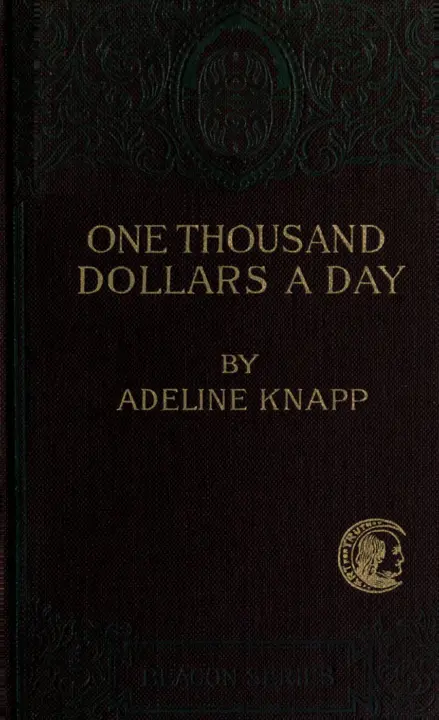
THE CLASSIC COLLECTION · 1894
"One Thousand Dollars a Day: Studies in Practical Economics" by Adeline Knapp is a collection of essays and fables that delve into the complexities of economics and societal structures, written in the late 19th century. This book combines literary elements with socio-economic commentary, likely intended for readers interested in understanding the practical implications of economic theory on everyday lives. The underlying topic examines the interplay between labor and capital in a rapidly industrializing society, reflecting the challenges and inequalities of that era. The book presents several distinct pieces, among them a fictional narrative about a financial experiment that distributes wealth to citizens, leading to unforeseen societal chaos. Knapp explores human behavior in response to sudden wealth and critiques the capitalist system, illustrating through her characters the disconnect between the rich and the poor, as well as the alienation laborers feel despite being essential to production. Other essays in the collection address themes of community, the nature of work, and the moral responsibilities of capitalism, leaving readers to ponder the necessary balance between economic gain and social equity. Overall, Knapp's work serves as a reflective critique on the economic and ethical dilemmas of her time, resonant with contemporary discussions about wealth distribution and labor rights.
Introduction adapted from the source catalogue; source summaries may be automatically generated.
Free to read · English · 16,036 words · No account needed
MAKE TIME FOR A GOOD BOOK
On by default. Untick to stop anonymous reading totals. Each page counts after 10 seconds in view. How this works.
Anonymous counting is on unless you have switched it off.
“It does, but there seems to be no help for it.”
“But, as the whole organism is the loser, and would be the gainer under a better management, why does it not take charge of the system and manage it so all would be benefited?”
“Why! that would be interfering with individual rights! It would never do. It would destroy all individual enterprise, all individual ambition, all individuality of every sort, and reduce everything to a dead level. It would not do at all. Besides, the liver has too much influence with the organism, and would never allow such a state of things to come to pass.”
“Why should the organism ask permission of the liver?”
“Well,” said the other, “the liver is the most important body of our whole community. All our richest corpuscles compose it.”
“Richest corpuscles? What are they?”
“Why, those who have the largest share of the organic wealth, of course. You must be very stupid not to know that.”
“How did they get more of this organic wealth than the others have?”
“Oh, in various ways. By their superior enterprise for one thing. They saw in the beginning the necessity for transportation facilities for the blood, chyle, and so forth, and through their efforts the Venous and Arterial Transit Systems were established.”
“Do you mean that they formed the veins and arteries?”
“Oh, no, of course not. They had not the means for that, but the organism aided them, knowing that it would be a great thing to have this system established; that it would build up the organism.”
“I see; and then I suppose these rich corpuscles of the liver paid the organism back out of their gains?”
“Not exactly—that is to say—they’ve not yet done so. You see, somehow, the system has not paid as well as they thought it would. It seems there have been unforeseen exigencies, they have not been able to pay. In fact, they say the system is on the verge of insolvency.”
“But I thought you said the corpuscles owning it are the richest ones in
the organism?”
“So they are; but that is their individual wealth, don’t you see? It takes all that the system can earn to pay expenses, and reimburse the management for their original outlay in getting things in running order. You could not expect them to invest their capital for nothing, you know.”
“But I understood you to say a little while ago that the organism advanced the means and that the management still owes for the advances.”
“Yes, yes, that is true. But, don’t you see, these corpuscles assumed the responsibility, and their enterprise merits some reward.”
Your reading position is saved on this browser. Take it to another device with a library code. Reading pages adapt to text, rather than matching a printed edition.
Adeline Knapp
Adeline Knapp
Adeline Knapp

Adeline Knapp
BEHIND THE BOOK
This eBook is for the use of anyone anywhere in the United States and most other parts of the world at no cost and with almost no restrictions whatsoever. You may copy it, give it away or re-use it under the terms of the Project Gutenberg License included with this eBook or online at www.gutenberg.org. If you are not located in the United States, you will have to check the laws of the country where you are located before using this eBook. Read the source licence.
The original source file, including credits and licence, is retained by this library. Request an original-format copy at no charge. Please include the book title and Project Gutenberg identifier #62983.
KEEP YOUR CURIOSITY GOING

David Patterson (Spirit) Hatch

David Patterson (Spirit) Hatch

David Patterson (Spirit) Hatch
Coulson Kernahan

Ralph Waldo Emerson

Maurice Baring