A laugh a day keeps the doctor away
Irvin S. (Irvin Shrewsbury) Cobb
THE CLASSIC COLLECTION · 1921
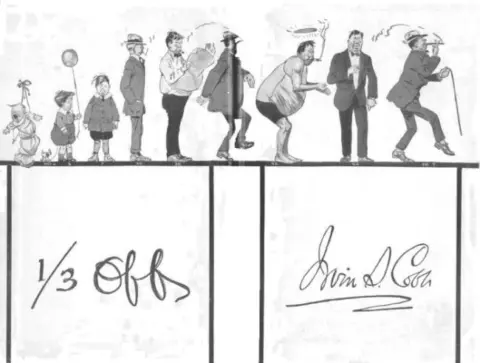
"One Third Off" by Irvin S. Cobb is a humorous work of fiction written in the early 20th century. The book presents a lighthearted exploration of dieting and self-improvement, touching on the experiences of the author as he attempts to shed excess weight while sharing humorous anecdotes and societal observations. Cobb writes in a relatable manner, combining wit and charm that reflects the cultural attitudes of his time. In this engaging narrative, Cobb recounts his journey from a once-slim youth to a man who finds himself grappling with weight gain and the challenges that come with it. The story delves into his reflections on societal expectations regarding body image and the often humorous excuses people create to justify their lifestyle choices. Through various episodes and misadventures, he shares both the struggles and small victories of his weight loss journey, culminating in a light-hearted critique of fad diets and a self-deprecating acknowledgment of the human condition. Overall, "One Third Off" is a candid and entertaining look at personal transformation, wrapped in Cobb's signature humor.
Introduction adapted from the source catalogue; source summaries may be automatically generated.
Free to read · English · 17,345 words · No account needed
MAKE TIME FOR A GOOD BOOK
On by default. Untick to stop anonymous reading totals. Each page counts after 10 seconds in view. How this works.
Anonymous counting is on unless you have switched it off.
Well, I made up my mind, having tried violent exercise in the gymnasium, coupled with violent language in the steam room, and having found neither or both had been of the least avail in trimming down my proportions, but on the contrary had augmented them to the extent of nearly ten pounds, live weight, that I would let well enough alone. If 'twere my ordained fate to be fat--why, then so be it; I'd be fatly fatalistic and go on through life undulating and rippling. If an all-wise Providence meant to call me to the estate of being the bulkiest writing man using the English language for a vehicle, then let Hilaire Belloc look to his laurels and Gilbert K. Chesterton to his unholsterings. There was one consolation: Thank heavens the championship would remain in America!
The years go marching by in ordered processional. A great war bursts and for a space endures. In our own land prohibition is nationally enacted and women's suffrage comes to be, and Irving Berlin, reading the signs of the times, decides to write The Blue Laws Blues. Fashions of thought change; other fashions, also. A girl who was born without hips or eyebrows and who in childhood was regarded as a freak, now finds herself, at the age of eighteen, exactly in the mode, thus proving that all things come to those who wait. Czecho-Slovakia is discovered. The American forces spent three days taking Château-Thierry and three years trying to learn to pronounce it. Ireland undertakes to settle her ancient problem on the basis of self-extermination. Several rich retail profiteers die, the approval being hearty and general, and on arriving at heaven experience great difficulty in passing through the Needle's Eye, or tradesmen's entrance. Somebody tells Henry Ford about what some high priests did in Jerusalem nearly two thousand years ago and in the first flush of his startled indignation he becomes violently anti-Semitic. General Pershing returns from the battlefields of Europe universally acclaimed a model of military efficiency and wearing so many medals that alongside him John Philip Sousa, by contrast, looks absolutely nude. His friends project him into the political arena and the result is summed in a phrase--"Lafayette, he ain't there!" Unavailing efforts are made by a rebellious and unreconciled few of us to find a presidential candidate willing to run on a platform of but four planks, namely: Wines, ales, liquors and cigars. Harding wins, Scattering second; Cox also ran: slogan: "He Kept Us Out of McAdoo." Manhattan Island, from whence the rest of the country derives its panics, its jazz tremblors and its girl shows, develops a severe sinking sensation in the pit of its financial stomach, accompanied by acute darting pains at the juncture of Broad and Wall. This is the way Thomas Carlyle used to start off a new chapter, and I like it. It denotes erudition. Ziegfeld builds a new Follies show around twelve pairs of winsome knee joints. North Dakota blows down the Nonpartisan League and discovers that darned thing was loaded in both barrels. The Prussians are pained to note that for some reason or other a number of people seem to harbor a grudge against them. Nine thousand Kentucky mint patches are plowed under and the sites sown with rosemary; that's for remembrance. In New York plans are undertaken for construing the Eighteenth Amendment along the lines of the selective draft, upon the theory that booze is a bad thing for some people and much too good for many of the others. The word "intrigued" creeps into our language and becomes common property, but the fiction writers saw it first. A business men's cabinet, composed almost exclusively of politicians, succeeds a business men's cabinet composed almost exclusively of politicians. In order to hurry along the payment of Installment One of the Indemnity France whistles up the reserves and that chore is chored. Pessimists, including many of the old-line Democrats, practically all the maltsters, and Aunt Emma Goldman, are filled with a dismal conviction that creation has gone plum' to perdition in a hand basket. Those more optimistically inclined look upon the brighter side of things and distill consolation from the thought that nothing is so bad but what it might have been worse--Trotzky might have been born twins. Great Britain has her post-war industrial crisis, Serial Number 24. The Sinn Féin enlarges the British national anthem to read God Save the King Till We Can Get at Him! By a strict party vote Congress decides the share in the victory achieved by the A.E.F. was overwhelmingly Republican, but that the airship program went heavily Democratic. Popular distrust of home-brew recipes assumes a nationwide phase. This brings us up to the early spring of this year of grace, 1921, which is what I have been aiming for all through this paragraph.
Your reading position is saved on this browser. Take it to another device with a library code. Reading pages adapt to text, rather than matching a printed edition.
Irvin S. (Irvin Shrewsbury) Cobb
Irvin S. (Irvin Shrewsbury) Cobb
Irvin S. (Irvin Shrewsbury) Cobb
Irvin S. (Irvin Shrewsbury) Cobb
BEHIND THE BOOK
This eBook is for the use of anyone anywhere in the United States and most other parts of the world at no cost and with almost no restrictions whatsoever. You may copy it, give it away or re-use it under the terms of the Project Gutenberg License included with this eBook or online at www.gutenberg.org. If you are not located in the United States, you will have to check the laws of the country where you are located before using this eBook. Read the source licence.
The original source file, including credits and licence, is retained by this library. Request an original-format copy at no charge. Please include the book title and Project Gutenberg identifier #16197.
KEEP YOUR CURIOSITY GOING
Coulson Kernahan

Maurice Baring
Frances Wright
Cécile Tormay

Frederic Jesup Stimson

W. H. P. (William Henry Pope) Jarvis