THE CLASSIC COLLECTION✦Building the pacific railwayCLASSIC FREE BOOKS
Building the pacific railway
Edwin L. (Edwin Legrand) Sabin
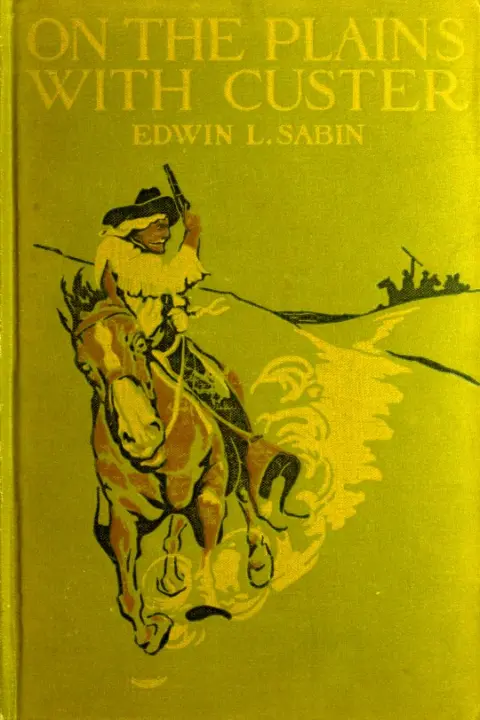
THE CLASSIC COLLECTION · 1913
"On the Plains with Custer" by Edwin L. Sabin is a historical account written in the early 20th century. The work centers around the life and experiences of the young bugler Ned Fletcher during the tumultuous years of the late 1860s and the 1870s when General George Armstrong Custer and the Seventh Cavalry played critical roles in the westward expansion of white civilization and the conflicts with Native American tribes. The narrative offers insights into both the military and everyday life on the American plains during a period of significant historical change. The opening of the book introduces us to Ned Fletcher, a young boy who has escaped from captivity with the Sioux and is navigating the vast and lonely Kansas prairie alone in search of safety and his lost sister. As he wanders, he encounters a herd of buffalo being chased by a horseman, who is revealed to be the famous General Custer. The interaction between Ned and Custer leads to a sense of hope for the boy, who expresses a desire to join the army and find his sister. The early chapters set the tone for an adventure filled with the realities of frontier life, the challenges faced by young soldiers, and the complex relations between white settlers and Native Americans, establishing the groundwork for Ned's journey alongside Custer and the Seventh Cavalry.
Introduction adapted from the source catalogue; source summaries may be automatically generated.
Free to read · English · 68,963 words · No account needed
MAKE TIME FOR A GOOD BOOK
On by default. Untick to stop anonymous reading totals. Each page counts after 10 seconds in view. How this works.
Anonymous counting is on unless you have switched it off.
Was the hard, cold march of three days to be a failure? Were the Indians already on the alert? See! Now, bending low, out from the edge of the timber issued an Osage. California Joe followed close. One after another the scouts all issued, approaching the fire. They reached it, they straightened up—apparently nothing happened, and a great sigh of relief swept through the tense column, where the companies sat at their intervals.
After prying about, and examining shrewdly, the scouts returned.
California Joe reported.
“Tain’t no reg’lar camp-fire,” he uttered. “The party we’re trailin’ never made it, ’cordin’ to them Osages. It’s the work of Injun herders; boys, like as not, to warm ’em while they watched the ponies. Village ought to be within two or three miles, at most.”
That was good news. The general gave the word to advance again, but more cautiously than ever. And taking Ned, as orderly, with his usual impulsiveness he rode forward accompanying the two Osage guides who had done so well.
The trail had left the stream, to cut across a big bend. The guides kept just at the head of the general’s horse. Whenever they came to a rise, one would creep forward and peer over. Seeing that the coast was clear, he would signal for the others to come on. Breathless work was this, and Ned’s heart thumped so that he feared he would be ordered to stay where he was. Now from the crest of a long brushy divide the Osage, reconnoitering, had put his hand to his brow, peering from under it. He crouched lower, and came hastily back. Something had been sighted.
“What is it?” asked the general, eagerly.
“Heaps Injuns down there,” grunted gutturally the Osage, at the saddle flaps. And he pointed ahead.
Off from his horse swung the general; he signed to Ned, and leaving their mounts in charge of the other Osage, with the first one they also stole forward.
“Drop that sabre,” whispered the general to Ned, sternly. Ned unbuckled his belt and dropped it, with the dragging scabbard. He was making too much noise.
Low in the moonlight, peeping over the top of the ridge they scanned the valley before. About half a mile beyond, upon the snow which edged the timber skirting the icy stream was a large blackish mass, like a great mass of animals.
“Buffalo!” hazarded the general, after looking long and earnestly.
The Osage said not a word.
“Why do you think Indians?” whispered the general. “Maybe buffalo.”
The Osage shook his feathered head.
“No. Me heard dog bark,” he asserted, softly.
Your reading position is saved on this browser. Take it to another device with a library code. Reading pages adapt to text, rather than matching a printed edition.
Edwin L. (Edwin Legrand) Sabin

Edwin L. (Edwin Legrand) Sabin

Edwin L. (Edwin Legrand) Sabin

Edwin L. (Edwin Legrand) Sabin
BEHIND THE BOOK
This eBook is for the use of anyone anywhere in the United States and most other parts of the world at no cost and with almost no restrictions whatsoever. You may copy it, give it away or re-use it under the terms of the Project Gutenberg License included with this eBook or online at www.gutenberg.org. If you are not located in the United States, you will have to check the laws of the country where you are located before using this eBook. Read the source licence.
The original source file, including credits and licence, is retained by this library. Request an original-format copy at no charge. Please include the book title and Project Gutenberg identifier #60157.
KEEP YOUR CURIOSITY GOING
Cécile Tormay

Moritz Busch
Coulson Kernahan
John L. Ransom

Maurice Baring
Frances Wright