THE CLASSIC COLLECTION✦Building the pacific railwayCLASSIC FREE BOOKS
Building the pacific railway
Edwin L. (Edwin Legrand) Sabin
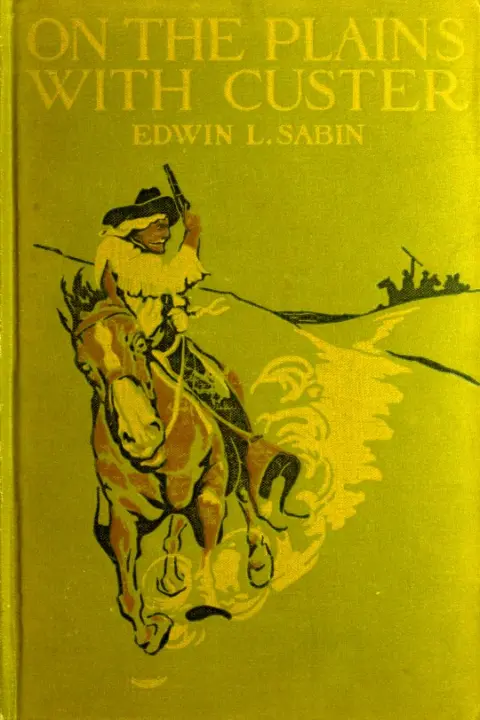
THE CLASSIC COLLECTION · 1913
"On the Plains with Custer" by Edwin L. Sabin is a historical account written in the early 20th century. The work centers around the life and experiences of the young bugler Ned Fletcher during the tumultuous years of the late 1860s and the 1870s when General George Armstrong Custer and the Seventh Cavalry played critical roles in the westward expansion of white civilization and the conflicts with Native American tribes. The narrative offers insights into both the military and everyday life on the American plains during a period of significant historical change. The opening of the book introduces us to Ned Fletcher, a young boy who has escaped from captivity with the Sioux and is navigating the vast and lonely Kansas prairie alone in search of safety and his lost sister. As he wanders, he encounters a herd of buffalo being chased by a horseman, who is revealed to be the famous General Custer. The interaction between Ned and Custer leads to a sense of hope for the boy, who expresses a desire to join the army and find his sister. The early chapters set the tone for an adventure filled with the realities of frontier life, the challenges faced by young soldiers, and the complex relations between white settlers and Native Americans, establishing the groundwork for Ned's journey alongside Custer and the Seventh Cavalry.
Introduction adapted from the source catalogue; source summaries may be automatically generated.
Free to read · English · 68,963 words · No account needed
MAKE TIME FOR A GOOD BOOK
On by default. Untick to stop anonymous reading totals. Each page counts after 10 seconds in view. How this works.
Anonymous counting is on unless you have switched it off.
“Who were the chiefs?”
“The Sioux chief was Pawnee Killer, and the Cheyenne chief was Cut Nose. I ran away from Pawnee Killer. My sister’s out with old Cut Nose’s Cheyennes, I think.”
“Where do you want to go, my boy?”
“Anywhere, so that I find my sister.”
“All right.” Colonel Custer had finished cutting out the tongue. Now he wiped his knife on the buffalo’s wool, and stood. “We’ll take you back to Riley, first. That’s where I live—Fort Riley. It isn’t far; a day’s ride. We’re out on a little scout. There comes my orderly, now. The lazy fellow! Eh, Phil?” and the handsome bay horse, thus addressed, pricked his ears. “First we leave the orderly, then we leave the dogs, and we kill a buffalo and pick up a boy! That will be something to tell the old lady when we get back.”
About this handsome, energetic army officer was an air so happy-go-lucky and boyish that Ned, another boy, found himself already loving him.
Now the orderly galloped up. He wore fatigue cap and blouse and trousers, of the regulation service blue; and by yellow braid and chevrons and the brass horn hanging from his shoulder he was a bugler.
He arrived dusty and red, his horse much blown; pulling short he saluted, trying not to stare. Colonel Custer drew himself up very tall and straight and military, surveyed him sternly and spoke gruffly—although Ned felt certain that those blue eyes held a twinkle.
“Take this boy on before you, Odell. Where’s the rest of the troop?”
“Yes, sir. Following the buffalo, sir.”
“Where have you been?”
“Trying to catch up with you, sir.”
“Oh! I see.” And as Colonel Custer turned, to his own horse, and tied the buffalo tongue to the saddle, Ned fancied not only the twinkle in the eyes but a smile under the yellow moustache.
“Well, boy, you’re to get aboard with me, the general says,” said Bugler Odell. “Give me a grip on ye and I’ll help ye up. But you ought to have coverin’ for your legs. It’s cold, ridin’. Use that blanket, now, I see lyin’ there.”
“No. I’ve got enough,” asserted Ned, eyeing the blanket fragment disdainfully. The heavy buckskin coat fell below his knees, and he was used to the cold air.
“Yes; wrap that piece of blanketing around you, or you’ll wear a hole through Odell’s saddle-skirts,” bade Colonel Custer, as he vaulted astride his own saddle.
“You hear what the general says,” reminded Bugler Odell, soberly. “Fetch the blanket and come on, now.”
Your reading position is saved on this browser. Take it to another device with a library code. Reading pages adapt to text, rather than matching a printed edition.
Edwin L. (Edwin Legrand) Sabin

Edwin L. (Edwin Legrand) Sabin

Edwin L. (Edwin Legrand) Sabin

Edwin L. (Edwin Legrand) Sabin
BEHIND THE BOOK
This eBook is for the use of anyone anywhere in the United States and most other parts of the world at no cost and with almost no restrictions whatsoever. You may copy it, give it away or re-use it under the terms of the Project Gutenberg License included with this eBook or online at www.gutenberg.org. If you are not located in the United States, you will have to check the laws of the country where you are located before using this eBook. Read the source licence.
The original source file, including credits and licence, is retained by this library. Request an original-format copy at no charge. Please include the book title and Project Gutenberg identifier #60157.
KEEP YOUR CURIOSITY GOING
Cécile Tormay

Moritz Busch
Coulson Kernahan
John L. Ransom

Maurice Baring
Frances Wright