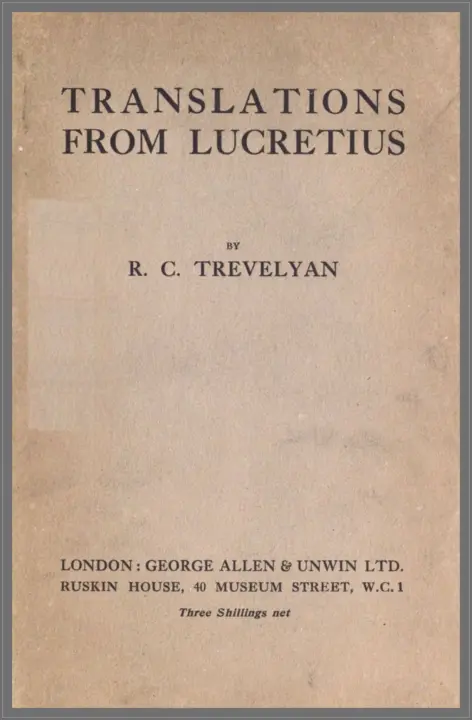
Translations from Lucretius
Titus Lucretius Carus
THE CLASSIC COLLECTION · 1921
"On the Nature of Things" by Titus Lucretius Carus is a didactic poem written in the first century BC. Spanning 7,400 verses across six books, this work aims to explain Epicurean philosophy to Roman readers through poetic language. Lucretius explores atomism, the nature of mind and soul, and celestial phenomena, arguing that the universe operates by physical principles and chance rather than divine intervention. The poem seeks to free readers from religious fear by demonstrating that natural laws, not gods, govern existence.
Introduction adapted from the source catalogue; source summaries may be automatically generated.
Free to read · English · 73,942 words · No account needed
MAKE TIME FOR A GOOD BOOK
On by default. Untick to stop anonymous reading totals. Each page counts after 10 seconds in view. How this works.
Anonymous counting is on unless you have switched it off.
Then, too, why never is the intellect,
The counselling mind, begotten in the head,
The feet, the hands, instead of cleaving still
To one sole seat, to one fixed haunt, the breast,
If not that fixed places be assigned
For each thing's birth, where each, when 'tis create,
Is able to endure, and that our frames
Have such complex adjustments that no shift
In order of our members may appear?
To that degree effect succeeds to cause,
Nor is the flame once wont to be create
In flowing streams, nor cold begot in fire.
Besides, if nature of soul immortal be,
And able to feel, when from our frame disjoined,
The same, I fancy, must be thought to be
Endowed with senses five,--nor is there way
But this whereby to image to ourselves
How under-souls may roam in Acheron.
Thus painters and the elder race of bards
Have pictured souls with senses so endowed.
But neither eyes, nor nose, nor hand, alone
Apart from body can exist for soul,
Nor tongue nor ears apart. And hence indeed
Alone by self they can nor feel nor be.
And since we mark the vital sense to be In the whole body, all one living thing, If of a sudden a force with rapid stroke Should slice it down the middle and cleave in twain, Beyond a doubt likewise the soul itself, Divided, dissevered, asunder will be flung Along with body. But what severed is And into sundry parts divides, indeed Admits it owns no everlasting nature. We hear how chariots of war, areek With hurly slaughter, lop with flashing scythes The limbs away so suddenly that there, Fallen from the trunk, they quiver on the earth, The while the mind and powers of the man Can feel no pain, for swiftness of his hurt, And sheer abandon in the zest of battle: With the remainder of his frame he seeks Anew the battle and the slaughter, nor marks How the swift wheels and scythes of ravin have dragged Off with the horses his left arm and shield; Nor other how his right has dropped away, Mounting again and on. A third attempts With leg dismembered to arise and stand, Whilst, on the ground hard by, the dying foot Twitches its spreading toes. And even the head, When from the warm and living trunk lopped off, Keeps on the ground the vital countenance And open eyes, until 't has rendered up All remnants of the soul. Nay, once again: If, when a serpent's darting forth its tongue, And lashing its tail, thou gettest chance to hew With axe its length of trunk to many parts, Thou'lt see each severed fragment writhing round With its fresh wound, and spattering up the sod, And there the fore-part seeking with the jaws After the hinder, with bite to stop the pain. So shall we say that these be souls entire In all those fractions?--but from that 'twould follow One creature'd have in body many souls. Therefore, the soul, which was indeed but one, Has been divided with the body too: Each is but mortal, since alike is each Hewn into many parts. Again, how often We view our fellow going by degrees, And losing limb by limb the vital sense; First nails and fingers of the feet turn blue, Next die the feet and legs, then o'er the rest Slow crawl the certain footsteps of cold death. And since this nature of the soul is torn, Nor mounts away, as at one time, entire, We needs must hold it mortal. But perchance If thou supposest that the soul itself Can inward draw along the frame, and bring Its parts together to one place, and so From all the members draw the sense away, Why, then, that place in which such stock of soul Collected is, should greater seem in sense. But since such place is nowhere, for a fact, As said before, 'tis rent and scattered forth, And so goes under. Or again, if now I please to grant the false, and say that soul Can thus be lumped within the frames of those Who leave the sunshine, dying bit by bit, Still must the soul as mortal be confessed; Nor aught it matters whether to wrack it go, Dispersed in the winds, or, gathered in a mass From all its parts, sink down to brutish death, Since more and more in every region sense Fails the whole man, and less and less of life In every region lingers.
Your reading position is saved on this browser. Take it to another device with a library code. Reading pages adapt to text, rather than matching a printed edition.
Titus Lucretius Carus
BEHIND THE BOOK
This eBook is for the use of anyone anywhere in the United States and most other parts of the world at no cost and with almost no restrictions whatsoever. You may copy it, give it away or re-use it under the terms of the Project Gutenberg License included with this eBook or online at www.gutenberg.org. If you are not located in the United States, you will have to check the laws of the country where you are located before using this eBook. Read the source licence.
The original source file, including credits and licence, is retained by this library. Request an original-format copy at no charge. Please include the book title and Project Gutenberg identifier #785.
KEEP YOUR CURIOSITY GOING

David Patterson (Spirit) Hatch
Coulson Kernahan

Ralph Waldo Emerson
Frances Wright

Edwin Abbott Abbott

Joseph Droz