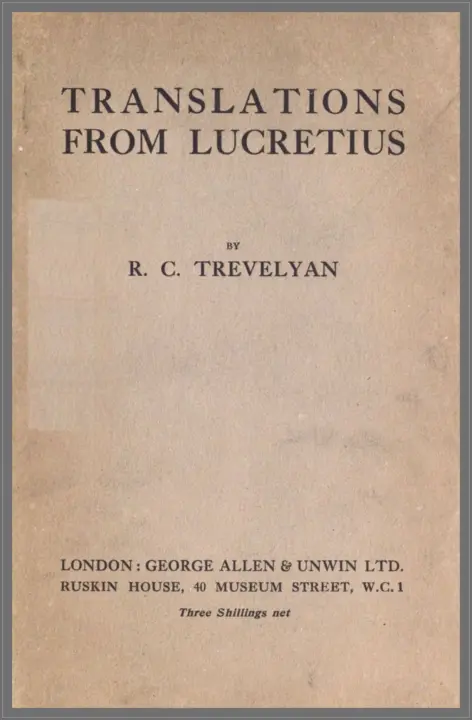
Translations from Lucretius
Titus Lucretius Carus
THE CLASSIC COLLECTION · 1921
"On the Nature of Things" by Titus Lucretius Carus is a didactic poem written in the first century BC. Spanning 7,400 verses across six books, this work aims to explain Epicurean philosophy to Roman readers through poetic language. Lucretius explores atomism, the nature of mind and soul, and celestial phenomena, arguing that the universe operates by physical principles and chance rather than divine intervention. The poem seeks to free readers from religious fear by demonstrating that natural laws, not gods, govern existence.
Introduction adapted from the source catalogue; source summaries may be automatically generated.
Free to read · English · 73,942 words · No account needed
MAKE TIME FOR A GOOD BOOK
On by default. Untick to stop anonymous reading totals. Each page counts after 10 seconds in view. How this works.
Anonymous counting is on unless you have switched it off.
Again, the body's and the mind's live powers
Only in union prosper and enjoy;
For neither can nature of mind, alone of self
Sans body, give the vital motions forth;
Nor, then, can body, wanting soul, endure
And use the senses. Verily, as the eye,
Alone, up-rended from its roots, apart
From all the body, can peer about at naught,
So soul and mind it seems are nothing able,
When by themselves. No marvel, because, commixed
Through veins and inwards, and through bones and thews,
Their elements primordial are confined
By all the body, and own no power free
To bound around through interspaces big,
Thus, shut within these confines, they take on
Motions of sense, which, after death, thrown out
Beyond the body to the winds of air,
Take on they cannot--and on this account,
Because no more in such a way confined.
For air will be a body, be alive,
If in that air the soul can keep itself,
And in that air enclose those motions all
Which in the thews and in the body itself
A while ago 'twas making. So for this,
Again, again, I say confess we must,
That, when the body's wrappings are unwound,
And when the vital breath is forced without,
The soul, the senses of the mind dissolve,--
Since for the twain the cause and ground of life
Is in the fact of their conjoined estate.
Once more, since body's unable to sustain
Division from the soul, without decay
And obscene stench, how canst thou doubt but that
The soul, uprisen from the body's deeps,
Has filtered away, wide-drifted like a smoke,
Or that the changed body crumbling fell
With ruin so entire, because, indeed,
Its deep foundations have been moved from place,
The soul out-filtering even through the frame,
And through the body's every winding way
And orifice? And so by many means
Thou'rt free to learn that nature of the soul
Hath passed in fragments out along the frame,
And that 'twas shivered in the very body
Ere ever it slipped abroad and swam away
Into the winds of air. For never a man
Dying appears to feel the soul go forth
As one sure whole from all his body at once,
Nor first come up the throat and into mouth;
But feels it failing in a certain spot,
Even as he knows the senses too dissolve
Each in its own location in the frame.
But were this mind of ours immortal mind,
Dying 'twould scarce bewail a dissolution,
But rather the going, the leaving of its coat,
Like to a snake. Wherefore, when once the body
Hath passed away, admit we must that soul,
Shivered in all that body, perished too.
Nay, even when moving in the bounds of life,
Often the soul, now tottering from some cause,
Craves to go out, and from the frame entire
Loosened to be; the countenance becomes
Flaccid, as if the supreme hour were there;
And flabbily collapse the members all
Against the bloodless trunk--the kind of case
We see when we remark in common phrase,
"That man's quite gone," or "fainted dead away";
And where there's now a bustle of alarm,
And all are eager to get some hold upon
The man's last link of life. For then the mind
And all the power of soul are shook so sore,
And these so totter along with all the frame,
That any cause a little stronger might
Dissolve them altogether.--Why, then, doubt
That soul, when once without the body thrust,
There in the open, an enfeebled thing,
Its wrappings stripped away, cannot endure
Not only through no everlasting age,
But even, indeed, through not the least of time?
Your reading position is saved on this browser. Take it to another device with a library code. Reading pages adapt to text, rather than matching a printed edition.
Titus Lucretius Carus
BEHIND THE BOOK
This eBook is for the use of anyone anywhere in the United States and most other parts of the world at no cost and with almost no restrictions whatsoever. You may copy it, give it away or re-use it under the terms of the Project Gutenberg License included with this eBook or online at www.gutenberg.org. If you are not located in the United States, you will have to check the laws of the country where you are located before using this eBook. Read the source licence.
The original source file, including credits and licence, is retained by this library. Request an original-format copy at no charge. Please include the book title and Project Gutenberg identifier #785.
KEEP YOUR CURIOSITY GOING

David Patterson (Spirit) Hatch
Coulson Kernahan

Ralph Waldo Emerson
Frances Wright

Edwin Abbott Abbott

Joseph Droz