
Why not? A book for every woman
Horatio Robinson Storer
THE CLASSIC COLLECTION · 1860
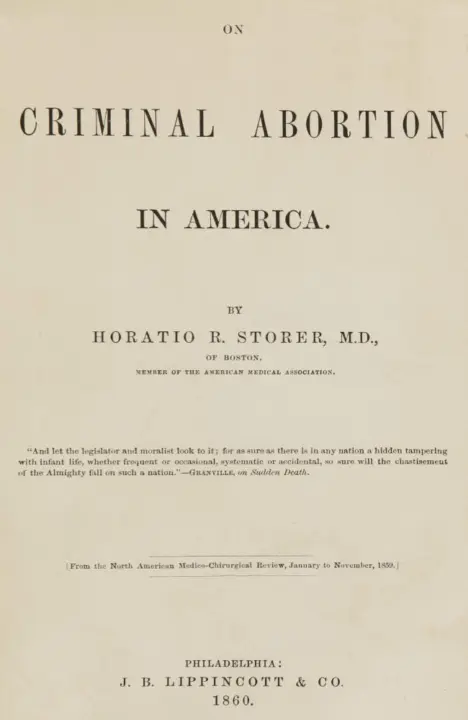
"On Criminal Abortion in America" by Horatio Robinson Storer is a medical treatise written in the mid-19th century. The work critically examines the legal and moral issues surrounding abortion, highlighting its perceived status as a crime against fetal life that has largely been overlooked by existing laws. Storer argues for the need for a more robust legal framework that reflects society's moral responsibilities toward both mothers and their unborn children. The opening of the text lays the groundwork for a detailed investigation into the complexities and frequency of criminal abortion, outlining the initial assumptions and subsequent arguments necessary for the discourse. Storer addresses the legal ambiguities surrounding abortion, emphasizing that common law and many state codes largely ignore fetal life, positioning the crime as one primarily against the mother. He goes on to assert the necessity of evaluating the frequency and consequences of this practice, suggesting that the medical community has a pivotal role in shaping public sentiment and legal standards regarding abortion. Storer prepares the reader for an exploration of both the legislative deficiencies and the ethical imperative for medical professionals and society as a whole to confront this "great opprobrium of the law."
Introduction adapted from the source catalogue; source summaries may be automatically generated.
Free to read · English · 45,185 words · No account needed
MAKE TIME FOR A GOOD BOOK
On by default. Untick to stop anonymous reading totals. Each page counts after 10 seconds in view. How this works.
Anonymous counting is on unless you have switched it off.
[234] Rex vs. Scudder, 1 MOODY, 216, 3 CAR. & P., 605, overruling Rex vs. Phillips, 3 CAMPBELL, 73; RUSSELL, Cr., 763, note.
[235] If made without her consent?
[236] Regina vs. Goodchild, 2 CAR. & KIR., 293; Rex vs. Goodhall, 1 DEN. C. C., 187; 3 CAMPBELL, 76.
[237] 1 BISHOP, Crim. Law, 518.
[238] 1 BISHOP, Crim. Law, 385.
[239] WHARTON, Crim. Law, 541.
[240] 1 HARRIS, Pa., 631, 633.
[241] LEE, Note to Guy’s Principles of Forensic Medicine, p. 134.
[242] BECCARIA, Crimes and Punishments, 104.
[243] “An efficient, and practical remedy for the prevention of this crime would be a law requiring the causes of death to be certified by the physician in attendance, or where there has been no physician, by one called in for the purpose. In this way the cause of death, both in infants and mothers, could be traced to attempts to procure abortion. In three cases which occurred in Boston, in 1855, the death was reported by friends to be owing to natural causes, and in each it was subsequently ascertained that the patient died in consequence of injuries received in procuring abortion. It is probable that such cases are by no means rare; and if the cause of death were known, an immediate investigation might lead to the detection of the guilty party.” (Boston Med. and Surg. Journal, Dec., 1857, p. 365.)
[244] Register of the Morgue.
[245] From 1846 to 1850, 188 cases of criminal abortion were discovered in Paris, but for want of proof, only 22 of them were sent to trial. (Comptes Rendus Ann. de la Justice Criminelle.)
[246] Report on the Medico-legal duties of Coroner. 1857.
[247] RADFORD, British Record of Obstetric Medicine, vol. i. p. 55.
[248] WHARTON, Criminal Law, 540.
[249] Smith vs. The State, 33 MAINE, (3 RED.) 48.
[250] Rex vs. Phillips; Regina vs. Goodall; Reg. vs. Haynes, etc.
[251] TAYLOR, Med. Jurisprudence, p. 386.
[252] PERCIVAL, Medical Ethics, p. 84.
[253] Ibid., p. 85.
[254] Loc. cit., article 317.
[255] Report to Suffolk District Med. Society, May, 1857, p. 12.
[256] In this connection, I cannot too strongly deprecate a practice that has lately been proposed, the detection, namely, of the early existence of pregnancy by the administration of ergot. (Boston Med. and Surg. Journal, April, 1859, p. 197.) The use of ergot for this purpose, in however small a dose, would seem utterly unjustifiable.
[257] Fifteenth Massachusetts Registration Report, 1857, p. 199.
[258] QUETELET, Theory of Probabilities, p. 234.
[259] New York Med. Gazette, Editorial; London Medical Times and Gazette,
1850, p. 487.
[260] Boston Med. and Surg. Journal, Editorial, 1855, p. 411.
[261] DEAN, Medical Jurisprudence, p. 139.
[262] Boston Med. and Surg. Journal, Editorial, Dec. 13, 1855.
[263] American Medical Gazette, Editorial, July, 1857, p. 390.
[264] Ibid., April 1859, p. 289.
[265] Maine Med. and Surg. Reporter, Editorial, June, 1858, p. 39.
[266] DEVILLE, Researches on the proportion of still-born children compared with the mortality of the City of Paris during the thirteen years, 1846-58. Memoirs of the French Academy, 1859.
[267] New Hampshire Journal of Medicine, Editorial, July, 1857, p. 216.
[268] London Lancet, Editorial, July, 1858, p. 66.
[269] TATUM, Virginia Med. Journal, June, 1856, p. 457.
[270] Loc. cit., p. 19.
Your reading position is saved on this browser. Take it to another device with a library code. Reading pages adapt to text, rather than matching a printed edition.
Horatio Robinson Storer
BEHIND THE BOOK
This eBook is for the use of anyone anywhere in the United States and most other parts of the world at no cost and with almost no restrictions whatsoever. You may copy it, give it away or re-use it under the terms of the Project Gutenberg License included with this eBook or online at www.gutenberg.org. If you are not located in the United States, you will have to check the laws of the country where you are located before using this eBook. Read the source licence.
The original source file, including credits and licence, is retained by this library. Request an original-format copy at no charge. Please include the book title and Project Gutenberg identifier #65244.
KEEP YOUR CURIOSITY GOING

David Patterson (Spirit) Hatch
Cécile Tormay

Moritz Busch
Coulson Kernahan
John L. Ransom

Ralph Waldo Emerson