THE CLASSIC COLLECTION✦An outlaw’s diary: the CommuneCLASSIC FREE BOOKS
An outlaw’s diary: the Commune
Cécile Tormay
THE CLASSIC COLLECTION · 1922
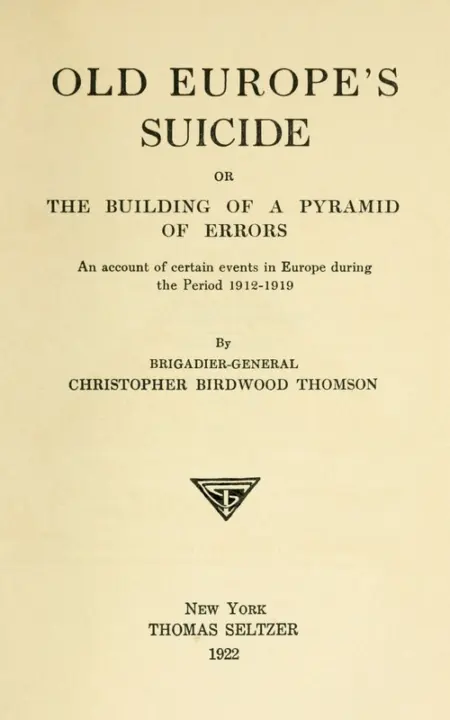
"Old Europe's Suicide; or, The Building of a Pyramid of Errors" by Brigadier-General Christopher Birdwood Thomson is a historical account written in the early 20th century. The book examines the tumultuous events in Europe from 1912 to 1919, with a particular focus on the Balkan Wars and the subsequent peace negotiations at Versailles. Thomson’s unique perspective as an eyewitness provides insight into the political missteps and societal conflicts that he argues led to the downfall of the Central Empires. The opening of the work establishes Thomson's credentials and intentions as an author. He reflects on his experiences during significant military campaigns and transitions into a commentary on the lead-up to World War I. Recognizing the intricate interplay of national ambitions and historical injustices, he draws attention to the underlying tensions in the Balkans and their catastrophic consequences for Europe. Using evocative metaphors, he likens the series of miscalculations and fervent nationalistic policies during this era to a pyramid of errors, suggesting that the conflicts of the time were not isolated incidents, but rather manifestations of deeper systemic failures. Thomson aims to dissect these events to advocate for a more enlightened approach to international relations, appealing to society’s conscience and the importance of informed decision-making in politics.
Introduction adapted from the source catalogue; source summaries may be automatically generated.
Free to read · English · 53,032 words · No account needed
MAKE TIME FOR A GOOD BOOK
On by default. Untick to stop anonymous reading totals. Each page counts after 10 seconds in view. How this works.
Anonymous counting is on unless you have switched it off.
[34] The River Pruth defines part of the frontier between Rumania and Bessarabia and enters the Danube at Galatz.
[35] About 60 per cent. of the supplies of ammunition sent by the Western Powers to Rumania were lost or stolen in transit through Russia.
[36] These Articles prescribed the position of the King of Rumania as Commander-in-Chief of all forces in Rumanian territory. After the retreat into Moldavia, advantage was taken of the somewhat inexplicit character of these Articles and the preponderance of Russian troops to place King Ferdinand under the orders of the Czar.
[37] The former German Minister to Bucharest.
[38] “Kyrie Eleison,” the Greek for “Lord have mercy on us,” described by Cardinal Wiseman as “that cry for mercy which is to be found in every liturgy of East and West.”
[39] Marasesti is a village in the Sereth Valley, where six Rumanian divisions repelled repeated assaults by numerically superior German and Austro-Hungarian forces under Field-Marshal Mackensen. The Rumanians fought unsupported and caused 100,000 casualties in the enemy ranks. They held their positions until the signature of peace at Bucharest.
[40] General Nivelles.
[41] To Paris.
[42] To Berlin.
[43] Speech of April 2nd, 1917.
[44] Message of December 4th, 1917.
[45] Declaration of September 27th, 1918.
[46] In a speech at Birmingham University on December 12, 1918, Lord Robert Cecil said: “Our new ‘Society of Nations’ must not be a group, however large and important. It is absolutely essential that the ‘League of Nations’ should be open to every nation which can be trusted by its fellows to accept ‘ex animo,’ the principles and basis of such a Society.”
[47] In the original--
“Sceptre and crown will tumble down,
And in the level dust be laid,” etc.
[48] The former Austro-Hungarian Foreign Office in Vienna.
[49] During the Conference, a well-known Pole, whose reputation for shrewd observation is established, remarked: “Mr. Lloyd George has a passion for popularity and is the most popular man in Paris, but the ‘Tiger’ is running the British Empire.”
[50] The ideal is reached for a moment only.
Transcriber’s Notes
Punctuation, hyphenation, and spelling were made consistent when a predominant preference was found in this book; otherwise they were not changed.
Simple typographical errors were corrected; occasional unbalanced
quotation marks retained.
Ambiguous hyphens at the ends of lines were retained.
Text uses both “Fraternalization” and “Fraternization”.
Page 133: “were” was missing in “Fundamentally, they were wrong”;
changed here.
Page 150: “battles are not merely battues” was printed that way, and may have been intentional.
Page 175: “bass-relief” was printed that way.
Page 188: “nobless oblige” was printed that way.
Footnote 2, originally Footnote 1 on page 20: “Enos-Midia line” appeared to have been misprinted as “Encs-Midia line”; changed here.
Your reading position is saved on this browser. Take it to another device with a library code. Reading pages adapt to text, rather than matching a printed edition.
BEHIND THE BOOK
This eBook is for the use of anyone anywhere in the United States and most other parts of the world at no cost and with almost no restrictions whatsoever. You may copy it, give it away or re-use it under the terms of the Project Gutenberg License included with this eBook or online at www.gutenberg.org. If you are not located in the United States, you will have to check the laws of the country where you are located before using this eBook. Read the source licence.
The original source file, including credits and licence, is retained by this library. Request an original-format copy at no charge. Please include the book title and Project Gutenberg identifier #53464.
KEEP YOUR CURIOSITY GOING
Cécile Tormay

Moritz Busch
John L. Ransom
Frances Wright
Cécile Tormay

Mabel Potter Daggett