THE CLASSIC COLLECTION✦An outlaw’s diary: the CommuneCLASSIC FREE BOOKS
An outlaw’s diary: the Commune
Cécile Tormay
THE CLASSIC COLLECTION · 1922
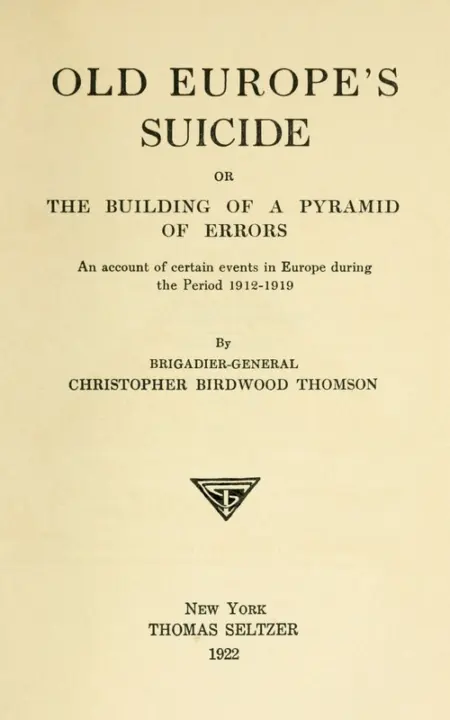
"Old Europe's Suicide; or, The Building of a Pyramid of Errors" by Brigadier-General Christopher Birdwood Thomson is a historical account written in the early 20th century. The book examines the tumultuous events in Europe from 1912 to 1919, with a particular focus on the Balkan Wars and the subsequent peace negotiations at Versailles. Thomson’s unique perspective as an eyewitness provides insight into the political missteps and societal conflicts that he argues led to the downfall of the Central Empires. The opening of the work establishes Thomson's credentials and intentions as an author. He reflects on his experiences during significant military campaigns and transitions into a commentary on the lead-up to World War I. Recognizing the intricate interplay of national ambitions and historical injustices, he draws attention to the underlying tensions in the Balkans and their catastrophic consequences for Europe. Using evocative metaphors, he likens the series of miscalculations and fervent nationalistic policies during this era to a pyramid of errors, suggesting that the conflicts of the time were not isolated incidents, but rather manifestations of deeper systemic failures. Thomson aims to dissect these events to advocate for a more enlightened approach to international relations, appealing to society’s conscience and the importance of informed decision-making in politics.
Introduction adapted from the source catalogue; source summaries may be automatically generated.
Free to read · English · 53,032 words · No account needed
MAKE TIME FOR A GOOD BOOK
On by default. Untick to stop anonymous reading totals. Each page counts after 10 seconds in view. How this works.
Anonymous counting is on unless you have switched it off.
[1] The Ergene is a tributary of the Maritza and lies in Turkish Thrace.
[2] On the Enos-Midia line, thus leaving Constantinople in Turkish hands with a small hinterland in Europe.
[3] Santa Sofia.
[4] “It is the liquidation of Austria.”
[5] Austro-Hungarian Foreign Office in Vienna.
[6] Turkish statistics: There is good reason to believe that these figures were approximately correct; it is most improbable, in any case, that the Turks would have exaggerated the number of Bulgars in this vilayet.
[7] A bay in the Eastern Mediterranean Coast to which a British
squadron was sent whenever it was necessary to put pressure on the
Turks.
[8] “The Great Powerless.”
[9] “Don’t touch the Adriatic.”
[10] Austria-Hungary.
[11] “An accomplished fact.”
[12] That is a big nothing.
[13] Baron Burian, afterwards Count Burian, a prominent Austro-Hungarian diplomat both before and during the war.
[14] Count Albert Mensdorff, Austro-Hungarian Ambassador in London for
15 years.
[15] A place close to and just outside the S.W. frontier of Bulgaria, where the Bulgars resisted the combined attacks of the Servian and Greek armies for 14 days.
[16] “A Cascade of Thrones.” The title of a series of articles published by M. Take Jonescu in 1915.
[17] “Balkan haggling.”
[18] See map.
[19] “The Thrust to the East.”
[20] Loans are made only to the rich.
[21] Count Tisza, leader of the Hungarian Conservatives and ultimately assassinated in Budapest by a Hungarian Socialist.
[22] Abandon Austria and we will abandon the French.
[23] The opportune moment.
[24] The father of M. Bratiano was the celebrated Rumanian patriot who, in 1878, was tricked out of Bessarabia by Prince Gortchakoff, the Russian Envoy, at the Treaty of Vienna.
[25] Count Czernin was at this period Austro-Hungarian Minister in Bucharest; he succeeded Count Berchtold as Chancellor in the Dual Monarchy after the death of the Emperor Francis Joseph.
[26] An Hungarian province at the confluence of the Danube and the
Theiss, N.E. of Belgrade.
[27] In the war of 1877 between Russia and Turkey, Rumania had come to the rescue of Russia when the Russian army was held up by the Turks under Osman Pasha at Plevna.
[28] The husband of Francesca da Rimini, who killed his wife and her
lover.
[29] The French General commanding the Allied Forces at Salonika.
[30] Baron von der Büsche; he became later Under-Secretary of State in the Foreign Office at Berlin.
[31] The River Sereth divides Wallachia from Moldavia.
[32] Presan was one of Rumania’s ablest generals; he had commanded the Northern Army at the commencement of hostilities, and was entrusted with the direction of the operations for the defence of Bucharest. After the retreat into Moldavia he became Chief of Staff to the King.
[33] Dorna Vatra is a town in the Carpathians on the S.W. frontier of
Bukovina.
Your reading position is saved on this browser. Take it to another device with a library code. Reading pages adapt to text, rather than matching a printed edition.
BEHIND THE BOOK
This eBook is for the use of anyone anywhere in the United States and most other parts of the world at no cost and with almost no restrictions whatsoever. You may copy it, give it away or re-use it under the terms of the Project Gutenberg License included with this eBook or online at www.gutenberg.org. If you are not located in the United States, you will have to check the laws of the country where you are located before using this eBook. Read the source licence.
The original source file, including credits and licence, is retained by this library. Request an original-format copy at no charge. Please include the book title and Project Gutenberg identifier #53464.
KEEP YOUR CURIOSITY GOING
Cécile Tormay

Moritz Busch
John L. Ransom
Frances Wright
Cécile Tormay

Mabel Potter Daggett