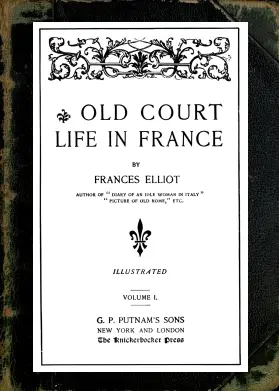
Old Court Life in France, vol. 2/2
Frances Minto Dickinson Elliot
THE CLASSIC COLLECTION · 1893
"Old Court Life in France" by Frances Minto Dickinson Elliot is a historical account written in the late 19th century. The work explores the intricate dynamics of the French royal court from the reign of Francis I to Louis XIV, focusing on the relationships, politics, and intrigues that defined this opulent era. The book delves into the lives of significant figures, including monarchs and their favorites, providing insightful anecdotes that shape the narrative of the time. The opening of the text introduces us to the vibrant backdrop of 16th-century France, emphasizing the cultural and political landscape influenced by the Reformation and the Italian Renaissance. We are introduced to the ambitious Francis I, whose court is alive with art, architecture, and the complexity of personal relationships. The detailed portrayal of court life, alongside Francis's character and his interactions with family members and contemporaries, sets expectations for a rich tapestry of historical drama to unfold. The introduction promises an exploration of how personal ambitions and emotional ties intertwine with the broader historical currents of the time.
Introduction adapted from the source catalogue; source summaries may be automatically generated.
Free to read · English · 86,955 words · No account needed
MAKE TIME FOR A GOOD BOOK
On by default. Untick to stop anonymous reading totals. Each page counts after 10 seconds in view. How this works.
Anonymous counting is on unless you have switched it off.
The next scene is in Italy. The French army lies encamped on the broad plains of Lombardy, backed by snowy lines of Alpine fastnesses.
Bonnivet, in command of the French, presumptuous and inexperienced, has been hitherto defeated in every battle. Bourbon, fighting on the side of Spain, is, as before, victorious.
Francis, stung by the repeated defeat of his troops, has now joined the army, and commands in person. Milan, where the plague rages, has opened its gates to him; but Pavia, distant about twenty miles, is occupied by the Spaniards in force. Antonio de Leyva is governor. Thither the French advance in order to besiege the city.
The open country is defended by the Spanish forces under Bourbon. Francis, maddened by the presence of his cousin, rushes onward. Montmorenci and Bonnivet, flatterers both, assure him that victory is certain by means of a coup de main.
It is night; the days are short, for it is February. The winter moon lights up the rich meadow lands divided by the broad Ticino and broken by the deep ditches and sluggish streams which surround the city. Tower, campanile, dome, and turret, with here and there the grim façade of a mediæval palace, stand out in the darkness.
Yonder among the meadows are the French, darkening the surrounding plain. Francis knows that the Constable is advancing to support the garrison of Pavia, and he desires to carry the city by assault before his arrival. Ever too rash, and now excited by a passionate sense of injury, Francis, with D’Alençon, De la Trémouille, De Foix, and Bonnivet, leads the attack at the head of his cavalry. Now he is under the very walls. Despite the dim moonlight, no one can mistake him. He wears a suit of steel armour inlaid with gold; a crimson surcoat, embroidered with gilt “F’s”; a helmet encircled by a jewelled crown, out of which rises a yellow plume and golden salamander. For an instant success seems certain; the scaling-ladders thick with soldiers are already planted against the lowest walls, and the garrison retreats under cover of the bastions. A sudden panic seizes the troops beneath, who are to support the assault. In the treacherous moonlight they have fallen into confusion among the deep, slimy ditches; many are drifted away in the current of the great river. A murderous cannonade from the city walls now opens on the assailants and on the cavalry. Francis falls back. The older generals conjure him to retreat and raise the siege before the arrival of Bourbon, but, backed by Bonnivet and Montmorenci, he will not hear of it. The battle rages during the night. The morning light discovers the Spaniards commanded by Bourbon and Pescara, with the whole strength of their army, close under the walls. Again the King leads a fresh assault--a forlorn hope, rather. He fights desperately; the yellow plumes of his helmet wave hither and thither as his horse dashes wildly from side to side amidst the smoke, in the thickest of the battle. See, for an instant he falters,--he is wounded and bleeding. He recovers, however, and again clapping spurs to his horse, scatters his surrounding foes; six have already fallen by his hand. Look! his charger is pierced by a ball and falls with his rider. After a desperate struggle the King extricates himself; now on foot, he still fights furiously. Alas! it is in vain. Every moment his enemies thicken around him, pressing closer and closer. His gallant followers drop one by one under the unerring aim of the Basque marksmen. La Trémouille has fallen. De Foix lies a corpse at his feet. Bonnivet in despair expiates his evil counsel by death.[4] Every shot takes from him one of the pillars of his throne. Francis flings himself wildly on the points of the Spanish pikes. The Royal Guards fall like summer grass before the sickle; but where the King stands, still dealing desperate blows, the bodies of the slain form a rampart of protection around him. His very enemies stand back amazed at such furious courage. While he struggles for his life hand to hand with D’Avila and D’Ovietta, plumeless, soiled, and bloody, a loud cry rises from a thousand voices--“It is the King--LET HIM SURRENDER--Capture the King!” There is a dead silence; the Spanish troops fall back. A circle is formed round the now almost fainting Francis, who lies upon the blood-stained earth. De Pompérant advances. He kneels before the master whom he has betrayed, he implores him to yield to Bourbon.
Your reading position is saved on this browser. Take it to another device with a library code. Reading pages adapt to text, rather than matching a printed edition.
Frances Minto Dickinson Elliot
BEHIND THE BOOK
This eBook is for the use of anyone anywhere in the United States and most other parts of the world at no cost and with almost no restrictions whatsoever. You may copy it, give it away or re-use it under the terms of the Project Gutenberg License included with this eBook or online at www.gutenberg.org. If you are not located in the United States, you will have to check the laws of the country where you are located before using this eBook. Read the source licence.
The original source file, including credits and licence, is retained by this library. Request an original-format copy at no charge. Please include the book title and Project Gutenberg identifier #50218.
KEEP YOUR CURIOSITY GOING
Cécile Tormay

Moritz Busch
John L. Ransom
Frances Wright
Cécile Tormay

Mabel Potter Daggett