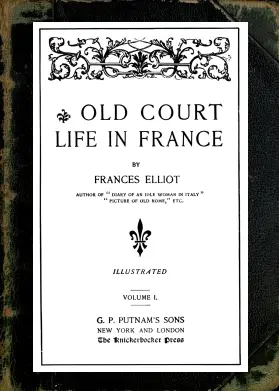
Old Court Life in France, vol. 2/2
Frances Minto Dickinson Elliot
THE CLASSIC COLLECTION · 1893
"Old Court Life in France" by Frances Minto Dickinson Elliot is a historical account written in the late 19th century. The work explores the intricate dynamics of the French royal court from the reign of Francis I to Louis XIV, focusing on the relationships, politics, and intrigues that defined this opulent era. The book delves into the lives of significant figures, including monarchs and their favorites, providing insightful anecdotes that shape the narrative of the time. The opening of the text introduces us to the vibrant backdrop of 16th-century France, emphasizing the cultural and political landscape influenced by the Reformation and the Italian Renaissance. We are introduced to the ambitious Francis I, whose court is alive with art, architecture, and the complexity of personal relationships. The detailed portrayal of court life, alongside Francis's character and his interactions with family members and contemporaries, sets expectations for a rich tapestry of historical drama to unfold. The introduction promises an exploration of how personal ambitions and emotional ties intertwine with the broader historical currents of the time.
Introduction adapted from the source catalogue; source summaries may be automatically generated.
Free to read · English · 86,955 words · No account needed
MAKE TIME FOR A GOOD BOOK
On by default. Untick to stop anonymous reading totals. Each page counts after 10 seconds in view. How this works.
Anonymous counting is on unless you have switched it off.
“It is to prepare you for an unexpected event that I wish to talk to you. It is possible that I may shortly leave Compiègne suddenly and secretly. I must tear myself away from you for a while.”
“Leave the Court, Sire! What do you mean?”
“The quarrels between my mother and Richelieu are more than I can endure. They must end. One must go--I will not say which. You can guess. I am assured by Richelieu, who has information from all parts of France, that her Majesty is hated by the people. She is suspected of a knowledge of my great father’s death; she has abused her position. No one feels any interest in her fate.”
“But, surely, your Majesty feels no pleasure in knowing that it is so, even if it be true, which I much doubt.”
“Well, her Majesty has deserved little favour of me,” replied he with indifference. “Richelieu tells me that her exile would be a popular act----”
“Her exile, Sire! You surely do not contemplate the exile of your own
mother?”
“Possibly not--possibly not; but a sovereign must be advised by his ministers. It is indispensable to the prosperity of the State.”
Mademoiselle de Hautefort was silent, but something of the contempt she felt might have been seen in her expressive eyes.
“I do not feel disposed,” continued he, “to face the anger of the Queen-mother when she hears my determination. She would use violent language to me that might make me forget I am her son. Richelieu must break it to her. He can do it while I am away. Agitation injures my health, it deranges my digestion. I have enough to bear from my wife, from whom it is not so easy to escape----”
Again he stopped abruptly, as if he were about to say more than he
intended.
Mademoiselle de Hautefort, ever on the lookout for all that concerned her mistress the Queen, glanced at him with sullen curiosity. Her eyes read his thoughts.
“Your Majesty is concealing something from me?” she said.
“Well, yes,”--and he hesitated--“it is a subject too delicate to
mention.”
“Have you, then, withdrawn your confidence from me, Sire?” asked she, affecting the deepest concern.
“No, no--never. I tell you everything--yet, I blush to allude to such a
subject.”
“What subject, Sire? Does it concern her Majesty?”
“By heaven it does!” cried the King, with unwonted excitement, a look of rage on his face. “It is said--” and he stopped, and looked round suspiciously, and became crimson. “Not here--not here,” he muttered, rising. “I cannot speak of it here. It is too public. Come with me into this closet.”
Your reading position is saved on this browser. Take it to another device with a library code. Reading pages adapt to text, rather than matching a printed edition.
Frances Minto Dickinson Elliot
BEHIND THE BOOK
This eBook is for the use of anyone anywhere in the United States and most other parts of the world at no cost and with almost no restrictions whatsoever. You may copy it, give it away or re-use it under the terms of the Project Gutenberg License included with this eBook or online at www.gutenberg.org. If you are not located in the United States, you will have to check the laws of the country where you are located before using this eBook. Read the source licence.
The original source file, including credits and licence, is retained by this library. Request an original-format copy at no charge. Please include the book title and Project Gutenberg identifier #50218.
KEEP YOUR CURIOSITY GOING
Cécile Tormay

Moritz Busch
John L. Ransom
Frances Wright
Cécile Tormay

Mabel Potter Daggett