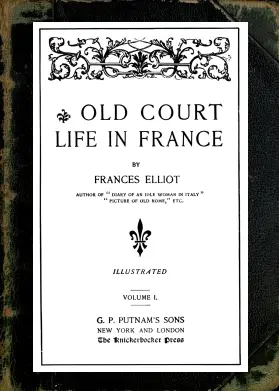
Old Court Life in France, vol. 2/2
Frances Minto Dickinson Elliot
THE CLASSIC COLLECTION · 1893
"Old Court Life in France" by Frances Minto Dickinson Elliot is a historical account written in the late 19th century. The work explores the intricate dynamics of the French royal court from the reign of Francis I to Louis XIV, focusing on the relationships, politics, and intrigues that defined this opulent era. The book delves into the lives of significant figures, including monarchs and their favorites, providing insightful anecdotes that shape the narrative of the time. The opening of the text introduces us to the vibrant backdrop of 16th-century France, emphasizing the cultural and political landscape influenced by the Reformation and the Italian Renaissance. We are introduced to the ambitious Francis I, whose court is alive with art, architecture, and the complexity of personal relationships. The detailed portrayal of court life, alongside Francis's character and his interactions with family members and contemporaries, sets expectations for a rich tapestry of historical drama to unfold. The introduction promises an exploration of how personal ambitions and emotional ties intertwine with the broader historical currents of the time.
Introduction adapted from the source catalogue; source summaries may be automatically generated.
Free to read · English · 86,955 words · No account needed
MAKE TIME FOR A GOOD BOOK
On by default. Untick to stop anonymous reading totals. Each page counts after 10 seconds in view. How this works.
Anonymous counting is on unless you have switched it off.
“Ah!” exclaimed Gabrielle, her eyes sparkling with enthusiasm, “if some second Agnes Sorel would but appear, and, making like her a noble use of the King’s love and her influence, incite him to conquer himself, to forsake all follies, and to devote his great talents in fighting heart and soul against the rebels and the League!”
“Alas!” sighed Don Juan, “those were the early ages; such love as that is not to be found now--it is a dream, a fantasy. Henry will find no Agnes Sorel in these later days.”
“Say not so, noble Don,” replied Gabrielle; “I for my part adore the King--I long to know him.”
The Spaniard’s eyes flashed, and Bellegarde started visibly.
“Love,” continued Gabrielle, flushing with excitement, “love is of all times and of all seasons. True love is immortal. But I allow that it is rare, though not impossible, to excite such a passion.”
“If it is a science to be learnt, will you teach me, fair lady?” asked the Spaniard tenderly.
At this turn in the conversation Bellegarde again became painfully agitated, and the subject dropped. The Don now addressed his conversation to the sisters of Gabrielle, and at their request took up the lute and sang an improvised song with considerable taste, in a fine manly voice, which gained for him loud applauses all around. The words were these:
“Charmante Gabrielle,
Percé de mille dards,
Quand la gloire m’appelle
A la suite de Mars,
Cruelle départie.
Que ne suis-je sans vie
Ou sans amour?”
Gabrielle looked, perhaps, a trifle too much pleased at the somewhat free admiration expressed in these verses, and spite of Bellegarde, approached the Don to thank him after he had finished.
“Lady, did my song please you?” said he softly, trying to kiss her hand. “If it had any merit you inspired me.”
“Yes,” replied she musingly. “You wished just now you were my prisoner. Had you been, I should long ago have freed you if you had sung to me like that, I am sure.”
“And why?” asked he.
“Because you have something in your voice I should have feared to hear too often,” said she in a low voice, lest Bellegarde should hear her.
“Then in that case I would always have remained your voluntary captive,
ma belle.”
How long this conversation might have continued authorities do not state; but Bellegarde, now really displeased, approached the whispering pair, giving an indignant glance at Gabrielle and a look full of reproach at the Don.
“Come, come, Don Juan!” said he. “It is time to go. Where are our horses? The day wears on, we shall scarce reach the camp ere sundown.”
Your reading position is saved on this browser. Take it to another device with a library code. Reading pages adapt to text, rather than matching a printed edition.
Frances Minto Dickinson Elliot
BEHIND THE BOOK
This eBook is for the use of anyone anywhere in the United States and most other parts of the world at no cost and with almost no restrictions whatsoever. You may copy it, give it away or re-use it under the terms of the Project Gutenberg License included with this eBook or online at www.gutenberg.org. If you are not located in the United States, you will have to check the laws of the country where you are located before using this eBook. Read the source licence.
The original source file, including credits and licence, is retained by this library. Request an original-format copy at no charge. Please include the book title and Project Gutenberg identifier #50218.
KEEP YOUR CURIOSITY GOING
Cécile Tormay

Moritz Busch
John L. Ransom
Frances Wright
Cécile Tormay

Mabel Potter Daggett