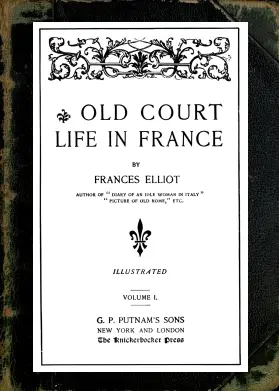
Old Court Life in France, vol. 2/2
Frances Minto Dickinson Elliot
THE CLASSIC COLLECTION · 1893
"Old Court Life in France" by Frances Minto Dickinson Elliot is a historical account written in the late 19th century. The work explores the intricate dynamics of the French royal court from the reign of Francis I to Louis XIV, focusing on the relationships, politics, and intrigues that defined this opulent era. The book delves into the lives of significant figures, including monarchs and their favorites, providing insightful anecdotes that shape the narrative of the time. The opening of the text introduces us to the vibrant backdrop of 16th-century France, emphasizing the cultural and political landscape influenced by the Reformation and the Italian Renaissance. We are introduced to the ambitious Francis I, whose court is alive with art, architecture, and the complexity of personal relationships. The detailed portrayal of court life, alongside Francis's character and his interactions with family members and contemporaries, sets expectations for a rich tapestry of historical drama to unfold. The introduction promises an exploration of how personal ambitions and emotional ties intertwine with the broader historical currents of the time.
Introduction adapted from the source catalogue; source summaries may be automatically generated.
Free to read · English · 86,955 words · No account needed
MAKE TIME FOR A GOOD BOOK
On by default. Untick to stop anonymous reading totals. Each page counts after 10 seconds in view. How this works.
Anonymous counting is on unless you have switched it off.
“Sire, they mourn over the approaching extinction of your race.”
“Heaven preserve us!” answers the King, with affected consternation, caressing his puppies. “But tell me now, if you have any knowledge, what do the celestial powers think of those accursed rebels, the Leaguers, and their chief, the Duc de Mayenne? Is that bold traitor in favour among the stars?”
Osman does not at once reply; but, advancing to the window, throws open the sash, and silently observes the heavens.
“Sire, I see one star shining brightly in the firmament.”
“Where?” asks the King.
“Just over the Camp of Meudon, where Henry of Navarre lies this night. But look, your Majesty, at that other star there over the woods. It blazes for a moment; and now, see--it falls; it has disappeared behind the palace!”
“By the mother of God,” says the King, reddening either with terror or passion, “I have had enough of this gibberish. Hark ye, you wandering Jew! no more of these ugly portents, or, by St. Louis, the guardian of our race, we will hold you warrant for all that may happen to our person.”
Osman shrunk back from the window, trembling with fright. He does not wait for permission to depart, but as the King rises to address some gentlemen he glides from the gallery.
“If ever I heard a voice hoarse with blood, it is his,” mutters the astrologer, pointing to the King as he crept away. “By the brightness of the celestial bodies, there will be evil this night. I will never draw horoscope more, if to-morrow’s sun finds Henry of Valois alive. There is blood on him, but he sees it not. His star has fallen, he beheld it; but he understood not the portent.”
As Osman crosses the circular hall opening from the gallery and leading to the principal staircase, he meets the Comte d’Auvergne[18] conversing with a Dominican monk, whose sinister countenance expressed every evil passion. A crowd of attendants had assembled and are listening to the conversation.
“Good father,” says M. d’Auvergne, addressing the Dominican, “you must not, at this late hour, insist on seeing his Majesty; he is engaged.”
“But, indeed, monseigneur, I do insist upon seeing him without a moment’s delay, and alone. It is on a matter of life and death.” The monk’s bold words and determined bearing evidently impress M. d’Auvergne in his favour.
“Are you the bearer of any despatches for his Majesty?” he asks. “Those might be delivered, although his Majesty has just retired and is at this moment in his oratory, busy with his devotions.”
Your reading position is saved on this browser. Take it to another device with a library code. Reading pages adapt to text, rather than matching a printed edition.
Frances Minto Dickinson Elliot
BEHIND THE BOOK
This eBook is for the use of anyone anywhere in the United States and most other parts of the world at no cost and with almost no restrictions whatsoever. You may copy it, give it away or re-use it under the terms of the Project Gutenberg License included with this eBook or online at www.gutenberg.org. If you are not located in the United States, you will have to check the laws of the country where you are located before using this eBook. Read the source licence.
The original source file, including credits and licence, is retained by this library. Request an original-format copy at no charge. Please include the book title and Project Gutenberg identifier #50218.
KEEP YOUR CURIOSITY GOING
Cécile Tormay

Moritz Busch
John L. Ransom
Frances Wright
Cécile Tormay

Mabel Potter Daggett