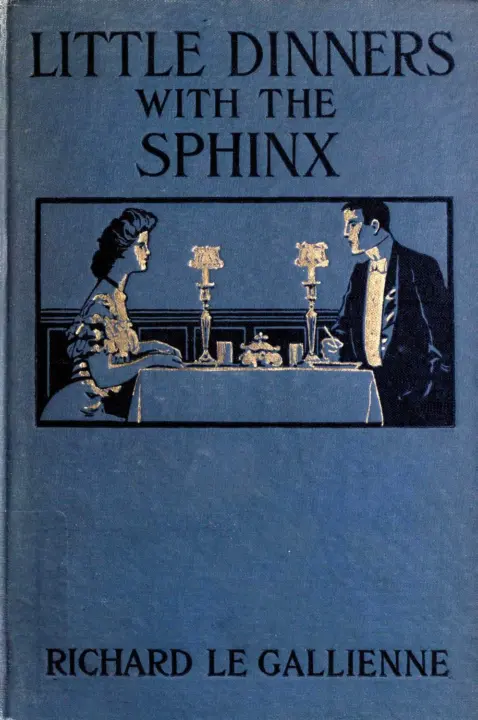
Little Dinners With the Sphinx, and Other Prose Fancies
Richard Le Gallienne
THE CLASSIC COLLECTION · 1910
"October Vagabonds" by Richard Le Gallienne is a collection of poetic reflections and observations written during the early 20th century. The book captures the essence of nature and the transition from summer to autumn as experienced by the narrator and his companion Colin, who seek solace and meaning in the quiet beauty of their surroundings. Through a series of thematic essays, the author explores themes of solitude, friendship, artistry, and the deep connection between humans and nature, evoking a sense of nostalgia and appreciation for the simpler pleasures of life. The opening portion of "October Vagabonds" introduces the reader to the end of a summer adventure through the eyes of its narrator, who feels the sadness of seasonal change as he retrieves a notice of the last baseball match of the summer from a gatepost. This imagery sets the tone for the book, blending elements of melancholy and beauty. As the narrator makes his way to their log cabin in the woods, he reflects on the fleeting nature of summer, acknowledging its warm presence as Colin busily prepares their evening meal. The exchange of wistfulness between the characters establishes their bond and appreciation for the natural world surrounding them, setting the stage for their exploration of the land and the adventures that lie ahead as they prepare to embark on a walk to New York.
Introduction adapted from the source catalogue; source summaries may be automatically generated.
Free to read · English · 25,004 words · No account needed
MAKE TIME FOR A GOOD BOOK
On by default. Untick to stop anonymous reading totals. Each page counts after 10 seconds in view. How this works.
Anonymous counting is on unless you have switched it off.
At Dansville we fell in with a man after our own hearts. Fortunately for himself and his friends, he is unaware of the simple fact that he is a poet. We didn't tell him, either--though we longed to. He was standing outside his prosperous-looking planing-mill, at about half-past eight of a dreaming October morning. Inside, the saws were making that droning, sweet-smelling, sawdust noise that made Colin think of "Adam Bede." The willows and button-wood trees at the back of the workshops were still smoking with sunlit mist, and the quiet, massive, pretty water looked like a sleepy mirror, as it softly flooded along to its work on the big, dripping wheels.
To our left a great hill, all huge and damp, glittering with gossamers, and smelling of restless yellow leaves, shouldered the morning sky.
Then, turning away from talk with three or four workmen, standing at his office door, he saluted the two apparitional figures, so oddly passing along the muddy morning road.
"Out for a walk, boys?" he called.
He was a handsome man of about forty-three, with a romantic scar slashed down his left cheek, a startling scar that must have meant hideous agony to him, and yet, here in the end, had made his face beautiful, by the presence in it of a spiritual conquest.
"How far are you walking?--you are not going so far as my little river
here, I'll bet--"
And then we understood that we were in the presence of romantic conversation, and we listened with a great gladness.
"Yes! who would think that this little, quiet, mill-race is on her way to
the Gulf of Mexico!"
We looked at the little reeded river, so demure in her morning mists, so discreet and hushed among her willows, and in our friend's eyes, and by the magic of his fanciful tongue, we saw her tripping along to dangerous conjunctions with resounding rock-bedded streams, adventurously taking hands with swirling, impulsive floods, fragrant with water-flowers and laden with old forests, and at length, through the strange, starlit hills, sweeping out into some moonlit estuary of the all-enfolding sea.
"Aren't you glad we walked, Colin?" I said, a mile or two after. "You are, of course, a great artist; but I don't remember you ever having a thought quite so fine and romantic as that, do you?"
"How strange it must be," said Colin, after a while, "to have beauty--beautiful thoughts, beautiful pictures--merely as a recreation; not as one's business, I mean. And the world is full of people who have no need to sell their beautiful thoughts!"
Your reading position is saved on this browser. Take it to another device with a library code. Reading pages adapt to text, rather than matching a printed edition.
Richard Le Gallienne
Richard Le Gallienne
Richard Le Gallienne
Richard Le Gallienne
BEHIND THE BOOK
This eBook is for the use of anyone anywhere in the United States and most other parts of the world at no cost and with almost no restrictions whatsoever. You may copy it, give it away or re-use it under the terms of the Project Gutenberg License included with this eBook or online at www.gutenberg.org. If you are not located in the United States, you will have to check the laws of the country where you are located before using this eBook. Read the source licence.
The original source file, including credits and licence, is retained by this library. Request an original-format copy at no charge. Please include the book title and Project Gutenberg identifier #10447.
KEEP YOUR CURIOSITY GOING
Wilfrid Scawen Blunt
Wilfrid Scawen Blunt

E. W. (Edgar Watson) Howe

David Patterson (Spirit) Hatch

David Patterson (Spirit) Hatch

David Patterson (Spirit) Hatch