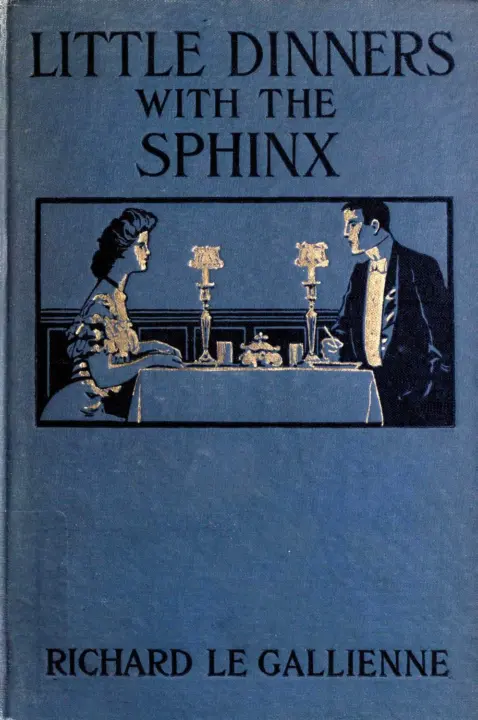
Little Dinners With the Sphinx, and Other Prose Fancies
Richard Le Gallienne
THE CLASSIC COLLECTION · 1910
"October Vagabonds" by Richard Le Gallienne is a collection of poetic reflections and observations written during the early 20th century. The book captures the essence of nature and the transition from summer to autumn as experienced by the narrator and his companion Colin, who seek solace and meaning in the quiet beauty of their surroundings. Through a series of thematic essays, the author explores themes of solitude, friendship, artistry, and the deep connection between humans and nature, evoking a sense of nostalgia and appreciation for the simpler pleasures of life. The opening portion of "October Vagabonds" introduces the reader to the end of a summer adventure through the eyes of its narrator, who feels the sadness of seasonal change as he retrieves a notice of the last baseball match of the summer from a gatepost. This imagery sets the tone for the book, blending elements of melancholy and beauty. As the narrator makes his way to their log cabin in the woods, he reflects on the fleeting nature of summer, acknowledging its warm presence as Colin busily prepares their evening meal. The exchange of wistfulness between the characters establishes their bond and appreciation for the natural world surrounding them, setting the stage for their exploration of the land and the adventures that lie ahead as they prepare to embark on a walk to New York.
Introduction adapted from the source catalogue; source summaries may be automatically generated.
Free to read · English · 25,004 words · No account needed
MAKE TIME FOR A GOOD BOOK
On by default. Untick to stop anonymous reading totals. Each page counts after 10 seconds in view. How this works.
Anonymous counting is on unless you have switched it off.
Minstrel Bands, Circus Bands, Killing
Pigs, Cat Greeting Her Kitten, Barn-Yard
of Hens and Roosters, Opera
Singers with Guitar, Whistling with
Guitar, Old Lady Singing with False
Teeth, Cow and Calf, Harmonica with
the Guitar, Arab Song, Trombone Solo
with the Guitar.
Yes! "See thou mock him not," gentle reader, for Billy is no subject for any man's condescension. We were in his company scarcely an hour, but we went away with a great feeling of respect and tenderness for him, and we hope some day to drop in on him again, and hear his music and his quaint, manly wisdom.
"All alone in the world, Billy?"
A shade of sadness passed over his face, and was gone again, as he smilingly answered, stroking the cat that purred and rubbed herself against his shoulder.
"Just puss and me and the guitar," he said. "The happiest of families. Ah! Music's a great thing of a lonely evening."
And a sense of the brave loneliness of Billy's days swept over me as we shook his strong hand, and he gave us a cheery godspeed on our way. I am convinced that Billy could earn quite a salary on the vaudeville stage; but--no! he is better where he is, sitting there at his bench, with his black cat and his guitar and his singing, manly soul.
The twilight was rapidly thickening as we left Billy, once more bent over his work, and, the fear of "supper-time" in our hearts, we pushed on at extra speed toward our night's lodging at Mount Morris. The oak-trees gloomed denser on our right as we plowed along a villainously sandy road. Labourers homing from the day's work greeted us now and again in the dimness, and presently one of these, plodding up behind us, broke forth into conversation:
"Ben-a carry pack-a lik-a dat-a--forty-two months--army--ol-a country," said the voice out of the darkness.
It was an Italian labourer on his way to supper, interested in our
knapsacks.
"You're an Italian?"
"Me come from Pal-aer-mo."
The little chap was evidently in a talkative mood, and I nudged Colin to do the honours of the conversation.
"Pal-aer-mo? Indeed!" said Colin. "Fine city, I guess."
"Been-a Pal-aer-mo?" asked the Italian eagerly. Colin couldn't say
that he had.
"Great city, Pal-aer-mo," continued our friend, "great theatre--cost
sixteen million dollars."
There is nothing like a walking-trip for gathering information of
this kind.
The Italian went on to explain that this country was a poor substitute
for the "ol-a country."
"This country--rough country. In this country me do rough-a work," he explained apologetically; "in Pal-aer-mo do polit-a work."
And he accentuated his statement by a vicious side spit upon the
American soil.
Your reading position is saved on this browser. Take it to another device with a library code. Reading pages adapt to text, rather than matching a printed edition.
Richard Le Gallienne
Richard Le Gallienne
Richard Le Gallienne
Richard Le Gallienne
BEHIND THE BOOK
This eBook is for the use of anyone anywhere in the United States and most other parts of the world at no cost and with almost no restrictions whatsoever. You may copy it, give it away or re-use it under the terms of the Project Gutenberg License included with this eBook or online at www.gutenberg.org. If you are not located in the United States, you will have to check the laws of the country where you are located before using this eBook. Read the source licence.
The original source file, including credits and licence, is retained by this library. Request an original-format copy at no charge. Please include the book title and Project Gutenberg identifier #10447.
KEEP YOUR CURIOSITY GOING
Wilfrid Scawen Blunt
Wilfrid Scawen Blunt

E. W. (Edgar Watson) Howe

David Patterson (Spirit) Hatch

David Patterson (Spirit) Hatch

David Patterson (Spirit) Hatch