
Last letters from the living dead man
David Patterson (Spirit) Hatch
THE CLASSIC COLLECTION · 1920
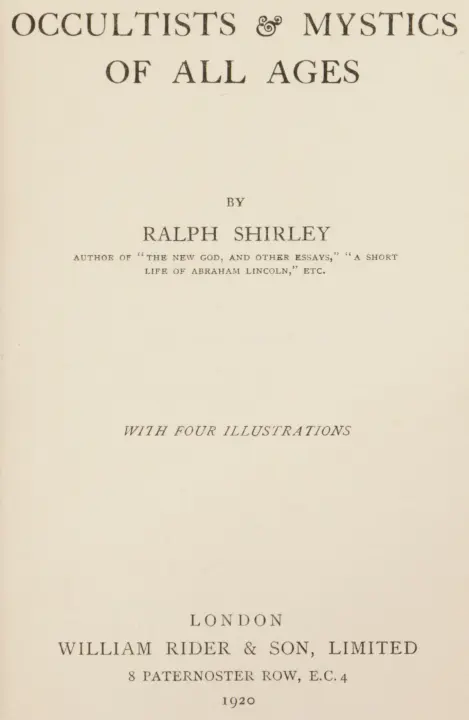
"Occultists & mystics of all ages" by Ralph Shirley is a collection of biographical essays written in the early 20th century. It examines the lives, legends, and philosophies of notable figures associated with occultism and mysticism, weighing primary sources against later myth and religious polemic to distinguish history from fable. The volume ranges from Apollonius of Tyana and Plotinus to Michael Scot, Paracelsus, Emanuel Swedenborg, Count Cagliostro, and Anna Kingsford. The opening of this volume lists its seven subjects and then launches into extended portraits. First comes Apollonius of Tyana, where the author sifts Philostratus and Damis against Christian polemics (Hierocles versus Eusebius), recounting emblematic episodes—reviving a Roman bride, foreknowing imperial events, and advising emperors—while stressing his Pythagorean asceticism, travels (including India), and teaching on reincarnation. Next, Plotinus is set in the Alexandrian milieu, his life (Ammonius Saccas, Rome, Porphyry’s editing) sketched before a clear outline of Neoplatonism: the One, Intellect, and Soul; matter as privation; the universe as a living, sympathetic organism; mystical union; and the perennial puzzles of evil, time, and creation. The section on Michael Scot intertwines border-ballad legend (Melrose Abbey’s “Book of Might”) with history—his Toledo translations of Arab science, colorful alchemical and hypnotic feats, service to Frederick II, medical reforms, frustrated church preferment, and death lore—and the next chapter opens by framing Paracelsus as a defiant reformer against entrenched orthodoxy.
Introduction adapted from the source catalogue; source summaries may be automatically generated.
Free to read · English · 40,641 words · No account needed
MAKE TIME FOR A GOOD BOOK
On by default. Untick to stop anonymous reading totals. Each page counts after 10 seconds in view. How this works.
Anonymous counting is on unless you have switched it off.
All who knew Anna Kingsford unite in testifying to the impression conveyed to them by her striking personality with its originality, freshness, and force, no less than by her many-sidedness and the strange contradictions of her character. Her biographer gives the following description of her appearance at the date when he first met her:
Tall, slender, and graceful in form. Fair and exquisite in complexion. Bright and sunny in expression. The hair long and golden, but the brows and lashes dark and the eyes deep set and hazel, and by turns dreamy and penetrating. The mouth rich, full, and exquisitely formed. The broad brow prominent and sharply cut. The nose delicate, slightly curved, and just sufficiently prominent to give character to the face. And the dress somewhat fantastic as became her looks. Anna Kingsford seemed at first more fairy than human and more child than woman. For though really twenty-seven she appeared scarcely seventeen, and made expressly to be caressed, petted and indulged, and by no means to be taken seriously.
These impressions as regards her character were appreciably modified on subsequent acquaintance, and Mr Maitland observes that “when she warmed to her favourite themes, her whole being radiant with a spiritual light, her utterances were those in turn of a savant, a sage, and a child, each part suiting her as well as if it were her one and only character.”
The relationship between the authors of The Perfect Way and the founders of the Theosophical Society in the days of its infancy affords matter of no little interest. The basic idea of the Theosophical Society, viz. the harmonising of the esoteric side of all religions, naturally suggested to the promoters of the movement that in the authors of so remarkable a work, they would find a tower of strength, and Madame Blavatsky, in particular, was most anxious to obtain their support and co-operation for the British section of the Society. Eventually, after considerable hesitation, Anna Kingsford responded to the advances made to her, and accepted the presidency of the British section. But the arrangement was not one which was destined to last long. That it was not likely to be a success might, I think, have been readily enough foreseen. Anna Kingsford and Edward Maitland were too uncompromising in their point of view—too positive that the source of their own information could not be impugned, to accept readily the bona fides of other and, as they considered, lower oracles. This, however, was by no means all. The attitude of Theosophy in its early days towards Christianity was in the main hostile. To make the esoteric interpretation of this creed the pivot of their teaching was the last idea they contemplated. Madame Blavatsky had attacked Christianity in Isis Unveiled. Mr Sinnett was equally unsympathetic. The basis of their actual teaching was an interpretation of Eastern religions, whereas the basis of The Perfect Way was an interpretation of Western. Anna Kingsford was just as unhesitating in giving her preference to Christianity as the leaders of Theosophy were in according theirs to Buddhism, Hinduism, and kindred Oriental philosophies. Mrs Besant’s attitude when she joined the Society showed similar preferences. Her early experiences of orthodox Christianity were not such as to bias her in its favour, and it was not until later days that she assumed the mantle of the prophet of The Perfect Way, and openly recognised the importance of the esoteric side of Christianity to complete the circle of theosophical teachings. The views with which Theosophy commenced have in the course of time been materially modified, and a curious sidelight is thrown, by a letter of Anna Kingsford’s, on the question whether the leaders of this Society had originally adopted the reincarnation hypothesis, or whether this was in the nature of a subsequent development. Mrs Kingsford writes under date 3rd July 1882, to her friend Lady Caithness, alluding to the reception of The Perfect Way by the Press:
Your reading position is saved on this browser. Take it to another device with a library code. Reading pages adapt to text, rather than matching a printed edition.
BEHIND THE BOOK
This eBook is for the use of anyone anywhere in the United States and most other parts of the world at no cost and with almost no restrictions whatsoever. You may copy it, give it away or re-use it under the terms of the Project Gutenberg License included with this eBook or online at www.gutenberg.org. If you are not located in the United States, you will have to check the laws of the country where you are located before using this eBook. Read the source licence.
The original source file, including credits and licence, is retained by this library. Request an original-format copy at no charge. Please include the book title and Project Gutenberg identifier #77108.
KEEP YOUR CURIOSITY GOING
David Patterson (Spirit) Hatch

David Patterson (Spirit) Hatch

David Patterson (Spirit) Hatch
Coulson Kernahan

Ralph Waldo Emerson
Frances Wright