
Last letters from the living dead man
David Patterson (Spirit) Hatch
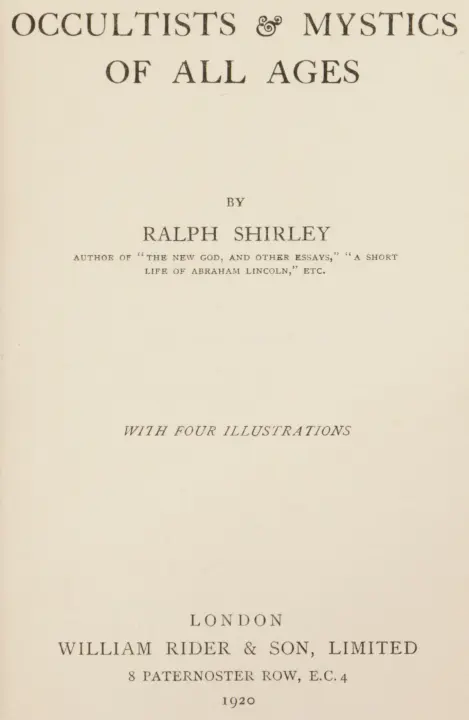
THE CLASSIC COLLECTION · 1920
"Occultists & mystics of all ages" by Ralph Shirley is a collection of biographical essays written in the early 20th century. It examines the lives, legends, and philosophies of notable figures associated with occultism and mysticism, weighing primary sources against later myth and religious polemic to distinguish history from fable. The volume ranges from Apollonius of Tyana and Plotinus to Michael Scot, Paracelsus, Emanuel Swedenborg, Count Cagliostro, and Anna Kingsford. The opening of this volume lists its seven subjects and then launches into extended portraits. First comes Apollonius of Tyana, where the author sifts Philostratus and Damis against Christian polemics (Hierocles versus Eusebius), recounting emblematic episodes—reviving a Roman bride, foreknowing imperial events, and advising emperors—while stressing his Pythagorean asceticism, travels (including India), and teaching on reincarnation. Next, Plotinus is set in the Alexandrian milieu, his life (Ammonius Saccas, Rome, Porphyry’s editing) sketched before a clear outline of Neoplatonism: the One, Intellect, and Soul; matter as privation; the universe as a living, sympathetic organism; mystical union; and the perennial puzzles of evil, time, and creation. The section on Michael Scot intertwines border-ballad legend (Melrose Abbey’s “Book of Might”) with history—his Toledo translations of Arab science, colorful alchemical and hypnotic feats, service to Frederick II, medical reforms, frustrated church preferment, and death lore—and the next chapter opens by framing Paracelsus as a defiant reformer against entrenched orthodoxy.
Introduction adapted from the source catalogue; source summaries may be automatically generated.
Free to read · English · 40,641 words · No account needed
MAKE TIME FOR A GOOD BOOK
On by default. Untick to stop anonymous reading totals. Each page counts after 10 seconds in view. How this works.
Anonymous counting is on unless you have switched it off.
Of all the men and women whom the world has classed under the general title of “mystic,” not one certainly occupies so singular a position as Emanuel Swedenborg. If we decide to accept the world’s verdict—and it seems difficult to do otherwise—and agree to call Swedenborg a mystic, we are confronted by the fact that we can find no parallel either to his personality or to his career, though we search the roll of the mystics of all the ages. Pascal indeed was, like Swedenborg, a master mathematician, and a man of wide general learning, but he was a mystic first and foremost, and his life from an early date was given up to his calling as a leading light of the Catholic Church. Swedenborg, on the other hand, was, until the age of fifty, a man of science and a man of affairs; that is, he was a scientist of the most eminently practical kind, one whose encyclopædic knowledge was turned always into utilitarian channels, and for whom knowledge of any kind appeared to have no meaning outside its practical application. It would be difficult to instance a single one of the world’s great men whose interests were so wide, or whose mental activity was so all-absorbing. Outside art there seemed literally nothing that did not appeal to him as a field for his indefatigable investigation, and, as regards art, it was presumably its lack of utilitarian value which led to its neglect by his essentially practical mentality.
Swedenborg started his travels in the first years of early manhood, and wherever they took him there was nothing which escaped his observant eye. To whatever part of Europe he went it would seem that he could not be satisfied without learning all that was to be learnt, without seeing all that was to be seen. When he establishes himself in London he does not merely take lodgings because the price is reasonable or because the cooking is good, or because he thinks he will be comfortable. He writes from London in 1711: “I turn my lodgings to some use, and change them often. At first I was at a watchmaker’s, and now I am at a mathematical instrument maker’s. From them I steal their trades, which some day will be of use to me.” At Leyden he learnt to grind glass for lenses, so that he might furnish himself with appliances which he could not afford to buy. His brother wishes for globes for the university at Upsala. These proved too expensive, and he was asked to purchase printed maps which might be mounted in Sweden. The makers would not supply these, so Swedenborg applied himself to learning engraving, and prepared them himself. When chafing at enforced inactivity at home he turns his attention to music, and writes to his brother-in-law that he has been able several times to take the place of the organist. In travelling on the Continent he studies the fortifications of the towns, the methods of constructing fences. He visits and investigates all the manufactories. He passes critical remarks with regard to the blast furnaces, the vitriol, arsenic, and sulphur works, the copper and tin manufactories, the paper mills, and studies also the methods of mining. Not content with this, he investigates the social conditions of the people, criticises the situation of affairs in France, the wealth of the Church and the poverty of the people. “Everywhere,” he says, “the convents, churches, and monks are the wealthiest and possess most land. The monks are fat, puffed up, and prosperous. A whole proud army might be formed of them without their being missed.” Again: “The houses are miserable, the convents magnificent, the people poor and wretched.” He investigates the problem of the revenue of the French Government, obtained by the system of taxation called tithing. “It amounts,” he says, “to some thirty-two million livres, and Paris, on account of its rents, contributes nearly two-thirds of the sum.” “I am told,” he says, “that the ecclesiastical order possesses one-fifth of all the property in the State, and that the country will be ruined if this goes on much longer.”[10] He gives the number of convents in France, actually at that date between fourteen and fifteen thousand; the number of the members of the religious orders; the number of the abbesses, prioresses, chapters, etc. He goes to hear the celebrated preachers, among them the King’s chaplain, who “gesticulates like an actor.” He discusses the adoration of saints with an abbé. He visits the hospitals and attends the opening of Parliament. Not content with this, he frequents the opera and the theatres, and passes opinions upon the most popular pieces and the most distinguished actors and actresses. In the midst of all this we find him speculating on the form of the particles of the atmosphere, and writing an introductory essay to a book which he is planning to prove that “the soul of wisdom is the knowledge and acknowledgment of the Supreme Being.” As if this were not enough, he occupies his spare moments in the study of anatomy, astronomy, magnetism, and hydrostatics.
Your reading position is saved on this browser. Take it to another device with a library code. Reading pages adapt to text, rather than matching a printed edition.
BEHIND THE BOOK
This eBook is for the use of anyone anywhere in the United States and most other parts of the world at no cost and with almost no restrictions whatsoever. You may copy it, give it away or re-use it under the terms of the Project Gutenberg License included with this eBook or online at www.gutenberg.org. If you are not located in the United States, you will have to check the laws of the country where you are located before using this eBook. Read the source licence.
The original source file, including credits and licence, is retained by this library. Request an original-format copy at no charge. Please include the book title and Project Gutenberg identifier #77108.
KEEP YOUR CURIOSITY GOING
David Patterson (Spirit) Hatch

David Patterson (Spirit) Hatch

David Patterson (Spirit) Hatch
Coulson Kernahan

Ralph Waldo Emerson
Frances Wright