
Last letters from the living dead man
David Patterson (Spirit) Hatch
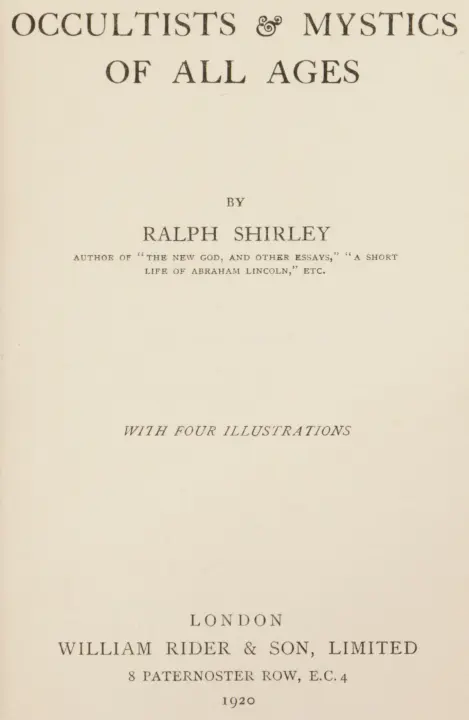
THE CLASSIC COLLECTION · 1920
"Occultists & mystics of all ages" by Ralph Shirley is a collection of biographical essays written in the early 20th century. It examines the lives, legends, and philosophies of notable figures associated with occultism and mysticism, weighing primary sources against later myth and religious polemic to distinguish history from fable. The volume ranges from Apollonius of Tyana and Plotinus to Michael Scot, Paracelsus, Emanuel Swedenborg, Count Cagliostro, and Anna Kingsford. The opening of this volume lists its seven subjects and then launches into extended portraits. First comes Apollonius of Tyana, where the author sifts Philostratus and Damis against Christian polemics (Hierocles versus Eusebius), recounting emblematic episodes—reviving a Roman bride, foreknowing imperial events, and advising emperors—while stressing his Pythagorean asceticism, travels (including India), and teaching on reincarnation. Next, Plotinus is set in the Alexandrian milieu, his life (Ammonius Saccas, Rome, Porphyry’s editing) sketched before a clear outline of Neoplatonism: the One, Intellect, and Soul; matter as privation; the universe as a living, sympathetic organism; mystical union; and the perennial puzzles of evil, time, and creation. The section on Michael Scot intertwines border-ballad legend (Melrose Abbey’s “Book of Might”) with history—his Toledo translations of Arab science, colorful alchemical and hypnotic feats, service to Frederick II, medical reforms, frustrated church preferment, and death lore—and the next chapter opens by framing Paracelsus as a defiant reformer against entrenched orthodoxy.
Introduction adapted from the source catalogue; source summaries may be automatically generated.
Free to read · English · 40,641 words · No account needed
MAKE TIME FOR A GOOD BOOK
On by default. Untick to stop anonymous reading totals. Each page counts after 10 seconds in view. How this works.
Anonymous counting is on unless you have switched it off.
That the name of Apollonius was regarded with the greatest veneration during the centuries following his death is abundantly evident. Caracalla (Roman Emperor 211-216 A.D.) honoured his memory with a chapel or monument (heroum). Alexander Severus (Emperor 225-235 A.D.) placed his statue in his lararium along with those of Christ, Abraham, and Orpheus. Aurelius is stated to have vowed a temple to the sage of Tyana, of whom he had seen a vision. Vopiscus at the end of the third century speaks of him as “a sage of the most widespread renown and authority, an ancient philosopher and a true friend of the gods.” “He it was,” says Vopiscus, “who gave life to the dead. He it was who did and said so many things beyond the power of men.” In the work entitled Quaestiones et Responsiones ad Orthodoxos, attributed (though apparently in error) to Justin Martyr, occurs among other of these “questions” the following: “If God is the maker and master of creation how do the telesmata of Apollonius have power in the orders of that creation? For as we see, they check the fury of the waves and the power of the winds, and the inroads of vermin and attacks of wild beasts.” These telesmata or talismans were articles that had been, or were supposed to have been, consecrated or magnetised, with some religious ceremony, by Apollonius.[2]
We see, then, that around the name of this philosopher gathered, as time went on, a mass of more or less incredible miraculous tradition. And, as happens too often in such cases, the real work of this great religious reformer was lost sight of amid this accumulation of legend that impressed the popular eye, which was too dull to appreciate or understand the deeper significance of the life-work and esoteric teaching of the sage. Orthodox religion in the Roman Empire had indeed at this time fallen into very much the same sort of discredit as orthodox Christianity has among ourselves to-day. Two definite attempts were made to resuscitate these old religions of Greece and Rome by reviving the understanding of the essential spiritual truths which they enshrined; the first by Apollonius of Tyana, who was above all else a reformer of the ancient Greek religion from within, and the other, an abortive one three hundred years later, by Julian the so-called Apostate. These classical faiths were, however, too much overlaid with mythological stories of an unedifying character ever again to recover their ascendancy over the popular imagination, and the ascetic life and esoteric interpretation which appealed to the isolated religious communities which Apollonius visited in his extensive travels throughout the countries bordering the Mediterranean, and as far east as Persia and India, could not in their very nature make a popular appeal to the average man. We see now that the triumph of Christianity was due to the universality of its appeal, and that however uncertain the issue of the struggle of the contending faiths appeared at the time, that issue was never really in doubt. The ascetic philosopher worked for the little public to whom the life of self-denial and esoteric truth are all in all, and to whom the world and the pursuits of the ordinary citizen take a place of minor importance. The “friend of publicans and sinners,” “who was in all things tempted like as we are,” was able to “draw all men unto him” by a compelling force such as the austere discipline and profound philosophy of Apollonius could never command. Jesus of Nazareth, in short, triumphed—and there is a profound significance in this fact—because mankind in the realisation of his true humanity forgot that he was accounted a God. The life of Apollonius was so far removed from anything the average man could comprehend that the world lost sight of the wisdom and deep spirituality of his teaching, in amazement at a worker of miracles so far beyond human ken that he came to be reckoned even a manifestation of Deity.
Your reading position is saved on this browser. Take it to another device with a library code. Reading pages adapt to text, rather than matching a printed edition.
BEHIND THE BOOK
This eBook is for the use of anyone anywhere in the United States and most other parts of the world at no cost and with almost no restrictions whatsoever. You may copy it, give it away or re-use it under the terms of the Project Gutenberg License included with this eBook or online at www.gutenberg.org. If you are not located in the United States, you will have to check the laws of the country where you are located before using this eBook. Read the source licence.
The original source file, including credits and licence, is retained by this library. Request an original-format copy at no charge. Please include the book title and Project Gutenberg identifier #77108.
KEEP YOUR CURIOSITY GOING
David Patterson (Spirit) Hatch

David Patterson (Spirit) Hatch

David Patterson (Spirit) Hatch
Coulson Kernahan

Ralph Waldo Emerson
Frances Wright