
Last letters from the living dead man
David Patterson (Spirit) Hatch
THE CLASSIC COLLECTION · 1920
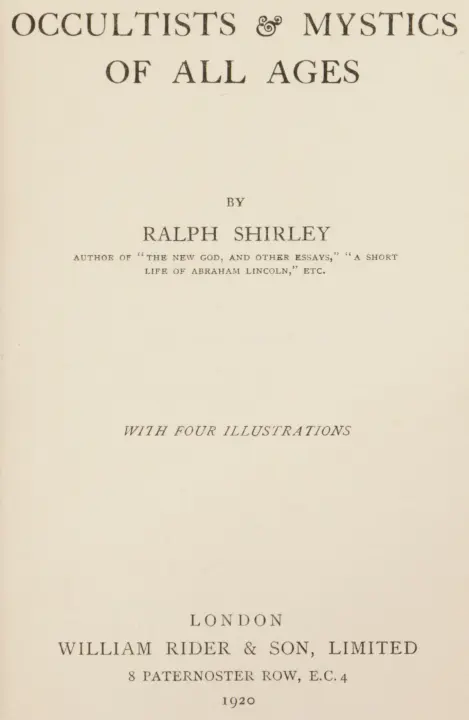
"Occultists & mystics of all ages" by Ralph Shirley is a collection of biographical essays written in the early 20th century. It examines the lives, legends, and philosophies of notable figures associated with occultism and mysticism, weighing primary sources against later myth and religious polemic to distinguish history from fable. The volume ranges from Apollonius of Tyana and Plotinus to Michael Scot, Paracelsus, Emanuel Swedenborg, Count Cagliostro, and Anna Kingsford. The opening of this volume lists its seven subjects and then launches into extended portraits. First comes Apollonius of Tyana, where the author sifts Philostratus and Damis against Christian polemics (Hierocles versus Eusebius), recounting emblematic episodes—reviving a Roman bride, foreknowing imperial events, and advising emperors—while stressing his Pythagorean asceticism, travels (including India), and teaching on reincarnation. Next, Plotinus is set in the Alexandrian milieu, his life (Ammonius Saccas, Rome, Porphyry’s editing) sketched before a clear outline of Neoplatonism: the One, Intellect, and Soul; matter as privation; the universe as a living, sympathetic organism; mystical union; and the perennial puzzles of evil, time, and creation. The section on Michael Scot intertwines border-ballad legend (Melrose Abbey’s “Book of Might”) with history—his Toledo translations of Arab science, colorful alchemical and hypnotic feats, service to Frederick II, medical reforms, frustrated church preferment, and death lore—and the next chapter opens by framing Paracelsus as a defiant reformer against entrenched orthodoxy.
Introduction adapted from the source catalogue; source summaries may be automatically generated.
Free to read · English · 40,641 words · No account needed
MAKE TIME FOR A GOOD BOOK
On by default. Untick to stop anonymous reading totals. Each page counts after 10 seconds in view. How this works.
Anonymous counting is on unless you have switched it off.
Meanwhile, after visiting Mittau, where he was enthusiastically taken up by Marshal von Medem, the head of the Masonic Lodge at that place, he passed on to Petersburg, Warsaw, and thence to Strassburg. Here he was destined to enjoy a great triumph and to win a powerful friend, who was eventually, through a pure accident, to prove the cause of his undoing. This was none other than the notorious Cardinal de Rohan. It is hardly necessary to state that the ecclesiastical dignitary of the eighteenth century in France was not selected for his high office by reason of his exemplary life or his Christian virtues. To neither of these did Cardinal de Rohan make any claim. Yet honours had fallen thick and fast upon him. He was Bishop of Strassburg, Grand Almoner of France, Cardinal, Prince of the Empire, Landgrave of Alsace, in addition to being Abbot of the richest abbey in France, the Abbey of St Waast Handsune. Of fascinating manner, an aristocrat of the aristocrats, there was no position in the kingdom to which he did not feel justified in aspiring. The fact that he enjoyed a reputation for dissipation and extravagance did not appear calculated to tell against him in such an age.
Surprising as it may seem, the Cardinal combined with a pleasure-loving disposition a passion for alchemy and the pursuit of the occult sciences, and the arrival of Cagliostro at Strassburg naturally enough excited his interest to no small degree. The Cardinal determined to lose no time in making the acquaintance of the man about whom and whose marvellous cures the whole town was already talking almost before he set foot in its streets. But Cagliostro was inclined to ride the high horse. “If the Cardinal is ill,” he replied to the great man’s messenger, “let him come to me and I will cure him. If not, he has no need of me nor I of him.” In spite of the Count’s stand-offishness, the Cardinal was not to be denied, and the acquaintance once made soon ripened into the closest intimacy. Cagliostro was told to consider the palace his own, and he and his wife resided there on the footing of the most honoured guests. Marvellous tales are told of the results of his experiments in the Cardinal’s laboratory, how he manufactured gold and jewels, and finally showed De Rohan in the crystal the form of the woman whom he had loved. It is on these stories alone that the reputation of Cagliostro as an alchemist really rests, and in the absence of further confirmatory evidence one is inclined to take them with a grain of salt. However this may be, it is certain that the Cardinal was completely won over, and Cagliostro took care not to lose caste by assuming airs of humility or deference. Never, certainly, was there less of a snob than this marvellous adventurer. “Cagliostro,” says Madame d’Oberkirch, “treated him and his other distinguished admirers as if they were under the deepest obligation to him; but he under none whatever to them.” As usual, our hero was besieged at Strassburg by those who would profit by his medical knowledge and skill as a healer, for he really appears to have possessed both, and as usual by obliging his clients he incurred the inveterate hostility of the medical profession. In all ages of the world’s history the natural healer has had the doctor as his enemy, and the prophet, the priest. Orthodoxy has ever closed its ranks against those who poach on its preserves. Doubtless it is the natural instinct of self-defence. For Cagliostro, however, it was extremely inconvenient. The people would throng his doorsteps to be cured and make him heal them willy-nilly, and the medical profession were equally determined to make each place in which he practised his medical skill too hot for him. Others might have been willing to let the dogs bark, but a fatal sensitiveness to criticism made the Count an all too easy target for their venom. They drove him from Strassburg as they had driven him from other places, in spite of the entreaties of De Rohan, who pressed him to stay and disregard their clamour.
Your reading position is saved on this browser. Take it to another device with a library code. Reading pages adapt to text, rather than matching a printed edition.
BEHIND THE BOOK
This eBook is for the use of anyone anywhere in the United States and most other parts of the world at no cost and with almost no restrictions whatsoever. You may copy it, give it away or re-use it under the terms of the Project Gutenberg License included with this eBook or online at www.gutenberg.org. If you are not located in the United States, you will have to check the laws of the country where you are located before using this eBook. Read the source licence.
The original source file, including credits and licence, is retained by this library. Request an original-format copy at no charge. Please include the book title and Project Gutenberg identifier #77108.
KEEP YOUR CURIOSITY GOING
David Patterson (Spirit) Hatch

David Patterson (Spirit) Hatch

David Patterson (Spirit) Hatch
Coulson Kernahan

Ralph Waldo Emerson
Frances Wright