
Last letters from the living dead man
David Patterson (Spirit) Hatch
THE CLASSIC COLLECTION · 1920
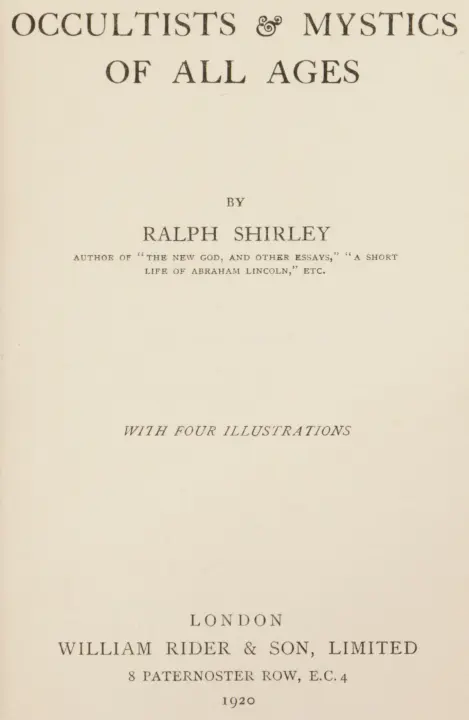
"Occultists & mystics of all ages" by Ralph Shirley is a collection of biographical essays written in the early 20th century. It examines the lives, legends, and philosophies of notable figures associated with occultism and mysticism, weighing primary sources against later myth and religious polemic to distinguish history from fable. The volume ranges from Apollonius of Tyana and Plotinus to Michael Scot, Paracelsus, Emanuel Swedenborg, Count Cagliostro, and Anna Kingsford. The opening of this volume lists its seven subjects and then launches into extended portraits. First comes Apollonius of Tyana, where the author sifts Philostratus and Damis against Christian polemics (Hierocles versus Eusebius), recounting emblematic episodes—reviving a Roman bride, foreknowing imperial events, and advising emperors—while stressing his Pythagorean asceticism, travels (including India), and teaching on reincarnation. Next, Plotinus is set in the Alexandrian milieu, his life (Ammonius Saccas, Rome, Porphyry’s editing) sketched before a clear outline of Neoplatonism: the One, Intellect, and Soul; matter as privation; the universe as a living, sympathetic organism; mystical union; and the perennial puzzles of evil, time, and creation. The section on Michael Scot intertwines border-ballad legend (Melrose Abbey’s “Book of Might”) with history—his Toledo translations of Arab science, colorful alchemical and hypnotic feats, service to Frederick II, medical reforms, frustrated church preferment, and death lore—and the next chapter opens by framing Paracelsus as a defiant reformer against entrenched orthodoxy.
Introduction adapted from the source catalogue; source summaries may be automatically generated.
Free to read · English · 40,641 words · No account needed
MAKE TIME FOR A GOOD BOOK
On by default. Untick to stop anonymous reading totals. Each page counts after 10 seconds in view. How this works.
Anonymous counting is on unless you have switched it off.
His philosophy recognises the synthetical as well as the analytical method as requisite to arrive at true conclusions. “Both,” he says, “are necessary in reflecting upon and tracing out one and the same thing; for in order to do so there is required both light, a priori, and experience, a posteriori.” “He who is possessed of scientific knowledge,” he says elsewhere, “and is merely skilled in experiment, had taken only the first steps in wisdom. For such a person is only acquainted with what is posterior, and is ignorant of what is prior. Thus his wisdom does not extend beyond the working of the senses and is unconnected with reason; whereas, nevertheless, true wisdom embraces both.”
Unquestionably Swedenborg, as he is known to us from the record of the first fifty years of his life (if we except the earliest years of his childhood), was about the last person one would expect to have his name associated with that Swedenborgian gospel by which eventually it came to be known to the world at large. He had, as we have seen, earned many titles to recognition, but assuredly that of a medium of communication between this world and the world of spirits was not one of them.
Swedenborg’s father was a Swedish Lutheran Bishop with leanings towards pietism, and a rather broader and more sympathetic outlook than the majority of his fellow clergy. His name, Swedborg, was subsequently changed to Swedenborg when the family was ennobled by the Swedish king. Emanuel was the second son and third child of Bishop Swedborg and his wife, Anna, of whom we know but little, and who died when Emanuel was only eight years old. The child was thus surrounded by religious influences in his early days, and it is said that his father had a guardian angel with whom he claimed to be able to hold converse on occasion. Reared under these conditions, he naturally enough evinced strongly religious tendencies in his childhood. “From my fourth to my tenth year,” he says, “I was constantly engaged in thought upon God, salvation, and the spiritual experiences of men. I revealed things at which my father and mother wondered, saying that angels must be speaking through me.” Here at least we obtain some suggestion of what he eventually became, and of which the intervening years between childhood and middle age seem to afford us little or no hint. The believer in heredity will point to the psychic temperament of the father as inherited by the son; but there appears to be no foreshadowing in his ancestry of that encyclopædic mind with which he was destined to astonish his contemporaries. His father evidently failed to understand his precocious son, and the relations between the two were far from cordial, the son considering that his father was inappreciative and failed to encourage his intellectual activities, and also blaming him for meanness in matters of finance. Bishop Swedborg had, however, eight other children besides Emanuel, and very probably he did not find it easy to make two ends meet, especially as he was something of an author himself, and published books at his own expense, which proved far from remunerative. Probably the father considered that the son ought to settle down to some regular trade or profession instead of commencing life by travelling in search of knowledge first to one country and then to another. Presumably he regarded his precocious offspring as likely to become a jack-of-all-trades and master of none, and there are doubtless many other parents who, under similar circumstances, would have thought the same. In any case the son was able to start off on his travels in spite of financial embarrassments and many dangers on the way. He was nearly wrecked when approaching England. Then the ship was boarded by pirates, and on the top of this was fired into by a British guardship, being mistaken for the pirate craft. Finally, our youthful hero narrowly escaped hanging for breaking the quarantine regulations, the plague at this time being prevalent in Sweden. Under somewhat similar circumstances the great Julius told the captain of his vessel not to be afraid, as he was carrying Cæsar. Whether Swedenborg had any such faith in a Providence watching over his future destiny, we are not told. He certainly realised his unique powers, but can hardly have suspected the channel into which they were eventually to be diverted.
Your reading position is saved on this browser. Take it to another device with a library code. Reading pages adapt to text, rather than matching a printed edition.
BEHIND THE BOOK
This eBook is for the use of anyone anywhere in the United States and most other parts of the world at no cost and with almost no restrictions whatsoever. You may copy it, give it away or re-use it under the terms of the Project Gutenberg License included with this eBook or online at www.gutenberg.org. If you are not located in the United States, you will have to check the laws of the country where you are located before using this eBook. Read the source licence.
The original source file, including credits and licence, is retained by this library. Request an original-format copy at no charge. Please include the book title and Project Gutenberg identifier #77108.
KEEP YOUR CURIOSITY GOING
David Patterson (Spirit) Hatch

David Patterson (Spirit) Hatch

David Patterson (Spirit) Hatch
Coulson Kernahan

Ralph Waldo Emerson
Frances Wright