
Last letters from the living dead man
David Patterson (Spirit) Hatch
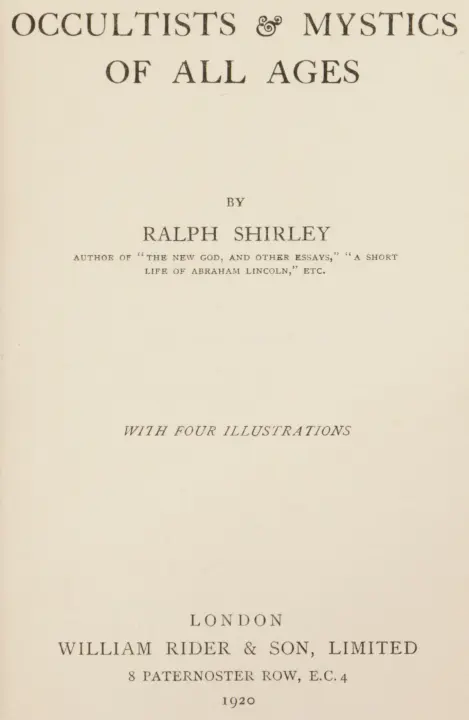
THE CLASSIC COLLECTION · 1920
"Occultists & mystics of all ages" by Ralph Shirley is a collection of biographical essays written in the early 20th century. It examines the lives, legends, and philosophies of notable figures associated with occultism and mysticism, weighing primary sources against later myth and religious polemic to distinguish history from fable. The volume ranges from Apollonius of Tyana and Plotinus to Michael Scot, Paracelsus, Emanuel Swedenborg, Count Cagliostro, and Anna Kingsford. The opening of this volume lists its seven subjects and then launches into extended portraits. First comes Apollonius of Tyana, where the author sifts Philostratus and Damis against Christian polemics (Hierocles versus Eusebius), recounting emblematic episodes—reviving a Roman bride, foreknowing imperial events, and advising emperors—while stressing his Pythagorean asceticism, travels (including India), and teaching on reincarnation. Next, Plotinus is set in the Alexandrian milieu, his life (Ammonius Saccas, Rome, Porphyry’s editing) sketched before a clear outline of Neoplatonism: the One, Intellect, and Soul; matter as privation; the universe as a living, sympathetic organism; mystical union; and the perennial puzzles of evil, time, and creation. The section on Michael Scot intertwines border-ballad legend (Melrose Abbey’s “Book of Might”) with history—his Toledo translations of Arab science, colorful alchemical and hypnotic feats, service to Frederick II, medical reforms, frustrated church preferment, and death lore—and the next chapter opens by framing Paracelsus as a defiant reformer against entrenched orthodoxy.
Introduction adapted from the source catalogue; source summaries may be automatically generated.
Free to read · English · 40,641 words · No account needed
MAKE TIME FOR A GOOD BOOK
On by default. Untick to stop anonymous reading totals. Each page counts after 10 seconds in view. How this works.
Anonymous counting is on unless you have switched it off.
was more absolutely appropriate. The hostility and venomous antagonism of his own profession, with a few notable exceptions, followed and persecuted him throughout his entire medical career. The boldness and independence of his medical attitude galled the leaders as well as the rank and file of the profession. But what was still more galling to them than his lack of orthodoxy, was the fact that his novel methods, as they must have appeared to the doctors of that day, were so immeasurably more successful than their own. Paracelsus, indeed, never gave nor asked for quarter. John the Baptist denouncing the Pharisees who came to him as “a generation of vipers” was no bad parallel to Paracelsus’s stinging invective on the ignorance and tradition-loving proclivities of his own profession.
Many to whom the name of Paracelsus is familiar are accustomed to look upon him as little more than a singularly successful quack who revived the traditions of an earlier school of Occultism in defiance of the more scientific methods of his own time. As a matter of fact, the doctors of his day were, in the vast majority of cases, merely theorists with little real practical experience, but with a fair store of book-learning of a very indifferent kind. It was Paracelsus whose medical knowledge was derived from experiment and experience, and who had acquired the greater part of his medical and surgical skill from wide and varied travelling and visiting more countries and more different nationalities than any other medical expert of his day, and who had learnt by actual association with all sorts and conditions of men in different climes, far more than any book-learning had ever taught him.
The period of Paracelsus’s career coincided with the Reformation of Luther, and with the wider and more general Renaissance movement. This latter development had brought back in its train the study of classical learning and classical ideals which had fallen into discredit about the period of the first triumph of Christianity and its establishment as a world-religion. The attitude of the earlier Christians, who looked upon the Pagan deities as devils, and Greek and Roman classical writers as apologists for devil-worship, had passed away; and the highest dignitaries of the Church were now often noted for their classical erudition and ripe scholarship. With the return of classical ideals came back also into favour in a number of unexpected quarters the doctrines of Neoplatonism. When Hypatia perished at Alexandria, orthodox Christianity set its foot on Plotinus and all his works. The struggle at the end had been one rather between Christianity and the later Greek philosophers with their Neoplatonic conceptions than between Christianity and Pagan Rome. The gods of Rome were dead already. Pan was dead past resurrecting. The danger that threatened Christianity was the triumph of such Emperors as Julian the Apostate—Julian, whose master was Plotinus, and whose religion was Neoplatonism merely dressed in an old Roman garb. To the thinkers and philosophers of that time the triumph of Christianity seemed like the victory of exoteric religion over the inner esoteric truths. Back, now, with all that was best of the scholarship and art of Greece and Rome, came the mystic doctrines of the Alexandrian philosophers—back, not in triumph, but daring once more to reassert themselves in the face of a hostile world that had long even forgotten their existence. A thousand years separated Hypatia from Cornelius Agrippa—a thousand years which, in the realm of thought, might well be characterised as the Dark Ages. Cornelius Agrippa von Nettesheim was born at Cologne in 1486. Seven years later, on 10th November 1493, at Einsiedeln, near Zurich, a son was born to Dr Wilhelm Bombast von Hohenheim, and was christened Theophrastus, in honour of Theophrastus Tyrtamos, a Greek physician, philosopher, and follower of Aristotle. This child was subsequently to be known to fame and held up to obloquy under the title of Paracelsus.
Your reading position is saved on this browser. Take it to another device with a library code. Reading pages adapt to text, rather than matching a printed edition.
BEHIND THE BOOK
This eBook is for the use of anyone anywhere in the United States and most other parts of the world at no cost and with almost no restrictions whatsoever. You may copy it, give it away or re-use it under the terms of the Project Gutenberg License included with this eBook or online at www.gutenberg.org. If you are not located in the United States, you will have to check the laws of the country where you are located before using this eBook. Read the source licence.
The original source file, including credits and licence, is retained by this library. Request an original-format copy at no charge. Please include the book title and Project Gutenberg identifier #77108.
KEEP YOUR CURIOSITY GOING
David Patterson (Spirit) Hatch

David Patterson (Spirit) Hatch

David Patterson (Spirit) Hatch
Coulson Kernahan

Ralph Waldo Emerson
Frances Wright