
Last letters from the living dead man
David Patterson (Spirit) Hatch
THE CLASSIC COLLECTION · 1920
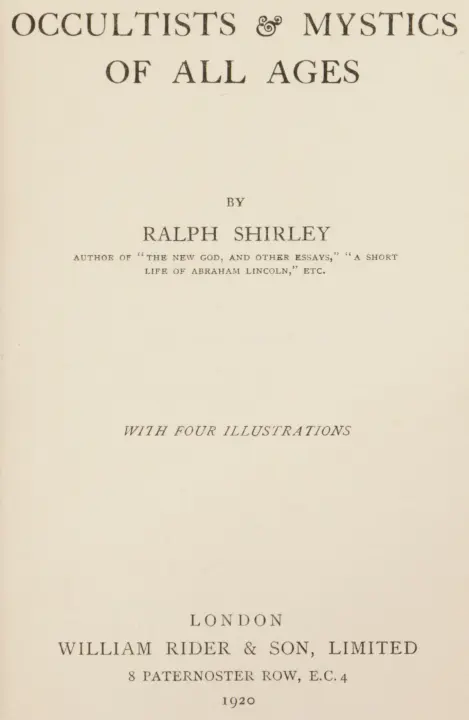
"Occultists & mystics of all ages" by Ralph Shirley is a collection of biographical essays written in the early 20th century. It examines the lives, legends, and philosophies of notable figures associated with occultism and mysticism, weighing primary sources against later myth and religious polemic to distinguish history from fable. The volume ranges from Apollonius of Tyana and Plotinus to Michael Scot, Paracelsus, Emanuel Swedenborg, Count Cagliostro, and Anna Kingsford. The opening of this volume lists its seven subjects and then launches into extended portraits. First comes Apollonius of Tyana, where the author sifts Philostratus and Damis against Christian polemics (Hierocles versus Eusebius), recounting emblematic episodes—reviving a Roman bride, foreknowing imperial events, and advising emperors—while stressing his Pythagorean asceticism, travels (including India), and teaching on reincarnation. Next, Plotinus is set in the Alexandrian milieu, his life (Ammonius Saccas, Rome, Porphyry’s editing) sketched before a clear outline of Neoplatonism: the One, Intellect, and Soul; matter as privation; the universe as a living, sympathetic organism; mystical union; and the perennial puzzles of evil, time, and creation. The section on Michael Scot intertwines border-ballad legend (Melrose Abbey’s “Book of Might”) with history—his Toledo translations of Arab science, colorful alchemical and hypnotic feats, service to Frederick II, medical reforms, frustrated church preferment, and death lore—and the next chapter opens by framing Paracelsus as a defiant reformer against entrenched orthodoxy.
Introduction adapted from the source catalogue; source summaries may be automatically generated.
Free to read · English · 40,641 words · No account needed
MAKE TIME FOR A GOOD BOOK
On by default. Untick to stop anonymous reading totals. Each page counts after 10 seconds in view. How this works.
Anonymous counting is on unless you have switched it off.
When he had arrived [says the narrative], Titus embraced him, saying, “My father has told me by letter everything in respect of which he consulted you; and lo! here is his letter, in which you are described as his benefactor and the being to whom we owe all that we are. Now though I am only just thirty years of age, I am held worthy of the same privileges to which my father only attained at the age of sixty. I am called to the throne to rule, perhaps before I have learnt myself to obey, and I therefore dread lest I am undertaking a task beyond my powers.” Thereupon Apollonius, after stroking his neck, said (for he had as stout a neck as any athlete in training), “And who will force so sturdy a bull-neck as yours under the yoke?” “He that from my youth up reared me as a calf,” answered Titus, meaning his own father, and implying that he could only be controlled by the latter, who had accustomed him from childhood to obey himself. “I am delighted then,” said Apollonius, “in the first place, to see you prepared to subordinate yourself to your father, whom without being his natural children so many are delighted to obey, and next to see you rendering to his court homage in which others will associate yourself. When youth and age are paired in authority, is there any lyre or any flute that will produce so sweet a harmony and so nicely blended? For the qualities of old age will be associated with those of youth, with the result that old age will gain in strength and youth in discipline.”
The records of Apollonius’s pithy sayings are very numerous and give a better insight into the man’s character than the startling achievements with which he is so commonly credited. Once, when staying at Smyrna, he complimented the inhabitants on their zeal for letters and philosophy and their numerous activities, urging them to take pride rather in themselves than in the beauty of their city, for “although they had the most beautiful of cities under the sun, and although they had a friendly sea at their doors, nevertheless it was more pleasing for the city to be crowned with men than with porticoes and pictures, or even with gold in excess of what they needed.” “For,” he said, “public edifices remain where they are and are nowhere seen except in that particular part of the earth where they exist, but good men are conspicuous everywhere and everywhere talked about, and so they can magnify the city the more to which they belong in proportion to the numbers in which they are able to visit any part of the earth.” And again, when visiting the monument to Leonidas, the hero of Thermopylæ, he was enthusiastic in admiration for the Greek leader, and on coming to the mound where the Lacedemonians were said to have been overwhelmed by the arrows which the enemy rained upon them, he heard his companions discussing with one another which was the loftiest peak in Hellas, the topic being suggested, apparently, by the sight of Mount Oeta which rose before their eyes. Accordingly ascending the mound, he said, “I consider this the loftiest of all, for those who fell here in defence of freedom raised it to a level with Oeta and carried it to a height surpassing many mountains like Olympus.” On another occasion when, on arriving at Athens, and meeting with an enthusiastic reception at the hands of the people, he proposed to be initiated into the Eleusinian Mysteries, the hierophant showed jealousy of Apollonius’s great reputation, which he felt put his own into the shade, and was reluctant, accordingly, to admit so formidable a rival. He therefore made the excuse that Apollonius was a wizard and had dabbled in impure rites, and that he could not in consequence consent to initiate him. Apollonius, however, was fully equal to the occasion, and retorted, “You have not yet mentioned the chief head of my offending, which is that knowing as I do more about the initiatory rite than you do yourself, I have nevertheless come for initiation to you as if you were wiser than I am.” The attitude of the crowd was so hostile to the hierophant, on discovering his rejection of their honoured guest, that he found it advisable to change his tone. But Apollonius preferred to postpone his initiation till a later occasion, and, it is said, foretold the name of the successor who was destined to initiate him four years after.
Your reading position is saved on this browser. Take it to another device with a library code. Reading pages adapt to text, rather than matching a printed edition.
BEHIND THE BOOK
This eBook is for the use of anyone anywhere in the United States and most other parts of the world at no cost and with almost no restrictions whatsoever. You may copy it, give it away or re-use it under the terms of the Project Gutenberg License included with this eBook or online at www.gutenberg.org. If you are not located in the United States, you will have to check the laws of the country where you are located before using this eBook. Read the source licence.
The original source file, including credits and licence, is retained by this library. Request an original-format copy at no charge. Please include the book title and Project Gutenberg identifier #77108.
KEEP YOUR CURIOSITY GOING
David Patterson (Spirit) Hatch

David Patterson (Spirit) Hatch

David Patterson (Spirit) Hatch
Coulson Kernahan

Ralph Waldo Emerson
Frances Wright