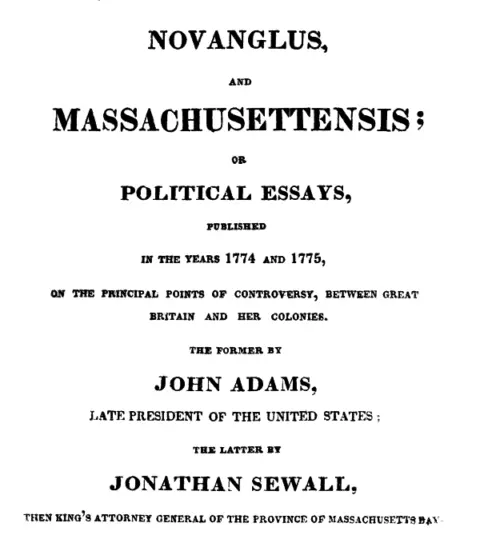
Novanglus, and Massachusettensis or, Political Essays, Published in the Years 1774 and 1775, on the Principal Points of Controversy, between Great Britain and Her Colonies
Upon this case I beg leave to make a few observations. 1. That Shower's reasoning, that we are not bound by statutes, because not represented in parliament, is universal, and therefore his exception, "unless specially named," although it is taken from analogy to the case of Ireland, by lord Coke and others, yet it is not taken from the common law, but is merely arbitrary and groundless, as applied to us: because, if the want of representation could be supplied, by "expressly naming" a country, the right of representation might be rendered null and nugatory. But of this, more another time.
2. That by the opinion of Holt, and the whole court, the laws of England, common and statute, are in force in a vacant country, discovered by Englishmen. But America was not a vacant country; it was full of inhabitants; our ancestors purchased the land; but if it had been vacant, his lordship has not shewn us any authority at common law, that the laws of England would have been in force there. On the contrary, by that law, it is clear they did not extend beyond seas, and therefore could not be binding there, any further than the free will of the discoverers should make them. The discoverers had a right by nature, to set up those laws, if they liked them, or any others, that pleased them better, provided they were not inconsistent with their allegiance to the king. 3. The court held that a country must be parcel of the kingdom of England, before the laws of England could take place there; which seems to be inconsistent with what is said before, because discovery of a vacant country does not make it parcel of the kingdom of England, which shews, that the court, when they said that all laws in force in England, are in force in the discovered country, meant no more than that the discoverers had a right to all such laws, if they chose to adopt them. 4. The idea of the court, in this case, is exactly conformable to, if not taken from the case of Wales. They consider a conquered country as Edward 1st. and his successors did Wales, as by the conquest annexed to the crown, as an absolute property, possession, or revenue, and therefore to be disposed of at its will; not entitled to the laws of England, although bound to be governed by the king's will, in parliament or out of it, as he pleased. 5. The Isle of Man and Ireland, are considered like Wales, as conquered countries, and part of the possessions (by which they mean property or revenue) of the crown of England, yet have been allowed by the king's will to retain their ancient laws. 6. That the case of America differs totally from the case of Wales, Ireland, Man, or any other case, which is known at common law, or in English history. There is no one precedent in point, in any English records, and therefore it can be determined only by eternal reason, and the law of nature. But yet that the analogy of all these cases of Ireland, Wales, Man, Chester, Durham, Lancaster, &c. clearly concur with the dictates of reason and nature, that Americans are entitled to all the liberties of Englishmen, and that they are not bound by any acts of parliament whatever, by any law known in English records or history, excepting those for the regulation of trade, which they have consented to and acquiesced in. 7. To these let me add, that as the laws of England, and the authority of parliament were by common law confined to the realm, and within the four seas, so was the force of the great seal of England. Salk. 510. "The great seal of England is appropriated to England, and what is done under it has relation to England, and to no other place." So that the king, by common law, had no authority to create peers or governments, or any thing out of the realm, by his great seal; and therefore our charters and commissions to governors, being under the great seal, gives us no more authority, nor binds us to any other duties, than if they had been given under the privy seal, or without any seal at all. Their binding force, both upon the crown and us, is wholly from compact and the law of nature.