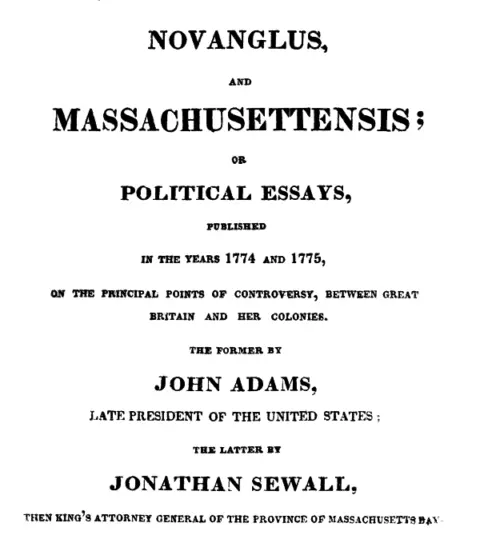
Novanglus, and Massachusettensis or, Political Essays, Published in the Years 1774 and 1775, on the Principal Points of Controversy, between Great Britain and Her Colonies
Thus I think that all the authorities in law, coincide exactly with the observation which I have heretofore made upon the case of Wales, and shew that subjection to a king of England does not necessarily imply subjection to the crown of England; and that subjection to the crown of England, does not imply subjection to the parliament of England; for allegiance is due to the person of the king, and to that alone, in all three cases, that is, whether we are subject to his parliament and crown, as well as his person, as the people in England are, whether we are subject to his crown and person, without parliament, as the Welch were after the conquest of Lewellyn, and before the union, or as the Irish were after the conquest and before Poyning's law, or whether we are subject to his person alone, as the Scots were to the king of England, after the accession of James 1st. being not at all subject to the parliament or crown of England.
We do not admit any binding authority in the decisions and adjudications of the court of king's bench or common pleas, or the court of chancery over America: but we quote them as the opinions of learned men. In these we find a distinction between a country conquered, and a country discovered. Conquest, they say, gives the crown an absolute power: discovery, only gives the subject a right to all the laws of England. They add, that all the laws of England are in force there. I confess I do not see the reason of this. There are several cases in books of law which may be properly thrown before the public. I am no more of a lawyer than Massachusettensis, but have taken his advice, and conversed with many lawyers upon our subject, some honest, some dishonest, some living, some dead, and am willing to lay before you what I have learned from all of them. In Salk. 411, the case of Blankard and Galdy. "In debt upon a bond, the defendant prayed oyer of the condition, and pleaded the statutes E. 6. against buying offices concerning the administration of justice; and averred that this bond was given for the purchase of the office of provost marshal in Jamaica, and that it concerned the administration of justice, and that Jamaica is part of the revenue and possessions of the crown of England. The plaintiff replied, that Jamaica is an island beyond the seas, which was conquered from the Indians and Spaniards in Queen Elizabeth's time, and the inhabitants are governed by their own laws, and not by the laws of England. The defendant rejoined, that before such conquest, they were governed by their own laws; but since that, by the laws of England. Shower argued for the plaintiff, that on a judgment in Jamaica, no writ of error lies here, but only an appeal to the council; and as they are not represented in our parliament, so they are not bound by our statutes, unless specially named. Vid. And. 115. Pemberton contra argued, that, by the conquest of a nation, its liberties, rights, and properties, are quite lost; that by consequence their laws are lost too, for the law is but the rule and guard of the other; those that conquer cannot, by their victory, lose their laws, and become subject to others. Vid. Vaugh. 405. That error lies here upon a judgment in Jamaica, which could not be, if they were not under the same law. Et. per Holt, C. J. and Cur. 1st. In case of an uninhabited country, newly found out by English subjects, all laws in force in England are in force there; so it seemed to be agreed. 2. Jamaica being conquered, and not pleaded to be parcel of the kingdom of England, but part of the possessions and revenue of the crown of England; the laws of England did not take place there, until declared so by the conqueror, or his successors. The Isle of Man and Ireland are part of the possessions of the crown of England, yet retain their ancient laws, that in Davis, 36, it is not pretended that the custom of tanistry was determined by the conquest of Ireland, but by the new settlement made there after the conquest: that it was impossible the laws of this nation, by mere conquest, without more should take place, in a conquered country, because for a time, there must want officers, without which our laws can have no force; that if our law did take place, yet they, in Jamaica, having power to make new laws, our general laws may be altered by theirs in particulars; also they held that in case of an infidel country; their laws by conquest do not entirely cease, but only such as are against the law of God; and that in such cases where the laws are rejected or silent, the conquered country shall be governed according to the rule of natural equity. Judgment, pro quer."