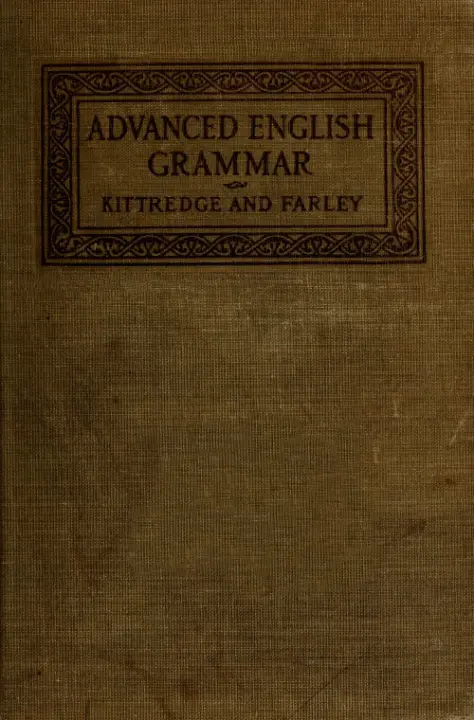
An Advanced English Grammar with Exercises
George Lyman Kittredge & Frank Edgar Farley
THE CLASSIC COLLECTION · 1907
"Notes on Witchcraft" by George Lyman Kittredge is a historical account written in the early 20th century. This work focuses on the witchcraft phenomenon in New England, particularly the Salem Witch Trials, providing an analysis of the sociocultural context of witchcraft beliefs and how they manifested during this period. Kittredge aims to explore the belief in witchcraft as a universal human concern rather than an anomaly of Puritan thought, emphasizing that the events at Salem should be interpreted within the broader historical framework of witchcraft. The opening of the book discusses the historical tendency to view New England colonists as uniquely separated from European thought patterns, particularly concerning beliefs in witchcraft. Kittredge sets the stage by asserting that witchcraft was a globally recognized superstition, not exclusive to Puritan belief, and that the events of 1692 should be viewed as part of a larger pattern of witch trials throughout history. He critiques the idea that the Salem witch trials were driven by uncommon fanaticism, arguing instead that they were emblematic of the broader societal beliefs and tensions of the time, shaped by the shared fears and influences that permeated 17th-century thought globally.
Introduction adapted from the source catalogue; source summaries may be automatically generated.
Free to read · English · 27,603 words · No account needed
MAKE TIME FOR A GOOD BOOK
On by default. Untick to stop anonymous reading totals. Each page counts after 10 seconds in view. How this works.
Anonymous counting is on unless you have switched it off.
[136] Mayhew’s letter of Oct. 22, 1652, in Eliot and Mayhew’s Tears of Repentance, 1653 (Mass. Hist. Soc. Collections, 3d Series, IV, 203-206); Gookin, Historical Collections of the Indians in New England (Mass. Hist. Soc. Collections, I, 154). See the references in Mr. Adams’s note to Morton’s New English Canaan, Prince Society edition, p. 152, and compare the following places in the Eliot Tracts (as reprinted in the Mass. Hist. Soc. Collections, 3d Series, IV),--pp. 17, 19-20, 39, 50-51, 55-57, 77, 82, 113-116, 133-134, 156, 186-187. See, for the impression that Indian ceremonies made on a devout man in 1745, David Brainerd’s Journal, Mirabilia Dei inter Indicos, Philadelphia, [1746,] pp. 49-57:--“I sat,” writes Brainerd, “at a small Distance, not more than Thirty Feet from them, (tho’ undiscover’d) with my Bible in my Hand, resolving if possible to spoil their Sport, and prevent their receiving any Answers from the infernal world” (p. 50).
[137] Gookin, Historical Collections (Mass. Hist. Soc.
Collections, I, 154); Mass. Records, ed. Shurtleff, II,
177; III, 98.
[138] The Most Strange and Admirable Discoverie of the Three Witches of Warboys, 1593, sig. B2 rᵒ. P vᵒ.
[139] Thomas Potts, The Wonderfull Discoverie of Witches, 1613 (Chetham Society reprint, sig. S); The Arraignment and Triall of Iennet Preston, of Gisborne in Craven, in the Countie of York, London, 1612 (in same reprint, sig. Y 2).
[140] Mary Smith’s case, Alexander Roberts, A Treatise of Witchcraft, 1616, pp. 52, 56, 57; the Husband’s Bosworth case, Letter of Alderman Robert Heyrick, of Leicester, July 18, 1616, printed in Nichols, History and Antiquities of the County of Leicester, II, 471*.
[141] Edward Fairfax, Dæmonologia, 1621 (first edited by W.
Grainge, Harrogate, 1882).
[142] Chetham Society Publications, V, lxiv.
[143] A True and Exact Relation of the Severall Informations, [etc.] of the late Witches, London, 1645, p. 20; T. B. Howell. State Trials, IV. 846.
[144] Depositions from the Castle of York, [edited by James Raine,] Surtees Society, 1861 (Publications, XL), pp. 28-30.
[145] The same, p. 58.
[146] The same, pp. 64-65, 67.
[147] Glanvill, Saducismus Triumphatus, ed. 1682, Relations, pp. 96, 98, 100 (ed. 1726, pp. 286, 288, 289).
[148] York Depositions, p. 82.
[149] The same, pp. 88-89. 92.
[150] The same, pp. 112-114; Glanvill, ed. 1682, pp.
160-161 (ed. 1726, pp. 328-329).
[151] A Tryal of Witches ... at Bury St. Edmonds ... 1664, London, 1682, pp. 18, 20, 23, 26, 29, 34, 38 (Sir Matthew Hale’s case); York Depositions, pp. 124-125.
[152] Glanvill, ed. 1682, pp. 103-104, 109 (ed. 1726, p.
291).
[153] Calendar of State Papers, Domestic Series, 1667-1668,
p. 4; York Depositions, p. 154.
[154] York Depositions, p. 176.
[155] Ann Tilling’s case, Gentleman’s Magazine for 1832, Part I, CII, 489 ff.; Inderwick, Side-Lights on the Stuarts, 2d ed., 1891, pp. 171-172, 191.
[156] York Depositions, pp. 192, 202-203.
[157] The same, p. 247.
[158] Margaret Stothard’s case, The Monthly Chronicle of North-Country Lore and Legend, [II] 1888, p. 395.
[159] See page 54.
Your reading position is saved on this browser. Take it to another device with a library code. Reading pages adapt to text, rather than matching a printed edition.
George Lyman Kittredge & Frank Edgar Farley
BEHIND THE BOOK
This eBook is for the use of anyone anywhere in the United States and most other parts of the world at no cost and with almost no restrictions whatsoever. You may copy it, give it away or re-use it under the terms of the Project Gutenberg License included with this eBook or online at www.gutenberg.org. If you are not located in the United States, you will have to check the laws of the country where you are located before using this eBook. Read the source licence.
The original source file, including credits and licence, is retained by this library. Request an original-format copy at no charge. Please include the book title and Project Gutenberg identifier #70895.
KEEP YOUR CURIOSITY GOING
Cécile Tormay

Moritz Busch
John L. Ransom
Frances Wright
Cécile Tormay

Mabel Potter Daggett