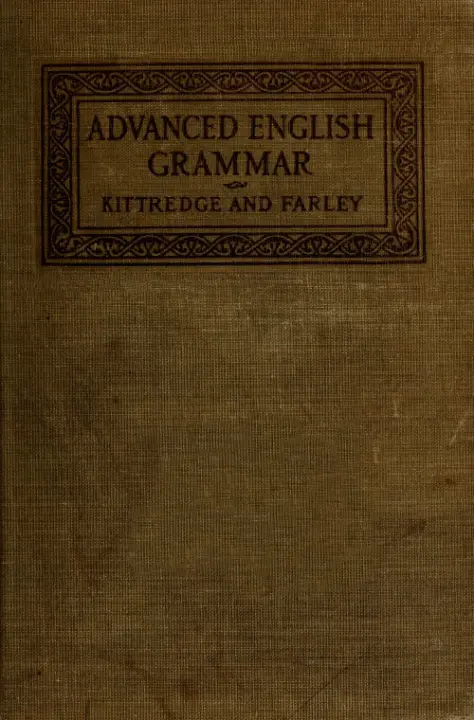
An Advanced English Grammar with Exercises
George Lyman Kittredge & Frank Edgar Farley
THE CLASSIC COLLECTION · 1907
"Notes on Witchcraft" by George Lyman Kittredge is a historical account written in the early 20th century. This work focuses on the witchcraft phenomenon in New England, particularly the Salem Witch Trials, providing an analysis of the sociocultural context of witchcraft beliefs and how they manifested during this period. Kittredge aims to explore the belief in witchcraft as a universal human concern rather than an anomaly of Puritan thought, emphasizing that the events at Salem should be interpreted within the broader historical framework of witchcraft. The opening of the book discusses the historical tendency to view New England colonists as uniquely separated from European thought patterns, particularly concerning beliefs in witchcraft. Kittredge sets the stage by asserting that witchcraft was a globally recognized superstition, not exclusive to Puritan belief, and that the events of 1692 should be viewed as part of a larger pattern of witch trials throughout history. He critiques the idea that the Salem witch trials were driven by uncommon fanaticism, arguing instead that they were emblematic of the broader societal beliefs and tensions of the time, shaped by the shared fears and influences that permeated 17th-century thought globally.
Introduction adapted from the source catalogue; source summaries may be automatically generated.
Free to read · English · 27,603 words · No account needed
MAKE TIME FOR A GOOD BOOK
On by default. Untick to stop anonymous reading totals. Each page counts after 10 seconds in view. How this works.
Anonymous counting is on unless you have switched it off.
[130] I refer to such remarks as the following:--“As the devil lost his empire among us in the last age, he exercised it with greater violence among the Indian Pawwaws, and our New England colonists” (Richard Gough, British Topography, 1780, II, 254, note ᵖ); “The colonists of [Massachusetts] appear to have carried with them, in an exaggerated form, the superstitious feelings with regard to witchcraft which then [at the time of the settlement] prevailed in the mother country” (Introduction to the reprint of Cotton Mather’s Wonders of the Invisible World, in the Library of Old Authors, 1862); “In the dark and dangerous forests of America the animistic instinct, the original source of the superstition, operated so powerfully in Puritan minds that Cotton Mather’s Wonders of the Invisible World and the Salem persecution surpassed in credulity and malignity anything the mother country could show” (Ferris Greenslet, Joseph Glanvill, New York, 1900, pp. 150-151); “The new world, from the time of its settlement, has been a kind of health resort for the worn-out delusions of the old.... For years prior to the Salem excitement, European witchcraft had been prostrate on its dying bed, under the watchful and apprehensive eyes of religion and of law; carried over the ocean it arose to its feet, and threatened to depopulate New England” (George M. Beard, The Psychology of the Salem Witchcraft Excitement, New York, 1882, p. 1).
[131] Narratives of Sorcery and Magic, II, 284.
[132] Proceedings American Antiquarian Society, New Series,
V, 267.
[133] F. Legge, Witchcraft in Scotland, in The Scottish
Review, October, 1891, XVIII, 263.
[134] On modern savages as devil worshippers, see, for example, Henry More, Divine Dialogues, 1668, I, 404 ff. (Dialogue iii, sections 15-16).
[135] Magnalia, book i, chap. i, §2, ed. 1853, I. 42; book vi, chap. vi, §3, III, 436; Jesuit Relations, ed. Thwaites, I, 286; II, 76; VIII, 124, 126. See also Thomas Morton, New English Canaan, 1637, chap. ix, ed. Adams, (Prince Society), p. 150, with the references in Mr. Adams’s note. Cf. Hutchinson, History of Massachusetts, chap. vi, ed. 1795, I, 419 ff.; Diary of Ezra Stiles, June 13, 1773, ed. Dexter, I, 385-386.
Your reading position is saved on this browser. Take it to another device with a library code. Reading pages adapt to text, rather than matching a printed edition.
George Lyman Kittredge & Frank Edgar Farley
BEHIND THE BOOK
This eBook is for the use of anyone anywhere in the United States and most other parts of the world at no cost and with almost no restrictions whatsoever. You may copy it, give it away or re-use it under the terms of the Project Gutenberg License included with this eBook or online at www.gutenberg.org. If you are not located in the United States, you will have to check the laws of the country where you are located before using this eBook. Read the source licence.
The original source file, including credits and licence, is retained by this library. Request an original-format copy at no charge. Please include the book title and Project Gutenberg identifier #70895.
KEEP YOUR CURIOSITY GOING
Cécile Tormay

Moritz Busch
John L. Ransom
Frances Wright
Cécile Tormay

Mabel Potter Daggett