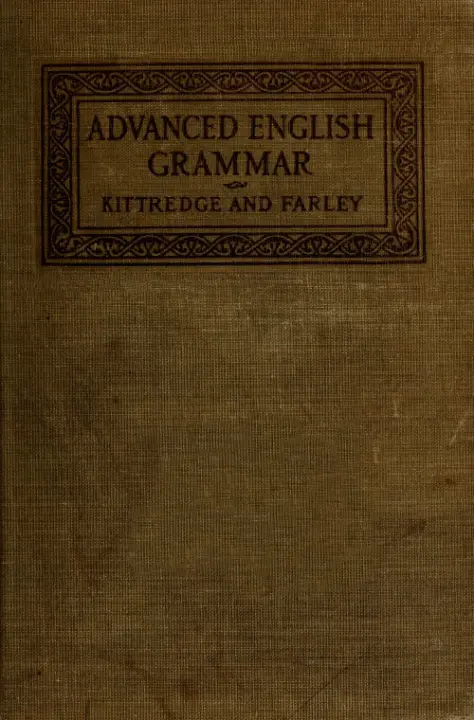
An Advanced English Grammar with Exercises
George Lyman Kittredge & Frank Edgar Farley
THE CLASSIC COLLECTION · 1907
"Notes on Witchcraft" by George Lyman Kittredge is a historical account written in the early 20th century. This work focuses on the witchcraft phenomenon in New England, particularly the Salem Witch Trials, providing an analysis of the sociocultural context of witchcraft beliefs and how they manifested during this period. Kittredge aims to explore the belief in witchcraft as a universal human concern rather than an anomaly of Puritan thought, emphasizing that the events at Salem should be interpreted within the broader historical framework of witchcraft. The opening of the book discusses the historical tendency to view New England colonists as uniquely separated from European thought patterns, particularly concerning beliefs in witchcraft. Kittredge sets the stage by asserting that witchcraft was a globally recognized superstition, not exclusive to Puritan belief, and that the events of 1692 should be viewed as part of a larger pattern of witch trials throughout history. He critiques the idea that the Salem witch trials were driven by uncommon fanaticism, arguing instead that they were emblematic of the broader societal beliefs and tensions of the time, shaped by the shared fears and influences that permeated 17th-century thought globally.
Introduction adapted from the source catalogue; source summaries may be automatically generated.
Free to read · English · 27,603 words · No account needed
MAKE TIME FOR A GOOD BOOK
On by default. Untick to stop anonymous reading totals. Each page counts after 10 seconds in view. How this works.
Anonymous counting is on unless you have switched it off.
[32] Compare Reginald Scot’s chapter “Of Theurgie, with a Confutation thereof” (Discoverie of Witchcraft, book xv, chap. 42, 1584, p. 466, ed. 1665, p. 280). See also Henry Hallywell, Melampronoea: or A Discourse of the Polity and Kingdom of Darkness. Together with a Solution of the Chiefest Objections brought against the Being of Witches, 1681, pp. 50-51.
[33] Cap. iv, §15, ed. Mosheim, 1773, I, 395-396.
[34] Sadducismus Triumphatus, ed. 1726, p. 336; see James Crossley’s Introduction to Potts, Discovery of Witches in the County of Lancaster, reprinted from the Edition of 1613 (Chetham Society, 1845), p. vi, note 2. This experiment was twice tried as late as 1712, in the case of Jane Wenham, by the Rev. Mr. Strutt, once in the presence of Sir Henry Chauncy, and again in the presence of the Rev. Mr. Gardiner. Its ill success is recorded by a third Anglican clergyman,--Mr. Francis Bragge (A Full and Impartial Account of the Discovery of Sorcery and Witchcraft, Practis’d by Jane Wenham, London, 1712, pp. 11, 15).
[35] Letter to Glanvill, Sept. 18, 1677, Works, ed. Birch, V, 244. Compare Dr. Samuel Collins’s letter to Boyle, Sept. 1, 1663 (Boyle’s Works, V, 633-634).
[36] In a letter to Glanvill (Works, V, 245).
[37] See Demonologie ou Traitte des Demons et Sorciers ... Par Fr. Perreaud. Ensemble l’Antidemon de Mascon, ou Histoire Veritable de ce qu’un Demon a fait & dit, il y a quelques années, en la maison dudit Sʳ. Perreaud à Mascon. Geneva, 1653.
[38] Theological Works, ed. 1830, IV, 480-482.
[39] In his Ravillae Redivivus, reprinted in the Somers Tracts, 2d ed., VIII, 510 ff. (see especially pp. 546 ff.). Weir, who was unquestionably insane, was executed in 1670.
[40] Diary and Correspondence of Samuel Pepys, London, 1885, IV, 275. On elf-arrows cf. Pitcairn, Criminal Trials in Scotland, I, ii, 192, 198; III, 607, 609, 615; W. Henderson, Notes on the Folk-Lore of the Northern Counties, 1879, pp. 185 ff.
[41] Evelyn may have derived his information from Sir William Phips’s letter to the home government (Oct. 14, 1692), as Dr. G. H. Moore suggests (Final Notes on Witchcraft in Massachusetts, N. Y., 1885, p. 66). For the letter see Goodell, Essex Institute Collections, 2d Series, I, ii, 86 ff. Phips’s second letter (Feb. 21, 1692-3, to the Earl of Nottingham) is printed by Moore, pp. 90 ff.
[42] The remark, sometimes heard, that Calvinism was especially responsible for witch trials is a loose assertion which has to reckon with the fact that the last burning for witchcraft at Geneva took place in 1652 (see Paul Ladame, Procès criminel de la dernière Sorcière brulée à Genève, Paris, 1888).
Your reading position is saved on this browser. Take it to another device with a library code. Reading pages adapt to text, rather than matching a printed edition.
George Lyman Kittredge & Frank Edgar Farley
BEHIND THE BOOK
This eBook is for the use of anyone anywhere in the United States and most other parts of the world at no cost and with almost no restrictions whatsoever. You may copy it, give it away or re-use it under the terms of the Project Gutenberg License included with this eBook or online at www.gutenberg.org. If you are not located in the United States, you will have to check the laws of the country where you are located before using this eBook. Read the source licence.
The original source file, including credits and licence, is retained by this library. Request an original-format copy at no charge. Please include the book title and Project Gutenberg identifier #70895.
KEEP YOUR CURIOSITY GOING
Cécile Tormay

Moritz Busch
John L. Ransom
Frances Wright
Cécile Tormay

Mabel Potter Daggett