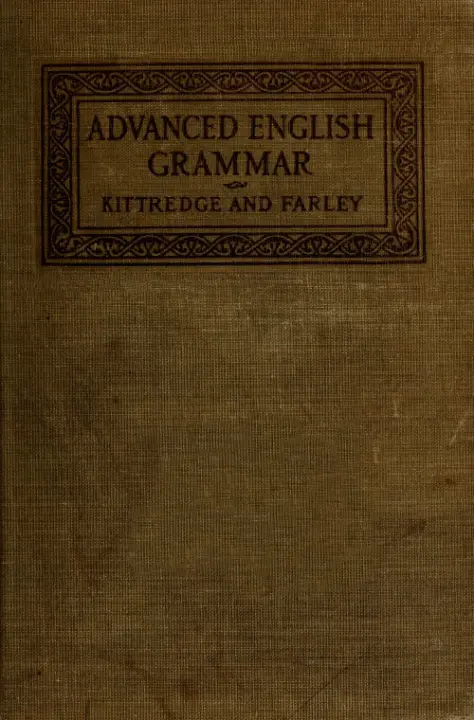
An Advanced English Grammar with Exercises
George Lyman Kittredge & Frank Edgar Farley
THE CLASSIC COLLECTION · 1907
"Notes on Witchcraft" by George Lyman Kittredge is a historical account written in the early 20th century. This work focuses on the witchcraft phenomenon in New England, particularly the Salem Witch Trials, providing an analysis of the sociocultural context of witchcraft beliefs and how they manifested during this period. Kittredge aims to explore the belief in witchcraft as a universal human concern rather than an anomaly of Puritan thought, emphasizing that the events at Salem should be interpreted within the broader historical framework of witchcraft. The opening of the book discusses the historical tendency to view New England colonists as uniquely separated from European thought patterns, particularly concerning beliefs in witchcraft. Kittredge sets the stage by asserting that witchcraft was a globally recognized superstition, not exclusive to Puritan belief, and that the events of 1692 should be viewed as part of a larger pattern of witch trials throughout history. He critiques the idea that the Salem witch trials were driven by uncommon fanaticism, arguing instead that they were emblematic of the broader societal beliefs and tensions of the time, shaped by the shared fears and influences that permeated 17th-century thought globally.
Introduction adapted from the source catalogue; source summaries may be automatically generated.
Free to read · English · 27,603 words · No account needed
MAKE TIME FOR A GOOD BOOK
On by default. Untick to stop anonymous reading totals. Each page counts after 10 seconds in view. How this works.
Anonymous counting is on unless you have switched it off.
[18] Published in 1682.
[19] Edition of 1826, I, 117 ff.
[20] State Papers (Domestic), 1682, Aug. 19, bundle 427,
no. 67, as quoted by Pike. History of Crime in England, II,
238.
[21] A Tryal of Witches, as above, p. 41.
[22] That is, hysteria.
[23] A Tryal, as above, p. 42. Cf. the Supplementary
Memoir, in Simon Wilkin’s edition of Browne’s Works, 1852,
I, liv-lvi.
[24] Anatomy of Melancholy, 1621, Part 1, section 2, member 1, subsection 3. I quote from the edition of 1624.
[25] The following short character of Glanvill, by Bishop Kennet, may be quoted, not because it is just, but because it might conceivably be brought forward by somebody in rebuttal of this proposition:--“Mr. Joseph Glanvill of Lincoln College, Oxon. Taking the Degree of M. A. in the beginning of 1658, was about that Time made Chaplain to old Francis Rous; one of Oliver’s Lords, and Provost of Eaton College.--He became a great Admirer of Mr. Richard Baxter, and a zealous Person for a Commonwealth. After his Majesty’s Restauration he turn’d about, became a Latitudinarian,--Rector of Bath, Prebendary of Worcester, and Chaplain to the King” (White Kennet, An Historical Register, 1744, p. 931).
[26] See Dr. Ferris Greenslet’s Joseph Glanvill, A Study in English Thought and Letters of the Seventeenth Century, New York, 1900, especially Chap. vi. For a bibliography of Glanvill, see Emanuel Green, Bibliotheca Somersetensis, Taunton (Eng.), 1902, I, 206 ff.
[27] More’s theories on the subject of apparitions, demons, and witches may also be read, at considerable length, in his Antidote against Atheism, Book iii, Chaps. 2-13 (Philosophical Writings, 2d ed., 1662, pp. 89 ff.); cf. the Appendix to the Antidote, Chaps. 12-13 (pp. 181 ff.) and The Immortality of the Soul, Chap. 16 (pp. 129 ff.).
[28] A Modest Enquiry into the Nature of Witchcraft,
Boston, 1702.
[29] Dated 1697-8.
[31] Meric Casaubon was born in 1599 and died in 1671. His learned, lively, and vastly entertaining work, A Treatise concerning Enthusiasme, as it is an Effect of Nature: but is mistaken by many for either Divine Inspiration, or Diabolicall Possession, appeared in 1655, and in a “Second edition: revised, and enlarged” in 1656. It shows an open mind and a temper rather skeptical than credulous. Passages of interest in our present discussion may be found on pp. 37-41, 44, 49, 94-95, 100, 118, 174 (Quakers), 286, of the second edition. Of particular significance is the Doctor’s account of his visit to a man who was thought to be possessed but whom he believed to be suffering from some bodily distemper (pp. 97 ff.). Casaubon’s treatise (in two parts) Of Credulity and Incredulity, in Things Natural, Civil, and Divine, came out in 1668, and was reissued, with a new title-page (as above), in 1672. A third part, Of Credulity and Incredulity in Things Divine and Spiritual, appeared in 1670. Webster’s assault upon Casaubon in his Displaying of Supposed Witchcraft was made in apparent ignorance of the fact that the venerable scholar had been dead for some years (see p. 24, below).
Your reading position is saved on this browser. Take it to another device with a library code. Reading pages adapt to text, rather than matching a printed edition.
George Lyman Kittredge & Frank Edgar Farley
BEHIND THE BOOK
This eBook is for the use of anyone anywhere in the United States and most other parts of the world at no cost and with almost no restrictions whatsoever. You may copy it, give it away or re-use it under the terms of the Project Gutenberg License included with this eBook or online at www.gutenberg.org. If you are not located in the United States, you will have to check the laws of the country where you are located before using this eBook. Read the source licence.
The original source file, including credits and licence, is retained by this library. Request an original-format copy at no charge. Please include the book title and Project Gutenberg identifier #70895.
KEEP YOUR CURIOSITY GOING
Cécile Tormay

Moritz Busch
John L. Ransom
Frances Wright
Cécile Tormay

Mabel Potter Daggett