THE CLASSIC COLLECTION✦An outlaw’s diary: the CommuneCLASSIC FREE BOOKS
An outlaw’s diary: the Commune
Cécile Tormay
THE CLASSIC COLLECTION · 1909
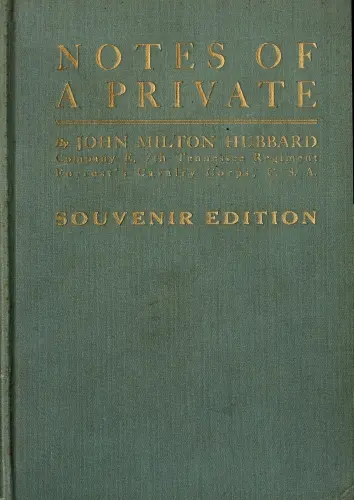
"Notes of a Private" by John Milton Hubbard is a historical account written in the early 20th century. The narrative is rooted in the author's personal experiences as a soldier in the Confederate Army during the American Civil War, specifically while serving in Company E of the Seventh Tennessee Cavalry. The book provides insights into the life and sentiments of the soldiers, as well as various events and battles they participated in, highlighting the complexities of loyalty, valor, and survival amidst the backdrop of war. The opening of the memoir introduces the reader to Hubbard's intentions in documenting his experiences, emphasizing a desire for truthfulness and justice regarding the men and events he observed. He recalls the initial excitement and camaraderie among the young recruits embarking on their military journey and discusses the stark transition from civilian life to war. The reader gets a glimpse of the naïveté of soldiers as they prepare for combat, filled with a mix of humor and earnestness, as they navigate through logistical challenges of soldiering. The narrative sets the foundation for a detailed exploration of wartime experiences, soldier behavior, and evolving perspectives as the Confederate forces engage in various campaigns and encounters throughout the South.
Introduction adapted from the source catalogue; source summaries may be automatically generated.
Free to read · English · 44,859 words · No account needed
MAKE TIME FOR A GOOD BOOK
On by default. Untick to stop anonymous reading totals. Each page counts after 10 seconds in view. How this works.
Anonymous counting is on unless you have switched it off.
At the Coldwater bridge there was a wagon heavily loaded with corn in the shuck, which was thought to be too heavy for the bridge. General Forrest ordered the corn thrown out and the wagon and corn carried over by hand. He was the first man to carry an armful across. There was hardly need of his setting the example for the men, for everybody was for leaving nothing undone that would hasten the expedition to a glorious conclusion. I never saw a command look more like it was out for a holiday. At Hernando we were twenty-five miles from our objective. From there on we had no rain, the road was better, and we moved along at a pace like that of Van Dorn, when on his way to Holly Springs. We were fondly expecting to write ditto under his performance, but in much larger letters, the very next morning. Forrest left Oxford with about fifteen hundred men, and every one of them thought that, if he “sought the bubble reputation at the cannon’s mouth,” he would likely draw a prize package into the bargain. The latter might be in the shape of a pair of boots or a horse, a suit of clothes or a small quantity of “store coffee.” A buttermilk and soda biscuit would not be “turned down,” if we took the town. Hilarity was hilarious and that’s the truth about it.
To water and to rest the horses a little were imperative. Every man carried a small quantity of shelled corn. The utmost quiet was now insisted upon. When within a few miles of the city Forrest had a consultation with his field officers, and these with their company officers, who gave quiet and explicit instructions to the men. The most drastic order was that if any officer or soldier saw one plundering he should shoot him on the spot. The different regiments were assigned to particular duties in certain localities in the city. More information was imparted to subordinate officers and private soldiers than is usual on such occasions. I think that it was intended that every man in the command should, as nearly as possible, understand just what his own regiment was to do in taking the city. Everybody about the head of the Fourteenth Tennessee understood that Captain Bill Forrest and his company would surprise and capture the vidette and outpost. While we believed that General Forrest was acting upon reliable information from spies and scouts as to the situation of affairs in Memphis, we knew that there was always a chance for an enemy to be fully informed. In that case, we did not know but that deadly ambuscades would be set for us. As we moved at a walk, the report of a single gun was heard. It was likely that some poor fellow had gone to his death. Day was breaking, but there was a dense fog. The column, moving by fours, struck a lively pace. The Fourteenth Regiment, turning into Mississippi avenue at Kerr soon plunged into a mudhole, which, in the dim light, looked interminable. Another command ahead of us was struggling to get through it. The men in the rear crowded upon those retarded in front, and the confusion was likely to defeat the whole plan of attack, which was to be executed promptly and rapidly. It added to the excitement that Captain Forrest’s company, pushing on into the city, had encountered a Federal battery near Trigg avenue, and we could hear the firing. The delay was unfortunate, but we soon got upon firmer ground. The men, by this time, had broken into a shout. As the Fourteenth Regiment was one of those designated for that purpose, Colonel White quickly dashed into the large Federal encampment to the right, and in a large grove, a part of which is yet standing. The tents stood in long white rows, but their occupants, recovering somewhat from their surprise, had rallied a little further north, and were delivering a brisk fire in the darkness, caused by the fog, but to very little purpose. In large, bold letters, I could see on the tents inscribed the words “One Hundred and Thirty-seventh Illinois Infantry.” The smoke from the guns of both sides intensified the foggy darkness. As we pushed through the encampment, I espied a man lying in one of the bunks with which the tents were supplied. The poor fellow had been left alone and sick. I advised him to lie still, as I did not care to see a non-resistant increase his chances of death by rising up. A splendid pair of army shoes was sitting on a shelf in front of a tent. Somehow, in the excitement, I reached down for the shoes and tied them to my saddle. I thought of the strict orders given in regard to appropriating anything prematurely, but I was practically barefoot. The shoes were new and a perfect fit. They supplied the place of the boots secured at Union City, and were good shoes at the surrender. I was fully repaid for my part in the raid.
Your reading position is saved on this browser. Take it to another device with a library code. Reading pages adapt to text, rather than matching a printed edition.
BEHIND THE BOOK
This eBook is for the use of anyone anywhere in the United States and most other parts of the world at no cost and with almost no restrictions whatsoever. You may copy it, give it away or re-use it under the terms of the Project Gutenberg License included with this eBook or online at www.gutenberg.org. If you are not located in the United States, you will have to check the laws of the country where you are located before using this eBook. Read the source licence.
The original source file, including credits and licence, is retained by this library. Request an original-format copy at no charge. Please include the book title and Project Gutenberg identifier #49466.
KEEP YOUR CURIOSITY GOING
Cécile Tormay

Moritz Busch
John L. Ransom
Frances Wright
Cécile Tormay

Mabel Potter Daggett