THE CLASSIC COLLECTION✦An outlaw’s diary: the CommuneCLASSIC FREE BOOKS
An outlaw’s diary: the Commune
Cécile Tormay
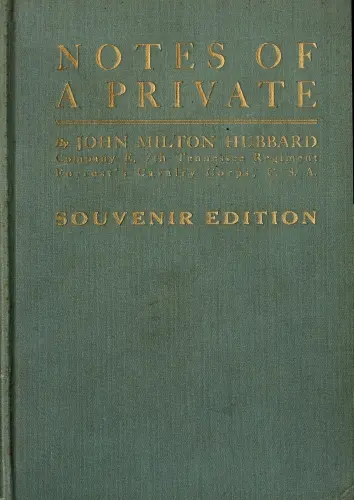
THE CLASSIC COLLECTION · 1909
"Notes of a Private" by John Milton Hubbard is a historical account written in the early 20th century. The narrative is rooted in the author's personal experiences as a soldier in the Confederate Army during the American Civil War, specifically while serving in Company E of the Seventh Tennessee Cavalry. The book provides insights into the life and sentiments of the soldiers, as well as various events and battles they participated in, highlighting the complexities of loyalty, valor, and survival amidst the backdrop of war. The opening of the memoir introduces the reader to Hubbard's intentions in documenting his experiences, emphasizing a desire for truthfulness and justice regarding the men and events he observed. He recalls the initial excitement and camaraderie among the young recruits embarking on their military journey and discusses the stark transition from civilian life to war. The reader gets a glimpse of the naïveté of soldiers as they prepare for combat, filled with a mix of humor and earnestness, as they navigate through logistical challenges of soldiering. The narrative sets the foundation for a detailed exploration of wartime experiences, soldier behavior, and evolving perspectives as the Confederate forces engage in various campaigns and encounters throughout the South.
Introduction adapted from the source catalogue; source summaries may be automatically generated.
Free to read · English · 44,859 words · No account needed
MAKE TIME FOR A GOOD BOOK
On by default. Untick to stop anonymous reading totals. Each page counts after 10 seconds in view. How this works.
Anonymous counting is on unless you have switched it off.
Rucker’s Brigade was now a thing of the past and the Seventh Tennessee was attached to Richardson’s Brigade, commanded by Colonel J. J. Neely. At his instance I had been temporarily detailed to attend to some clerical and other work in the ordnance department. For the time being I stopped at the quarters of Lieutenant-Colonel White, commanding the Fourteenth Tennessee, where we spent most of the time in trying to keep dry. Rations were in plenty, but we could scarcely get dry wood enough to cook them. Much of our ammunition was ruined and in our skirmishes many of the cartridges would not explode. All efforts to induce the Federals to cross to our side of the shallow creek failed, though our men frequently crossed to their side and, having engaged their advance, fell back hurriedly with the design of drawing them into a disadvantageous place. Colonel Neely one day, between showers, concluded to make an effort to lead the Federal cavalry into a well planned ambuscade by offering them superior inducements. The Fourteenth Regiment under White was ordered to cross the creek, dismount and get in a well-chosen place in the thick bushes and parallel with the road. A detachment of Neely’s escort, with which I crossed over, was to ride forward, engage the Federal advance briskly, and retreat in some confusion. The enemy took the bait and came on at a canter. Luckily for them, their flankers struck the right of the dismounted regiment and gave the alarm. However, part of their pursuing force came up to where the escort was posted. The dense growth of timber on this spot so obscured the view that the Federal cavalry soon found themselves face to face with, and in short range of, our reserve, and those who had rallied. It was a most exciting contest for only a minute or two, and chiefly with pistols, on our side, but both parties seemed to have lost the knack of hitting anything, for I saw no dead or wounded, though we quickly drove the enemy upon their reserve and kept up a spirited gunplay until it was our time to fall back. Everybody realized the inability of the Confederates to cope with the greatly superior force of the Federals, and we were liable to be driven from our position by a heavy flank movement at any time. A knowledge of this, of course, was possessed by the rank and file, and the suspense concerning coming results was great. In the midst of our anxiety, Colonel White received orders to prepare rations for an expedition. That something radical was on the tapis was evident. Only picked men and horses were wanted. It got abroad in camp that we were going to Memphis. That looked radical, but pleased us. There was a weeding out of sick men, sore back and lame horses. The camp took on new life. As the duties of my special assignment were about discharged, I could have asked to be relieved and to be returned to my own company, which was not under orders, but I preferred to take part in whatever excitement was in store for us, so I said nothing and went to Memphis with Colonel White. We left camp on the night of the 18th of August, 1864, in a downpour and in darkness so great that we could scarcely see the road. I had hard work that night with the help of a small detachment in having a quantity of cornbread baked by the good women along our way, keeping it dry, and promptly joining the regiment next morning on the road to Panola. At this old town there was a short delay to get the column well up, and to have another culling of disabled men and horses, for the night march had been a severe one on both man and beast. Having crossed the Tallahatchie, we turned our faces toward Memphis. The sun was now shining, and everybody was in jolly, good spirits. Our clothing was drying rapidly by evaporation. Reaching Senatobia, twenty-three miles from Panola, we rested till next morning. In the meantime, a competent detail was building a bridge over the Hickahala, a creek just north of the town, and swollen by the heavy rains. And such a bridge! An old flatboat placed in midstream for a central pontoon, and strengthened by floats made of dry cedar telegraph poles, which were bound together by grapevines, constituted the body of the structure. Other poles were used as beams to piece out the bridge, and over the whole was laid a floor of planks brought by hand from the ginhouses in the neighborhood. Finally, a twisted cable of grapevines was placed on the side down stream, and lashed to trees on either bank. The men dismounted and led their horses over in column of twos. The two pieces of artillery with their caissons were wheeled across by hand. At Coldwater river, seven miles further north, a longer bridge was required. The men assigned to the work of building one were not long in completing it, and the command crossed over as they did over the first bridge. Twice that morning I was reminded of the aphorism that “necessity is the mother of invention.”
Your reading position is saved on this browser. Take it to another device with a library code. Reading pages adapt to text, rather than matching a printed edition.
BEHIND THE BOOK
This eBook is for the use of anyone anywhere in the United States and most other parts of the world at no cost and with almost no restrictions whatsoever. You may copy it, give it away or re-use it under the terms of the Project Gutenberg License included with this eBook or online at www.gutenberg.org. If you are not located in the United States, you will have to check the laws of the country where you are located before using this eBook. Read the source licence.
The original source file, including credits and licence, is retained by this library. Request an original-format copy at no charge. Please include the book title and Project Gutenberg identifier #49466.
KEEP YOUR CURIOSITY GOING
Cécile Tormay

Moritz Busch
John L. Ransom
Frances Wright
Cécile Tormay

Mabel Potter Daggett