THE CLASSIC COLLECTION✦An outlaw’s diary: the CommuneCLASSIC FREE BOOKS
An outlaw’s diary: the Commune
Cécile Tormay
THE CLASSIC COLLECTION · 1856
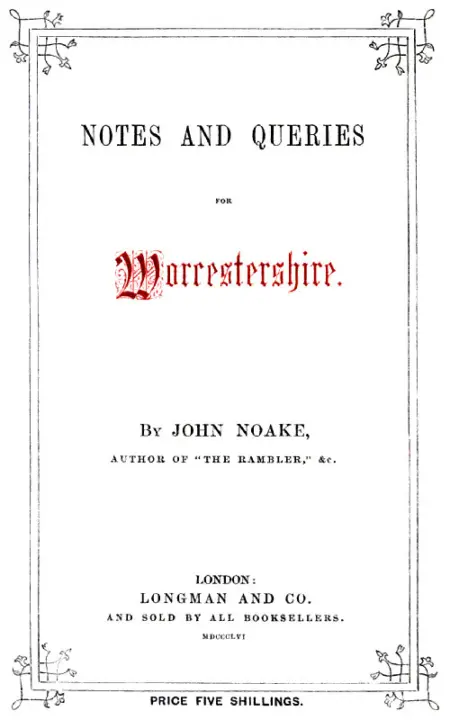
"Notes and Queries for Worcestershire" by John Noake is a historical account written in the mid-19th century. The work serves as a compilation of various details about Worcestershire, shedding light on its history, customs, and social life. The author aims to create a more nuanced narrative of the county's past, moving beyond dry statistics to a richer understanding of the people and their experiences. At the start of the publication, the author expresses his anticipation that this installment will contribute to the understudied history of Worcestershire. He reflects on the limitations of prior historical approaches, emphasizing the need for detailed research into local customs, traditions, and social life. Noake insists that a collaborative effort is essential for a comprehensive account, suggesting that while his work is a modest beginning, it invites further inquiry into the county's rich heritage, aiming to illuminate the lives of its inhabitants across the centuries.
Introduction adapted from the source catalogue; source summaries may be automatically generated.
Free to read · English · 101,259 words · No account needed
MAKE TIME FOR A GOOD BOOK
On by default. Untick to stop anonymous reading totals. Each page counts after 10 seconds in view. How this works.
Anonymous counting is on unless you have switched it off.
The Salt Market was held in the parish of St. Nicholas. At a parish meeting in 1792 it was agreed "That whereas there is a stage erected before the Salt Market, to the great prejudice and forestalling of the p'ish tenants, who pay considerable rents to the use of the poor of St. Nicholas, that all and every person," &c., should be proceeded against as counsel should advise. The site of the Salt Market was what is now the garden in front of the rectory house, close by the church. There was a stonemason's yard behind, and in the rear of that yard was a house which, by the addition of a new front, has been converted into the present rectory. Mr. Young, who is now living at the age of about eighty-three, informs me that he can recollect a man regularly selling salt at a small open shop or stall on the site in question. Three or four centuries ago the Salt Market was at "the well of Allhallow," near All Saints' church. In 1692 the parishioners were "p'sented for ye repaire of the way from Foregate to the Pound, in St. Martin's, lying near the town ditch," which had hitherto been repaired by the inhabitants living there, or else by the chamberlain of the city, the churchwardens therefore were instructed to litigate the point, and no further entry occurs on the subject. There was also much disputation about some property in the Butts, and at length "Wm. Lygon, Esq., John Price, chancellor, James Nash, of Martley, gentleman, and John Appletree, Esq., were requested to be arbitrators for the parish in a matter between ye p'ishioners and Mary Solley, widow, concerning the retakeing of the gravel butts and setting forth ye said butts and ye boundaries thereof." In 1770 a lease of "the rector's ten tenements at the bottom of Gaol Lane" was granted for fifty years, at a rental of £21. 10s., for a workhouse. This Gaol Lane was the present Nicholas Street, where also were several almshouses, repaired by the parish. The lane led to the old city gaol, which was situate on the site of the gardens and property now belonging to the Avenue House (Mr. Powell's) and cottages adjacent in Trinity Gardens. The entrance to the old gaol was near the premises in St. Nicholas Street, till recently occupied as a savings-bank. St. Nicholas Street--now the principal thoroughfare to and from the railway station--was at that time no street at all, there being no outlet to Lowesmoor except for foot passengers, who had to go through a narrow entry with turnstile. A public house called the Dolphin stretched across the street from the present police station to the point where Mr. Finch's house now stands, and the entry was at the left of that public house, close adjoining Mr. Finch's. The last house which then stood in the lane is still in existence, being occupied by a broker. Its old doorway and timbers speak for themselves. Mr. Finch's premises were then a workshop and timber-yard belonging to a Mr. Powell. The ten tenements above alluded to, as belonging to the rector, were on the opposite side of the lane, and were probably used as a parish workhouse only from 1770 till the building of the present House of Industry, about twenty years later. These tenements are now about to be sold, under an act passed a few years ago, enabling incumbents to sell dilapidated property for its bona fide value, the proceeds to be deposited in Queen Anne's Bounty fund, and the annual value to be paid to the incumbent. The cattle market was held in Gaol Lane within the recollection of aged persons now living. A by-law was made in the time of Henry VII, setting forth that, as the cattle market in Broad Street was a great annoyance, thenceforth the Welsh cattle should be brought to Dolday, and English cattle to Anger (Angel) Lane, and to the "old gayle." The garden and butter markets were also formerly held in front of St. Nicholas' church, having been removed thither from All Hallows Well. A great part of the area in front of St. Nicholas' church is consecrated ground, the boundary being still defined by a line of pavement. At the corner of the churchyard the old watchman's box was formerly placed. Richard Hill, the late beadle of St. Nicholas church, had the honour of being the "last man" of the ancient dynasty of Charleys in this city. He received a concussion of the brain in a night assault, but after lying by for some time he recovered and became beadle of the church. The first mention of public lamps in the churchwardens' books is in 1698; when it was ordered "Yt the lamps in the parish, and to be putt up in the parish, be fedd with oyle, and trimmed and cleaned at the charge of the parish, and that the churchwardens doe take care to have them lighted all dark nights in the winter season." Mention of a Sunday school is made in 1786, when it was agreed that the expense of it should be paid out of the money collected for the poor, and a committee was appointed to manage the affairs of the school. [I find that Sunday schools were ordered to be established as early as 1570, by the Council of Malines.] Present rector of St. Nicholas, the Rev. W. H. Havergal; churchwardens, Mr. F. Shrimpton and Mr. T. B. Burrow. Population in 1851, 2030.
Your reading position is saved on this browser. Take it to another device with a library code. Reading pages adapt to text, rather than matching a printed edition.
BEHIND THE BOOK
This eBook is for the use of anyone anywhere in the United States and most other parts of the world at no cost and with almost no restrictions whatsoever. You may copy it, give it away or re-use it under the terms of the Project Gutenberg License included with this eBook or online at www.gutenberg.org. If you are not located in the United States, you will have to check the laws of the country where you are located before using this eBook. Read the source licence.
The original source file, including credits and licence, is retained by this library. Request an original-format copy at no charge. Please include the book title and Project Gutenberg identifier #47105.
KEEP YOUR CURIOSITY GOING
Cécile Tormay

Moritz Busch
John L. Ransom
Frances Wright
Cécile Tormay

Mabel Potter Daggett