THE CLASSIC COLLECTION✦An outlaw’s diary: the CommuneCLASSIC FREE BOOKS
An outlaw’s diary: the Commune
Cécile Tormay
THE CLASSIC COLLECTION · 1856
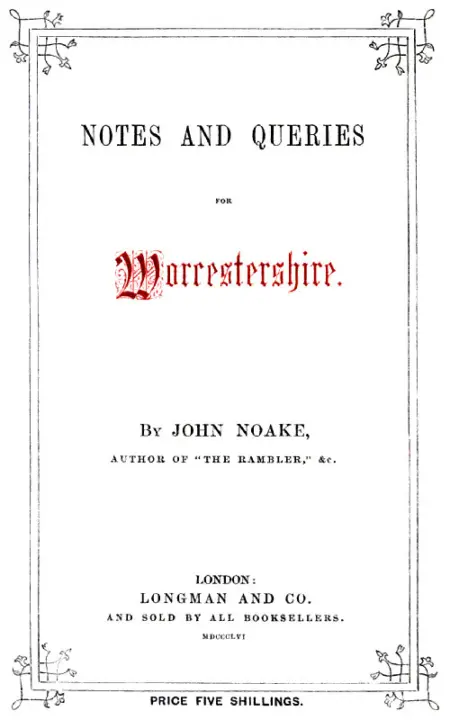
"Notes and Queries for Worcestershire" by John Noake is a historical account written in the mid-19th century. The work serves as a compilation of various details about Worcestershire, shedding light on its history, customs, and social life. The author aims to create a more nuanced narrative of the county's past, moving beyond dry statistics to a richer understanding of the people and their experiences. At the start of the publication, the author expresses his anticipation that this installment will contribute to the understudied history of Worcestershire. He reflects on the limitations of prior historical approaches, emphasizing the need for detailed research into local customs, traditions, and social life. Noake insists that a collaborative effort is essential for a comprehensive account, suggesting that while his work is a modest beginning, it invites further inquiry into the county's rich heritage, aiming to illuminate the lives of its inhabitants across the centuries.
Introduction adapted from the source catalogue; source summaries may be automatically generated.
Free to read · English · 101,259 words · No account needed
MAKE TIME FOR A GOOD BOOK
On by default. Untick to stop anonymous reading totals. Each page counts after 10 seconds in view. How this works.
Anonymous counting is on unless you have switched it off.
Rosemary and bayes were very regularly distributed about the church at Christmas. The bread for the communion for the whole year 1678 amounted to but 1s.; the wine, £1. 5s. 6d. Money collected at the communion in 1680, about £2, in seven collections. In 1684--bread, 3s. 6d.; wine, £4. 14s. 7d. Mr. Stephen Ashby, in 1737, "gave 20s. to the rector for preaching a sermon on Good Friday, suitable to the great subject of the day; and it is desired that the inhabitants of St. Swithin's may have liberty to attend the service and sermon, and that the blessed sacrament of the Lord's Supper may be administered that day, if there shall be a sufficient number of communicants." An inventory of the furniture belonging to the church in 1680 included "one English Bible, eleven service books, a book of homilies, Paraphrase of Erasmus, one book Jewell's works, one book called Musculus, one book of the Whole Duty of Man [two years previously three books of the Whole Duty of Man were entered as having been given to the parish], four books given by Mr. Griffith, the rector, being the Companion to the Temple, two parts, the Companion to the Altar, and the Occasional Office of Matrimony, a book of cannons, a book concerninge God and the Kinge," besides books for the poor, communion plate, green carpet, &c. A charge of 1s. 8d. for chaines and staples for the books in the church was made about the same time. In the year 1680 an old vestry order was revived, "That the clerk should buy and maynteyne sufficient ropes whenever required, and to have the benefit of the ringing the bells." The clerk was also discharged from keeping the clock, and it was ordered that some skilful person should be chosen for the purpose and paid 20s. yearly; but some twenty years after that a much more economical arrangement was made with one John Cox, who was paid 25s. "for mending the clock, upon his promise to keep it in order 21 years at 5s. a year." A new ring of bells for this church was cast at Bromsgrove in 1715. Patching up the old church was a frequent source of great outlay for some years before it was determined to build a new one. In 1682 the "pillar near the great door" being much decayed, and endangering the structure, and other repairs being needed, they were ordered to be done. I find that the cost of 400 tiles was 6s. 8d., 20 bushels of hair 6s. 8d., 400 Wyer brick 6s. 8d., 5 loads of sand 7s. 6d., eight loads of stone (from Ombersley) £2, lime 5d. a bushel; the workmen generally had 1s. a day, while others had more or less. Green flannel was bought for "the 48 seats," (the corporation), and red tape to be nailed on it. Three years afterwards an order was made to repair the church again at a cost of £150, and two men named Allibone and Pascall "to have ye job," Mr. Emes to give security for its proper performance. Malt was bought to make drink for the workmen. Three and a half yards of damask for the communion table were then charged £1. 2s. 9d. Next year the chancel was out of order, and a buttress was put up. In 1690 the steeple underwent reparation. Then it was found that the accommodation of the church was not sufficient, and in 1697 it was ordered, "That my Lord Bishopp be waited upon by the minister to desier his fyatt for the building a new gallery." The four front seats of this gallery were "put in order and matted fitt for ye gentlewomen to sit in." Only two years elapsed when the old vestry was ordered "to be taken down and removed to next pillar, and to be put in decent order for the parishioners to meet on all parish accounts." Then, in 1707, a new gallery was ordered to be erected under the west window, "in the most decent and workmanlike manner that can be found out and advised by able workmen, and that the pulpit, seats, and font, be removed and made more convenient." At length the old fabric was found not to be worth any further outlay, and it was pulled down in 1728. The vestry meetings were then held in the Berkeley chapel, also at several inns and private houses. [The Hop-pole is first mentioned in 1742, and the Star and Garter in 1748. Mr. G. Woodcock was the landlord of the former, and Mr. William Dyer of the latter.] The trustees appointed under the act for taking down and rebuilding the church were Mr. Thomas, Mr. Weston, Alderman Weston, Martin Sandys, Alderman Vaughan, Alderman Floyer, Mr. Hayles, Mr. John Nichols, Mr. Ashby, Mr. Mence, Alderman Hopkins, Dr. B. Purshall, and the churchwardens. Captain Wingfield, Mr. Sambach, and Mr. Garway, were afterwards chosen trustees to act with the others in carrying on the building. It was ordered that all gifts to the parish should be paid to the treasurer of the trustees, and the parish to pay the interest as directed by the wills of the respective donors. [I mention this in consequence of the bearing it has on a recent church-rate discussion here.] When the trustees should be reduced to thirty, any nine of the survivors were to fill up the number. Sums were borrowed at common interest and others as annuities, and heavy rates were levied. Great difficulty was experienced in raising the amount, the whole expense of the church being £3,345. It was ordered to prosecute all defaulters in the Ecclesiastical Court, except Quakers, who were to be brought before the magistrates; and among other modes of raising funds were the following: Alderman Weston gave £20 for a seat under the south window next the tower; Mr. Sandys and Mr. Mence £100 each for having conveyed and assured to them the two galleries on each side of the tower; and an order was made that the £20 given by Mr. Ashby for preaching a sermon on Good Friday be laid out on building a wall and enclosing the churchyard. The first vestry was held in the new church in 1730, when it was ordered that the seats should have numbers or figures put on them; "the persons to sit in them according to their weekly payments to the poor; and if any one should sit in a seat above his weekly pay he or she shall be immediately charged according to the figure on the seat."
Your reading position is saved on this browser. Take it to another device with a library code. Reading pages adapt to text, rather than matching a printed edition.
BEHIND THE BOOK
This eBook is for the use of anyone anywhere in the United States and most other parts of the world at no cost and with almost no restrictions whatsoever. You may copy it, give it away or re-use it under the terms of the Project Gutenberg License included with this eBook or online at www.gutenberg.org. If you are not located in the United States, you will have to check the laws of the country where you are located before using this eBook. Read the source licence.
The original source file, including credits and licence, is retained by this library. Request an original-format copy at no charge. Please include the book title and Project Gutenberg identifier #47105.
KEEP YOUR CURIOSITY GOING
Cécile Tormay

Moritz Busch
John L. Ransom
Frances Wright
Cécile Tormay

Mabel Potter Daggett