
Last letters from the living dead man
David Patterson (Spirit) Hatch
THE CLASSIC COLLECTION · 1875
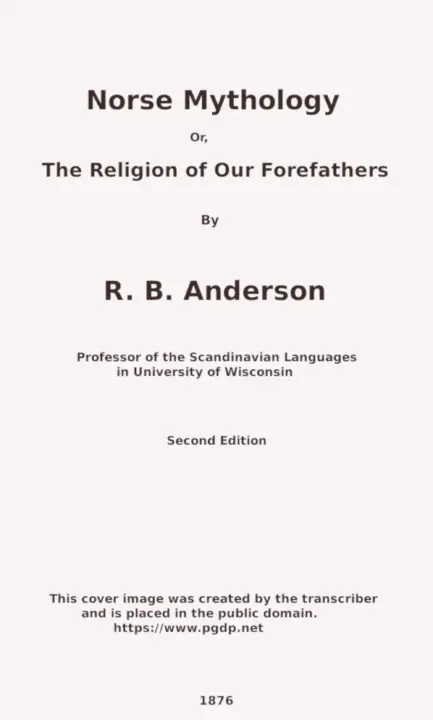
"Norse Mythology; or, The Religion of Our Forefathers, Containing All the Myths of the Eddas, Systematized and Interpreted" by R. B. Anderson is a comprehensive historical account written in the late 19th century. The work aims to present a complete and systematic understanding of Norse mythology, exploring the myths, deities, and cultural significance of the ancient beliefs of the Scandinavian peoples. Through this volume, the author asserts the importance of Norse mythology for contemporary readers, emphasizing its relevance to the cultural heritage of modern societies. At the start of the book, Anderson discusses the intriguing nature of Scandinavian paganism and its persistence until the 11th century. He reflects on the importance of understanding Norse mythology as a means of connecting with our ancestors and their worldview, which was steeped in a rich tapestry of myths and divine personifications of nature. The text also anticipates a debate regarding the merits of Norse mythology compared to Greek mythology and sets the stage for a systematic exploration of its various aspects, including a detailed examination of key figures such as Odin, Thor, and the concept of creation within this mythological framework. Anderson's aim is to revive interest in the myths preserved in the Eddas and to encourage a deeper appreciation of the Gothic inheritance among readers.
Introduction adapted from the source catalogue; source summaries may be automatically generated.
Free to read · English · 120,183 words · No account needed
MAKE TIME FOR A GOOD BOOK
On by default. Untick to stop anonymous reading totals. Each page counts after 10 seconds in view. How this works.
Anonymous counting is on unless you have switched it off.
Considerable has been said on this subject in the preceding pages, and the interpretation which will be adhered to in this volume has been clearly indicated. We propose now to give a general synopsis of the more prominent methods of interpreting Norse mythology.
In one thing all undoubtedly agree, namely, that all mythologies embody religious faith. As we, to this day, each in his own way, seek to find God by philosophical speculation (natural theology), by our emotions, by good deeds, or by all these at one time; and as we, when we have found him, rest upon his breast, although we do not fully agree as to our conception of him, each one of us having his own God as each has his own rainbow; thus our forefathers sought God everywhere—in the rocks, in the babbling stream, in the heavy ear of grain, in the star-strewn sky of night, and in the splendor of the sun. It was revelations of divinity that they looked for. The fundamental element in their mythology was a religious one, and this fact must never be lost sight of. To interpret a myth, then, is not only to give its source, but also its aim and object, together with the thoughts and feelings that it awakens in the human breast.
Some writers (William and Mary Howitt and others) maintain that the Norse mythology is a degradation of, or aberration from, the true religion, which was revealed to man in the earliest period of the history of the human race and is found pure and undefiled in the Bible; that it presents sparkling waters from the original fountain of tradition. They point with seriousness to it as something that bears us on toward the primal period of one tongue and one religion. In reference to the Elder Edda, they say that it descended through vast ages, growing, like all traditions, continually darker, and accumulating lower matter and more divergent and more pagan doctrines, as the walls of old castles become covered with mosses and lichens, till it finally assumed the form it which it was collected from the mouths of the people, and put in a permanent written form. These interpreters claim that through all mythologies there run certain great lines, which converge toward one common center and point to an original source of a religious faith, which has grown dimmer and more disfigured, the further it has gone. The geographical center, they say, from which all these systems of heathen belief have proceeded is the same—Central Asia; they point to the eastern origin of the Norseman; they assert, with full confidence, that the religious creed of the Norseman is the faith of Persia, India, Greece, and every other country, transferred to the snow-capped mountains of Norway and jokuls of Iceland, having only been modified there, so as to give it an air of originality without destroying its primeval features. They argue that Loke of the Norsemen, Pluto of the Greeks, Ahriman of the Persians, Siva of the Hindoos, etc., are all originally the devil of the Bible, who has changed his name and more or less his personal form and characteristics. The biblical Trinity is degenerated into the threefold trinity of Odin, Vile, and Ve; Odin, Hœner, and Loder; and Odin, Thor, and Balder. They find in the Norse cosmogony, in a somewhat mutilated and interpolated condition, the Scripture theory of the creation, preservation, destruction and regeneration of the world. Ygdrasil is the tree of life in the garden of Eden; Ask and Embla, the first human pair, are Adam and Eve; the blood of the slain giant Ymer, in which the whole race of frost-giants was drowned, (excepting one pair, who were saved, and from whom a new giant race descended,) is the flood of Noah, the deluge; the citadel called Midgard is the tower of Babel; in the death of Balder, by Hoder, who was instigated by Loke, they find the crucifixion of Christ by Judas, instigated by the devil, etc.; displaying a vast amount of erudition, profoundness and ingenuity, that might have been applied to some good purpose. We refrain from giving more of the results of their learned and erudite investigations, from fear of seducing ourselves or our readers into the adoption of their absurdities.
Your reading position is saved on this browser. Take it to another device with a library code. Reading pages adapt to text, rather than matching a printed edition.
BEHIND THE BOOK
This eBook is for the use of anyone anywhere in the United States and most other parts of the world at no cost and with almost no restrictions whatsoever. You may copy it, give it away or re-use it under the terms of the Project Gutenberg License included with this eBook or online at www.gutenberg.org. If you are not located in the United States, you will have to check the laws of the country where you are located before using this eBook. Read the source licence.
The original source file, including credits and licence, is retained by this library. Request an original-format copy at no charge. Please include the book title and Project Gutenberg identifier #65910.
KEEP YOUR CURIOSITY GOING
David Patterson (Spirit) Hatch

David Patterson (Spirit) Hatch

David Patterson (Spirit) Hatch
Cécile Tormay

Moritz Busch
John L. Ransom