
Last letters from the living dead man
David Patterson (Spirit) Hatch
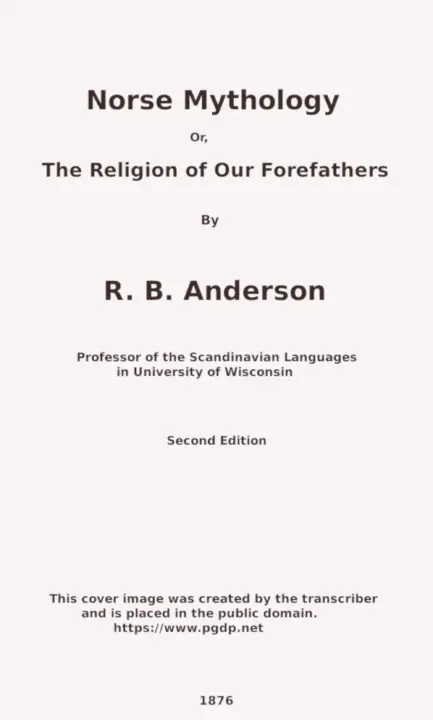
THE CLASSIC COLLECTION · 1875
"Norse Mythology; or, The Religion of Our Forefathers, Containing All the Myths of the Eddas, Systematized and Interpreted" by R. B. Anderson is a comprehensive historical account written in the late 19th century. The work aims to present a complete and systematic understanding of Norse mythology, exploring the myths, deities, and cultural significance of the ancient beliefs of the Scandinavian peoples. Through this volume, the author asserts the importance of Norse mythology for contemporary readers, emphasizing its relevance to the cultural heritage of modern societies. At the start of the book, Anderson discusses the intriguing nature of Scandinavian paganism and its persistence until the 11th century. He reflects on the importance of understanding Norse mythology as a means of connecting with our ancestors and their worldview, which was steeped in a rich tapestry of myths and divine personifications of nature. The text also anticipates a debate regarding the merits of Norse mythology compared to Greek mythology and sets the stage for a systematic exploration of its various aspects, including a detailed examination of key figures such as Odin, Thor, and the concept of creation within this mythological framework. Anderson's aim is to revive interest in the myths preserved in the Eddas and to encourage a deeper appreciation of the Gothic inheritance among readers.
Introduction adapted from the source catalogue; source summaries may be automatically generated.
Free to read · English · 120,183 words · No account needed
MAKE TIME FOR A GOOD BOOK
On by default. Untick to stop anonymous reading totals. Each page counts after 10 seconds in view. How this works.
Anonymous counting is on unless you have switched it off.
ELDIR. The fire-producer; a servant of Æger. Elder.
ÉLIVÁGAR. The ice-waves; poisonous cold streams that flow out of
Niflheim. Elivagar.
EMBLA. The first woman. The gods found two lifeless trees, the ask (ash) and the embla; of the ash they made man, of the embla, woman. It is a question what kind of tree the embla was; some suggest a metathesis, viz. emla, from almr (elm), but the compound emblu-askr, in one of Egil’s poems, seems to show that the embla was in some way related to the ash. Embla.
EYRGJAFA. One of Heimdal’s nine mothers. Eyrgjafa.
FÁFNIR. Son of Hreidmar. He kills his father to get possession of the Andvarenaut. He afterwards changes himself into a dragon and guards the treasure on Gnita-heath. He is slain by Sigurd, and his heart is roasted and eaten. Fafner.
FALHÓFNIR [Barrel-hoof, hollow-hoof]. One of the horses of the gods.
Falhofner.
FARBAUTI [Ship-beater, ship-destroyer]. The father of Loke. Farbaute.
FENRIR or FENRISÚLFR. The monster-wolf. He is the son of Loke. He bites the hand Tyr. The gods put him in chains, where he remains until Ragnarok. In Ragnarok he gets loose, swallows the sun and conquers Odin, but is killed by Vidar. Fenrer or Fenris-wolf.
FENSALIR. The abode of Frigg. Fensal.
FJALAR. A misnomer for Skrymer, in whose glove Thor took shelter.
Fjalar.
FJALAR. A dwarf, who slew Kvaser, and composed from his blood the poetic
mead. Fjalar.
FJALAR. A cock that crows at Ragnarok. Fjalar.
FIMAFENGR [fimr, quick, nimble]. The nimble servant of Æger. He was slain by the jealous Loke. Fimafeng.
FIMBUL. [Compare Germ. fimmel, an iron wedge; Bohem. fimol; Swed. fimmel-stång, the handle of a sledge-hammer; in Icel. obsolete, and only used in four or five compounds in old poetry.] It means mighty great. In the mythology we have:
FIMBULFAMBI. A mighty fool. Fimbulfambe.
FIMBULTÝR. The mighty god, great helper (Odin). Fimbultyr.
FIMBULVETR [vetr, winter]. The great and awful winter of three years’ duration preceding the end of the world. Fimbul-winter.
FIMBULÞUL. A heavenly river (þul, roaring.) Fimbulthul.
FIMBULÞULR. The great wise man (Odin’s High-song, 143). Fimbulthuler.
FJÖLNIR. A name of Odin. Fjolner.
FJÖRGYN. A personification of the earth; mother of Thor. Fjorgyn.
FÓLKVANGR [Anglo-Sax. folc; Germ. volk; Eng. folk, people, and vangr (Ulfilas, waggs), paradise; Anglo-Sax. wang; Dan. vang, a field]. The folk-field. Freyja’s dwelling. Folkvang.
Your reading position is saved on this browser. Take it to another device with a library code. Reading pages adapt to text, rather than matching a printed edition.
BEHIND THE BOOK
This eBook is for the use of anyone anywhere in the United States and most other parts of the world at no cost and with almost no restrictions whatsoever. You may copy it, give it away or re-use it under the terms of the Project Gutenberg License included with this eBook or online at www.gutenberg.org. If you are not located in the United States, you will have to check the laws of the country where you are located before using this eBook. Read the source licence.
The original source file, including credits and licence, is retained by this library. Request an original-format copy at no charge. Please include the book title and Project Gutenberg identifier #65910.
KEEP YOUR CURIOSITY GOING
David Patterson (Spirit) Hatch

David Patterson (Spirit) Hatch

David Patterson (Spirit) Hatch
Cécile Tormay

Moritz Busch
John L. Ransom