
Last letters from the living dead man
David Patterson (Spirit) Hatch
THE CLASSIC COLLECTION · 1875
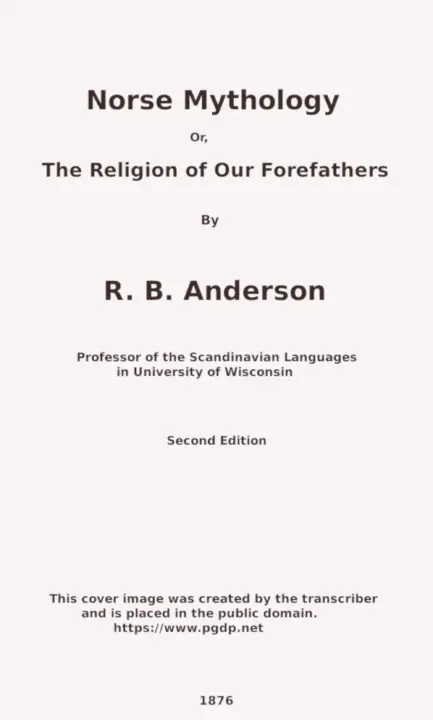
"Norse Mythology; or, The Religion of Our Forefathers, Containing All the Myths of the Eddas, Systematized and Interpreted" by R. B. Anderson is a comprehensive historical account written in the late 19th century. The work aims to present a complete and systematic understanding of Norse mythology, exploring the myths, deities, and cultural significance of the ancient beliefs of the Scandinavian peoples. Through this volume, the author asserts the importance of Norse mythology for contemporary readers, emphasizing its relevance to the cultural heritage of modern societies. At the start of the book, Anderson discusses the intriguing nature of Scandinavian paganism and its persistence until the 11th century. He reflects on the importance of understanding Norse mythology as a means of connecting with our ancestors and their worldview, which was steeped in a rich tapestry of myths and divine personifications of nature. The text also anticipates a debate regarding the merits of Norse mythology compared to Greek mythology and sets the stage for a systematic exploration of its various aspects, including a detailed examination of key figures such as Odin, Thor, and the concept of creation within this mythological framework. Anderson's aim is to revive interest in the myths preserved in the Eddas and to encourage a deeper appreciation of the Gothic inheritance among readers.
Introduction adapted from the source catalogue; source summaries may be automatically generated.
Free to read · English · 120,183 words · No account needed
MAKE TIME FOR A GOOD BOOK
On by default. Untick to stop anonymous reading totals. Each page counts after 10 seconds in view. How this works.
Anonymous counting is on unless you have switched it off.
Thor now went on with his companions till it was noon, when their eyes beheld a castle standing on a great plain, and it was so high that they had to bend their necks quite back in order to be able to look over it. They advanced to the castle; there was a gate to the entrance, which was locked. Thor tried to open it, but could not, and being anxious to get within the castle, they crept between the bars of the gate. They saw the palace before them, the door was open, and they entered, where they saw a multitude of men, of whom the greater number were immensely large, sitting on two benches. Then they came into the presence of the king, Utgard-Loke, and saluted him; but it took some time before he would deign to look at them, and he smiled scornfully, so that one could see his teeth, saying: It is tedious to ask for tidings of a long journey, but if I am not mistaken this little stripling must be Asathor; perhaps, however, you are really bigger than you look. Well, what are the feats that you and your companions are skilled in? No one is tolerated among us here unless he distinguishes himself by some art or accomplishment. Then said Loke: I understand an art, of which I am prepared to give proof, and that is, that there is none here who can eat his food as fast as I can. To this Utgard-Loke made reply: Truly that is an art, if you can achieve it, which we shall now see. He called to the men, who sat on one end of the bench, that he, whose name was Loge (flame), should come out on the floor and contend with Loke. A trough was brought in full of meat. Loke seated himself at one end and Loge at the other; both ate as fast as they could and met in the middle of the trough. Loke had picked the meat from the bones, but Loge had consumed meat, bones and trough all together; and now all agreed that Loke was beaten. Then asked Utgard-Loke, what that young man could do. It was Thjalfe. He answered, that he would run a race with any one that Utgard-Loke would appoint. Utgard-Loke replied that this was a splendid feat, but added that he must be very swift if he expected to win, but they should see, for it would soon be decided. Utgard-Loke arose and went out; there was a very good race-course on the level field. Then he called a little fellow, by name Huge (thought) and bade him race with Thjalfe. The first time they ran Huge was so much in advance that at the turning back in the course he met Thjalfe. You must ply your legs better, Thjalfe, said Utgard-Loke, if you expect to win, though I must confess that there never came a man here swifter of foot than you are. They ran a second time, but when Huge came to the end and turned around, Thjalfe was a full bow-shot from the goal. Well run, both of you, said Utgard-Loke, but I think Thjalfe will hardly win, but the third race shall decide it. They accordingly ran a third time, but Huge had already reached the goal before Thjalfe had got half-way. Then all who were present cried out that there had been sufficient trial of skill in this art. Utgard-Loke then asked Thor in what arts he would choose to give proof of his skill for which he was so famous. Thor answered that he preferred to contend in drinking with any one that wished. Utgard-Loke consented, and entering the palace he called his cup-bearer, and bade him bring the large horn which his courtiers were obliged to drink out of when they had trespassed in any way against established usage. The cup-bearer brought the horn, gave it to Thor, and Utgard-Loke said: Whoever is a good drinker will empty that horn at a single draught, though some men make two of it; but there is no so wretched drinker that he cannot exhaust it at the third draught. Thor looked at the horn and thought it was not large, though tolerably long; however, as he was very thirsty he set it to his lips, and without drawing breath drank as long and as deep as he could, in order that he might not be obliged to make a second draught of it. But when his breath gave way and he set the horn down, he saw to his astonishment that there was little less of the liquor in it than before. Utgard-Loke said: That is well drunk, but not much to boast of; I should never have believed but that Asathor could have drunk more; however, of this I am confident, you will empty it at the second draught. Thor made no reply, but put the horn to his mouth and drank as long as he had breath, but the point of the horn did not rise as he expected; and when he withdrew the horn from his mouth it seemed to him that its contents had sunk less this time than the first; still the horn could now be carried without spilling. Utgard-Loke said: How now, Thor, have you not saved for the third draught more than you can make away with? You must not spare yourself more in performing a feat than befits your skill, but if you mean to drain the horn at the third draught you must drink deeply. You will not be considered so great a man here as you are thought to be among the asas if you do not show greater skill in other games than you appear to have shown in this. Then Thor became angry, put the horn to his mouth, and drank with all his might, so as to empty it entirely; but on looking into the horn he found that its contents had lessened but little, upon which he resolved to make no further attempt, but gave back the horn to the cup-bearer. Then said Utgard-Loke: It is now plain that your strength is not so great as we thought it to be. Will you try some other games, for we see that you cannot succeed in this? Yes, said Thor, I will try something else, but I am sure that such draughts as I have been drinking would not have been counted small among the asas, but what new trial have you to propose? Utgard-Loke answered: We have a very trifling game here, in which we exercise none but children. Young men think it nothing but play to lift my cat from the ground, and I should never have proposed this to Asathor if I had not already observed that you are by no means what we took you for. Thereupon a large gray cat ran out upon the floor. Thor advancing put his hand under the cat’s body and did his utmost to raise it from the floor, but the cat, bending its back in the same degree as Thor lifted, had notwithstanding all Thor’s efforts only one of its feet lifted up, seeing which Thor made no further effort. Then said Utgard-Loke: The game has terminated just as I expected; the cat is large, but Thor is small and little compared with our men. Then said Thor: Little as you call me I challenge any one to wrestle with me, for now I am angry. I see no one here, replied Utgard-Loke, looking around on the benches, who would not think it beneath him to wrestle with you; but let somebody call hither that old woman, my nurse, Elle (old age), and let Thor prove his strength with her, if he will. She has thrown to the ground many a man not less strong and mighty than Thor is. A toothless old woman then entered the hall and she was told by Utgard-Loke to wrestle with Thor. To cut the story short, the more Thor tightened his hold the firmer she stood. Finally, after a violent struggle, Thor began to lose his footing, and it was not long before he was brought down on one knee. Then Utgard-Loke stepped forward and told them to stop, adding that Thor had now no occasion to ask anyone else in the hall to wrestle with him, and it was also getting late. He therefore showed Thor and his companions to their seats, and they passed the night there enjoying the best of hospitality.
Your reading position is saved on this browser. Take it to another device with a library code. Reading pages adapt to text, rather than matching a printed edition.
BEHIND THE BOOK
This eBook is for the use of anyone anywhere in the United States and most other parts of the world at no cost and with almost no restrictions whatsoever. You may copy it, give it away or re-use it under the terms of the Project Gutenberg License included with this eBook or online at www.gutenberg.org. If you are not located in the United States, you will have to check the laws of the country where you are located before using this eBook. Read the source licence.
The original source file, including credits and licence, is retained by this library. Request an original-format copy at no charge. Please include the book title and Project Gutenberg identifier #65910.
KEEP YOUR CURIOSITY GOING
David Patterson (Spirit) Hatch

David Patterson (Spirit) Hatch

David Patterson (Spirit) Hatch
Cécile Tormay

Moritz Busch
John L. Ransom