
Last letters from the living dead man
David Patterson (Spirit) Hatch
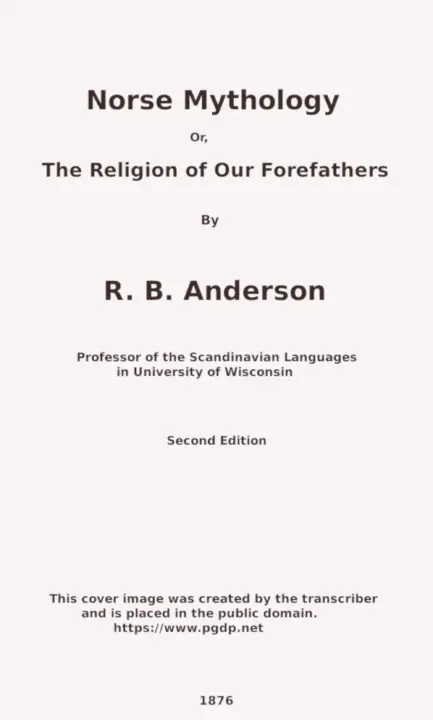
THE CLASSIC COLLECTION · 1875
"Norse Mythology; or, The Religion of Our Forefathers, Containing All the Myths of the Eddas, Systematized and Interpreted" by R. B. Anderson is a comprehensive historical account written in the late 19th century. The work aims to present a complete and systematic understanding of Norse mythology, exploring the myths, deities, and cultural significance of the ancient beliefs of the Scandinavian peoples. Through this volume, the author asserts the importance of Norse mythology for contemporary readers, emphasizing its relevance to the cultural heritage of modern societies. At the start of the book, Anderson discusses the intriguing nature of Scandinavian paganism and its persistence until the 11th century. He reflects on the importance of understanding Norse mythology as a means of connecting with our ancestors and their worldview, which was steeped in a rich tapestry of myths and divine personifications of nature. The text also anticipates a debate regarding the merits of Norse mythology compared to Greek mythology and sets the stage for a systematic exploration of its various aspects, including a detailed examination of key figures such as Odin, Thor, and the concept of creation within this mythological framework. Anderson's aim is to revive interest in the myths preserved in the Eddas and to encourage a deeper appreciation of the Gothic inheritance among readers.
Introduction adapted from the source catalogue; source summaries may be automatically generated.
Free to read · English · 120,183 words · No account needed
MAKE TIME FOR A GOOD BOOK
On by default. Untick to stop anonymous reading totals. Each page counts after 10 seconds in view. How this works.
Anonymous counting is on unless you have switched it off.
Thor’s wife, Sif, is another symbol of the earth. She is called the fair-haired. Gold is called Sif’s hair on account of the myth already related, according to which Loke cuts off her hair and gets dwarfs to forge for her golden locks. The interpreters of mythology are not willing to give to Sif the field waving with ripe grain, which belongs to the god Frey, being symbolized by his boar Goldenbristle, but say that Sif is the mountain clad with grass, in contradistinction to Jarnsaxa, who reigns in the barren deserts. Hrungner, that is, the naked rock, tried to win the favor of Sif, but did not succeed.
Uller is the son of Sif and the step-son of Thor. He is so well skilled in the use of the bow, and can go so fast on his snow-skates (skees), that in these arts no one can contend with him. He is also very handsome in his person and possesses every quality of a warrior; wherefore it is proper to invoke him in single combats. Uller’s mansion is Ydaler (valleys of rain). From his running on skees we judge that he is a personification of winter, and if the artist chooses him for his theme, he must represent him standing on snow-shoes, clad in winter-suit, with bow and arrow in his hands. We are now prepared to give some of Thor’s adventures.
Thor had once gone eastward to crush trolls, but Odin rode on his horse, Sleipner, to Jotunheim, and came to a giant by name Hrungner. Then asked Hrungner what man that was, who with a helmet of gold rode through the air and over the sea, and added that it was an extraordinarily good horse he had. Odin replied that he would wager his head that so good a horse could not be found in Jotunheim. Hrungner said that it was indeed a very excellent horse, but he had one, by name Goldfax (gold-mane), that could take much longer paces, and he immediately sprang upon his horse and galloped away after Odin. Odin constantly kept ahead, but Hrungner’s giant nature had become so excited that before he was himself aware of it he had come within the gates of Asgard. When he came to the door of the hall the gods invited him to drink, which as soon as he had entered he demanded. Then the gods set before him the bowls out of which Thor was accustomed to drink, and them he emptied each in one draught. And when he had become drunk, he gave the freest vent to his loud boastings. He was going to take Valhal, he said, and carry it off to Jotunheim; he would demolish Asgard and kill the gods, except Freyja and Sif, whom he would take home with him; and while Freyja was pouring the celestial beverage into the bowls for him he remarked that he was going to drink up all the ale of the gods. When the gods at length grew tired of his arrogance, they named Thor, who immediately came and swung his hammer and was very much enraged, and asked who was to blame that dogwise giants should be permitted to drink there, or who had given safety to Hrungner in Valhal, and why Freyja should pour ale for him as she did at the feasts of the gods. Hrungner, looking at Thor with anything but a friendly eye, answered that Odin had invited him and that he was under his protection. Thor said that Hrungner should come to rue that invitation before he came out; but the giant answered that it would be but little honor to Asathor to kill him, unarmed as he was; it would be a better proof of his valor if he dared contend with him at the boundaries of his territory, at Grjottungard (Grjóttunagarðar). Foolish was it also of me, continued Hrungner, to leave my shield and my flint-stone at home; had I my weapons here we would now try a holmgang;[64] but I declare you to be a coward if you kill me unarmed. Thor would not excuse himself from a duel when he was challenged out on a holm; this was something that no one had ever offered him before. Hrungner now went his way and hastened home. This journey of Hrungner was much talked of by the giants, and especially did his challenge of Thor awaken their interest, and it was of great importance to them which of the two should come out from the combat victorious. For if Hrungner, who was the most powerful among the giants, should be conquered, they might look for nothing but evil from Thor. They therefore made at Grjottungard a man of clay, nine rasts (miles?) high and three rasts broad between the shoulders; they could not find a heart corresponding to his size, and therefore took one out of a mare; but this fluttered and trembled when Thor came. Hrungner had a heart of hard stone, sharp and three-cornered; his head was also of stone, and likewise his shield, which was broad and thick, and this shield he held before himself when he stood at Grjottungard waiting for Thor. His weapon was a flint-stone, which he swung over his shoulders, so that it was no trifle to join in combat with him. By his side stood the clay-giant, that is called Mokkerkalfe (Mökkrkálfi), and was so extremely terrified that the sweat poured from off him. Thor went to the holmgang together with Thjalfe, a servant, whom he had got from a peasant by the sea. Thjalfe ran to the place where Hrungner was standing, and said to him: You stand unguarded, giant; you hold the shield before you, but Thor has seen you; he comes with violence from beneath the earth and attacks you. Then Hrungner hastily put the shield beneath his feet and stood on it, but he seized his flint-stone with both hands. Presently he saw flashes of lightning and heard loud crashings, and then he saw Thor in his asamight, rushing forward with impetuous speed, swinging his hammer and throwing it from the distance against Hrungner. The latter lifted the flint-stone with both his hands and threw it with all his might against the hammer; the two met in the air and the flint-stone broke into two pieces, one piece of which fell on the ground (and hence the flint mountains), while the other fell with such force against the head of Thor that he fell forward to the ground; but the hammer Mjolner hit Hrungner right in the head and crushed his skull into small pieces, he himself falling over Thor, so that his foot lay across Thor’s neck. Thjalfe contended with Mokkerkalfe, who fell with little honor. Then Thjalfe went over to Thor, and was going to take Hrungner’s foot away, but he was not able to do it. Thereupon came all the gods to Grjottungard, when they had learned that Thor had fallen, but neither was any one of them able to remove the foot of the giant. Then came Magne (magni, strength), the son of Thor and Jarnsaxa; he was only three nights old and he threw Hrungner’s foot off from Thor saying: It was a great mishap, father, that I came so late; this giant, I think, I could have slain with my fist. Thor stood up and lovingly greeted his son, adding that he would give him the giant’s horse Goldfax; but Odin remarked that this was wrongfully done of Thor to give the son of a hag (gýgjar syni, son of Jarnsaxa) and not his father so excellent a horse.
Your reading position is saved on this browser. Take it to another device with a library code. Reading pages adapt to text, rather than matching a printed edition.
BEHIND THE BOOK
This eBook is for the use of anyone anywhere in the United States and most other parts of the world at no cost and with almost no restrictions whatsoever. You may copy it, give it away or re-use it under the terms of the Project Gutenberg License included with this eBook or online at www.gutenberg.org. If you are not located in the United States, you will have to check the laws of the country where you are located before using this eBook. Read the source licence.
The original source file, including credits and licence, is retained by this library. Request an original-format copy at no charge. Please include the book title and Project Gutenberg identifier #65910.
KEEP YOUR CURIOSITY GOING
David Patterson (Spirit) Hatch

David Patterson (Spirit) Hatch

David Patterson (Spirit) Hatch
Cécile Tormay

Moritz Busch
John L. Ransom